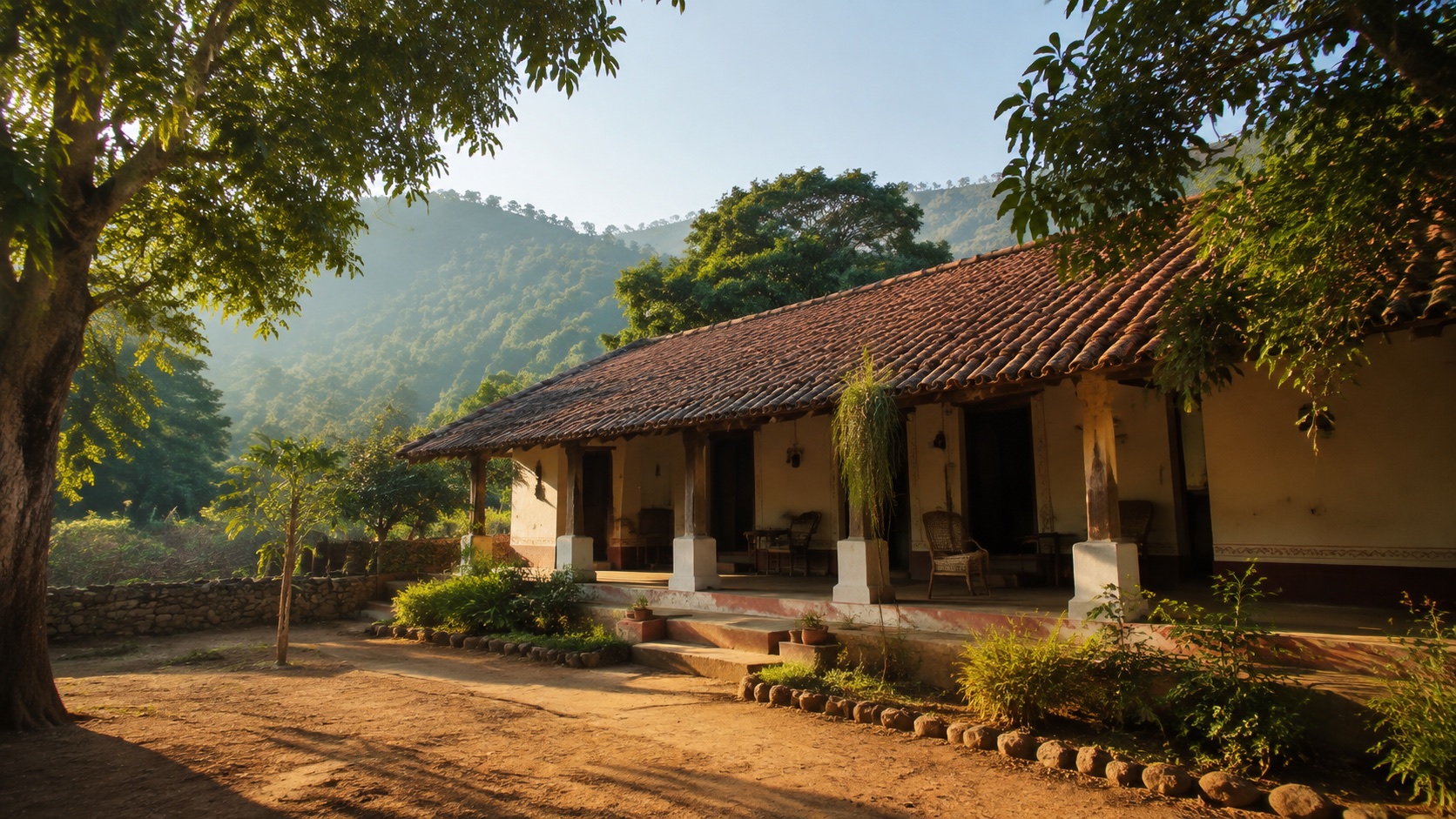
Before you choose the property
Start with the rules that actually shape the project.
G.O.Ms.No.17 dated 10.12.2024 is the current located Andhra Pradesh Tourism Policy 2024–2029 and replaced the 2020–2025 policy.
The located Homestay/B&B capacity is 1–6 lettable rooms and 2–12 beds.
Homestay requires owner + family residence; B&B expressly uses a non-resident owner/promoter and designated agent/operator.
Scope: Source-checked regulatory and business-planning guidance. It does not approve a particular title, building, tax position, food activity or operating structure.
01 / Executive finding
The practical starting point
- The current state-level tourism-policy framework located is the Andhra Pradesh Tourism Policy 2024–2029, issued through G.O.Ms.No.17, Youth Advancement, Tourism & Culture (Tourism) Department, dated 10 December 2024. It expressly replaces the Andhra Pradesh Tourism Policy 2020–2025 and operates for five years from 10 December 2024. [S1, opening order; §Policy Period]
- Detailed implementation is governed by Operational Guidelines – Andhra Pradesh Tourism Policy 2024–29, G.O.Ms.No.30 dated 24 September 2025. The guidelines state that the policy period runs from 10 December 2024 to 09 December 2029 and identify APTA as the nodal implementing agency. [S2, §2 definitions; §3.1, printed pp.6, 10]
- Under the current official operational guidelines, a Homestay has a minimum of 1 lettable room/2 beds and a maximum of 6 lettable rooms/12 beds. The owner together with the family must physically reside in the same establishment. [S2, §3.3, S.No.5(b), printed p.14]
- A B&B is materially different: the owner/promoter is stated not to reside in the establishment, and a designated agent/operator manages the premises for hospitality. The same 1–6-room/2–12-bed limits appear in the common Homestay/B&B provision. [S2, §3.3, S.No.5(b), printed p.14]
- The same provision requires the establishment to be free from dispute and states that Homestays/B&Bs registered with the Andhra Pradesh Tourism Authority (APTA) and meeting the applicable quality and safety/security standards are the units eligible under that policy framework. [S2, §3.3, S.No.5(b), printed p.14]
- For the project/incentive framework in G.O.Ms.No.30, S.No.5 carries the location condition “Within the focus tourism destination.” Exact legally operative address boundaries for “focus tourism destination” were Not stated in the current official material reviewed. The parent policy separately identifies seven anchor hubs—Visakhapatnam, Tirupati, Araku Valley, Rajahmundry, Amaravati, Srisailam and Gandikota—but those hub names should not be substituted for an address-level eligibility map. [S1, destination-development strategy; S2, §3.3, S.No.5]
- APTA currently operates a public Trade Registration portal. Its public new-user page exposes only Name, Mobile Number, Email, Password and Confirm Password before submission. No account was created, and the authenticated Homestay/B&B application, upload fields, payment screen, category selection and declarations were not inspected. [S4, Trade Registration login and New User form]
- A purported G.O.Ms.No.32 dated 08 October 2025, containing detailed Homestay/B&B registration, classification, fees and procedures, was located only through a non-government mirror. An official AP-government/APTA/GOIR copy was Not stated in the material reviewed. Consequently, the purported ₹50/₹100 classification fees, two-year validity, Gold/Silver checklist, renewal window, Forms A/B/C and inspection timelines cannot presently be published as settled requirements. [D1, discovery-only; S6, GOIR search facility]
- G.O.Ms.No.30's project-specific incentive matrix gives Rural Homestay and Heritage Homestay “Yes” entries for power, Net SGST, employment subsidy and utility-services/property-tax support, but “No” for stamp duty, land-conversion charges, quality-certification incentive, capital subsidy and Speed of Doing Business. Urban Homestays/B&Bs are not separately identified in that incentive matrix, creating an official-source ambiguity. [S2, Annexure I, S.Nos.9–10, printed p.47]
- The power incentive in G.O.Ms.No.30 is framed as reimbursement of the difference between commercial-tourism and industrial tariff, subject to detailed conditions including an enterprise/industry-name electricity connection; a later domestic-tariff treatment for registered homestays has been reported elsewhere, but the controlling official APERC/DISCOM order was Not stated in the material reviewed. Current homestay electricity classification therefore requires written verification. [S2, §8.6, printed pp.38–39; D2 discovery-only]
- Tourism registration does not establish lawful building use. The Andhra Pradesh Building Rules, 2017 apply to affected portions where occupancy changes, require an Occupancy Certificate for buildings under the rule, and impose separate fire-clearance consequences for high-rise buildings. The Rules were subsequently amended, including by G.O.Ms.No.4 dated 09 January 2025. [S7, Rules 3/occupancy provisions and OC provisions; S7A amendment register]
- A homestay serving food must independently test its position under FSSAI/FoSCoS. From 01 April 2026, FSSAI's revised turnover framework places registration at turnover up to ₹1.5 crore, State Licence above ₹1.5 crore and up to ₹50 crore, and Central Licence above ₹50 crore, subject to the food-business category and other applicable licensing criteria. [S8, FSSAI Order dated 13.03.2026, p.1]
- For foreign guests, the Immigration and Foreigners Rules, 2025 expressly include a home stay within “accommodation.” Rule 17 requires electronic foreigner records to be kept for at least one year and Form III information to be transmitted electronically within 24 hours after arrival and after departure. [S9, Rule 17, printed p.27]
- The current official evidence is sufficient to publish the core definition, room/bed cap, residence distinction and existence of the APTA/incentive framework, but not sufficient for a complete owner-facing registration guide because the official detailed Homestay/B&B order, current authenticated application, fees, classification checklist, validity/renewal mechanics and electricity implementation order remain unverified. [S1–S6; D1–D2]
02 / Document chronology
Use the current rules and implementation
- 28 March 2017 — G.O.Ms.No.119, Andhra Pradesh Building Rules, 2017. The state building-control framework predates the present tourism policy and remains relevant, subject to later amendments, to construction, occupancy/change of occupancy and OC questions. [S7]
- 04 January 2018 — CBIC Circular No.27/01/2018-GST. Provides historical central clarification on accommodation supplied through electronic commerce operators; its old numerical thresholds must not be copied forward without current-law testing. [S10A]
- 10 December 2024 — G.O.Ms.No.17, Andhra Pradesh Tourism Policy 2024–2029. Replaces the Tourism Policy 2020–2025 and starts the present five-year state tourism-policy period. [S1]
- 09 January 2025 — G.O.Ms.No.4. Official APCRDA register identifies a final notification amending the Andhra Pradesh Building Rules, 2017. [S7A]
- 2025 — Immigration and Foreigners Rules, 2025. Introduces the current central Rule 17 accommodation-reporting framework explicitly covering home stays. [S9, Rule 17]
- 24 September 2025 — G.O.Ms.No.30. Approves the operational guidelines for Andhra Pradesh Tourism Policy 2024–29. This is the current official source located containing the Homestay/B&B definition and policy/incentive treatment. [S2]
- 08 October 2025 — purported G.O.Ms.No.32. A non-government mirror presents itself as a later Homestay/B&B addendum. The official primary instrument was Not stated in the current official material reviewed. It therefore cannot presently be used to supersede, amend or supplement S2 for publication.
- 2025–26 — Development of Tribal Homestays in Maredumili cluster. Current Government of India material records an Andhra Pradesh project sanction of ₹1.23 crore. [S12B]
- 13 March 2026 / effective 01 April 2026 — FSSAI revised turnover thresholds. This changes the food-business registration/licensing thresholds relevant to a homestay that operates a food business. [S8]
- 05 May 2026 — purported APERC domestic-tariff implementation. Located only in secondary reporting. Official order Not stated in the material reviewed. It cannot yet be used to displace the power framework in G.O.Ms.No.30. No official source reviewed expressly states that G.O.Ms.No.32 supersedes the Homestay/B&B portions of G.O.Ms.No.30, because the official G.O.Ms.No.32 itself was not located.
03 / Category definitions
Choose the right accommodation category
| Category | Location | Eligible owner/applicant | Residence requirement | Operator allowed | Capacity | Food position | Source |
|---|---|---|---|---|---|---|---|
| Homestay | For S2 project framework: within “focus tourism destination”; statewide registration boundary Not stated in the material reviewed | “Owner”; registration-holder entity mechanics Not stated in the material reviewed | Owner along with family physically residing in same establishment | A separate operator replacing resident owner is not established for Homestay | 1–6 lettable rooms; 2–12 beds | Homestay-specific food rule not located; FSSAI independently applies if food business exists | [S2, §3.3, S.No.5(b), p.14] |
| B&B | Same S2 category/location issue | Owner/promoter; registration-holder mechanics not located | Owner/promoter shall not reside | Yes — designated agent/operator manages premises for hospitality | 1–6 lettable rooms; 2–12 beds | Detailed state food rule Not stated in the material reviewed | [S2, §3.3, S.No.5(b), p.14] |
| Hotel | Within applicable tourism-policy location; local approvals separate | Tourism enterprise meeting applicable category criteria | Not stated in the material reviewed as owner-residence condition | Professional operation inherent, but precise registration holder depends on approvals | Official tourism guidelines identify star-category requirements; Homestay cap does not apply | Restaurant/food approvals separate | [S2, §3.3] |
| Resort | Policy-designated project location | Tourism enterprise | Not stated in the material reviewed | Operational entity permitted within resort framework | S2 requires applicable star standard and recreational facilities | Food rules separately apply | [S2, §3.3] |
| Budget Hotel | Policy project location | Tourism enterprise | Not stated in the material reviewed | Not restricted to resident owner | S2 identifies minimum-room/restaurant criteria for tourism-project eligibility | Restaurant/food compliance separate | [S2, §3.3] |
| Motel | Policy project location | Tourism enterprise | Not stated in the material reviewed | Not restricted to resident owner | S2 identifies minimum-room plus restaurant criteria | Food compliance separate | [S2, §3.3] |
| Serviced Apartment | Applicable tourism-policy location | Tourism enterprise | No Homestay residence condition located | Professional operation contemplated | Minimum 3 apartments, with kitchenette/recreational standards in S2 | Kitchenette provided; FSSAI depends on actual food business | [S2, §3.3, serviced-apartment row] |
| Farm/Plantation Tourism | Applicable rural/farm location | Project/promoter criteria under S2 | Homestay residence rule not imported | Not stated in the material reviewed | S2 project definition includes minimum 5 acres, 5,000 sq ft built-up and 5 guest rooms | Separate food compliance | [S2, §3.3] |
| Rural Tourism Unit | Rural-tourism context | Project/promoter | Homestay residence rule not imported | Not stated in the material reviewed | S2 identifies minimum 5 rooms plus reception | Separate | [S2, §3.3] |
| Agro Tourism | On/near working farm | Project/promoter | Homestay residence rule not imported | Not stated in the material reviewed | S2 identifies minimum 5 lettable rooms | Separate | [S2, §3.3] |
| Eco-hut / camp / tented accommodation | Destination/site subject to local/environmental approvals | Tourism project | Not stated in the material reviewed | Not stated in the material reviewed | S2 contains separate land/capacity criteria; not a Homestay | Separate | [S2, §3.3] |
| Guest House | Not stated in the material reviewed as a separately defined current AP Tourism Policy category in sources reviewed | Not stated in the material reviewed | Not stated in the material reviewed | Not stated in the material reviewed | Not stated in the material reviewed | Not stated in the material reviewed | — |
A building marketed commercially as a “guest house,” “villa,” “Airbnb,” “farm stay” or “serviced accommodation” is not thereby converted into the official Homestay category. The applicable category must be matched to the official definition and address-specific approvals.
04 / Eligibility decision tree
Check whether the applicant and property qualify
Start with the exact property address and local-body category.
- Is the exact property identified?
- No; the person has capital only or an early idea: no Homestay eligibility conclusion can yet be reached. Select/search only after defining target local body, title form, resident-host model and intended capacity. Not established in the published material
- Yes: identify Municipal Corporation/Municipality/Nagar Panchayat/Gram Panchayat/development-authority jurisdiction and whether any CRZ, forest, wildlife, heritage or special planning control applies.
- Is the address within the tourism-policy location applicable to the proposed benefit/category?
- G.O.Ms.No.30 associates S.No.5 with a “focus tourism destination”, but no address-boundary instrument was located. [S2, §3.3]
- If incentive eligibility depends on this point: Confirm this in writing with the authority
- What is the ownership/lease position?
- Clear individual owner and establishment is free from dispute: proceed. [S2, §3.3, p.14]
- Joint/inherited title, disputed title or only lease/management rights: current Homestay registration-holder rules were not verified. Confirm this in writing with the authority
- Who is the proposed applicant?
- Resident individual owner: continue to Homestay test.
- Company/LLP/firm/lessee: legal entities are recognized as applicants in the incentive guidelines, but that does not establish their entitlement to hold a Homestay registration. [S2, definitions] Confirm this in writing with the authority
- Who will live at the property?
- Owner + family will physically reside in the same establishment: continue under Homestay definition. [S2, p.14]
- Owner will live elsewhere: the proposed arrangement does not satisfy the located Homestay residence wording. A B&B may be the relevant category. Consider another accommodation category
- Only caretaker/manager resides: this does not substitute for the express owner-and-family requirement located for a Homestay. Consider another accommodation category
- Who will operate it?
- Resident owner/family operates Homestay: consistent with located definition.
- Designated agent/operator manages for non-resident owner/promoter: consistent with the located B&B description. [S2, p.14]
- Professional company wants to be registration holder: Confirm this in writing with the authority
- What is the room/bed plan?
- 1–6 lettable rooms and 2–12 beds: within the located Homestay/B&B capacity. This appears to fit the published route, subject to the remaining checks if the other Homestay conditions are also satisfied.
- More than 6 lettable rooms or 12 beds: does not appear to fit the published homestay definition
- Total building contains more rooms but only six are proposed as guest rooms: the current official source defines *lettable* rooms but does not state a separate maximum for all rooms in the owner's house. Confirm this in writing with the authority
- Is the property existing, proposed, under construction or already running?
- Proposed/new construction: obtain applicable planning/building approvals before assuming tourism registration. Confirm this in writing with the authority
- Existing building without verified sanctioned use/OC: building position must first be verified. Confirm this in writing with the authority
- Running property with valid APTA certificate matching owner/category/address/capacity: verify current certificate/renewal conditions; detailed current renewal rules are not independently verified. Not established in the published material Use these branches as a starting test and confirm the result for the exact property.
05 / Applicant and operating structures
Set the ownership and operating structure
| Structure | Supported route | Principal obstacle | Source | Question requiring clarification |
|---|---|---|---|---|
| Resident individual owner | Strongest fit for Homestay: owner and family reside at establishment; 1–6 rooms/2–12 beds | Address eligibility, property approvals and detailed registration form remain | S2, §3.3 | Is the property address accepted for current Homestay registration, and what is the current official application order? |
| Joint/inherited ownership | May potentially use a resident co-owner, but no rule confirming this was located | Co-owner consent, applicant identity and which co-owner must reside | Not stated in the material reviewed | Must every co-owner consent, and may one co-owner be the resident registration holder? |
| Owner living elsewhere | Located wording points away from Homestay and toward B&B | Homestay expressly requires owner/family residence | S2, p.14 | Is B&B the mandatory category for all absentee owners? |
| Owner using caretaker | Caretaker may perform operations only if the applicable category permits it | Caretaker residence does not satisfy the located Homestay owner's residence rule | S2, p.14 | Can a Homestay employ a caretaker while owner/family remain resident; what duties can be delegated? |
| Long-term lessee | Lease is recognized in S2 for certain incentive projects | No official primary source located establishing a lessee as Homestay registration holder | S2, incentive lease provisions | Can a registered lessee apply for Homestay/B&B registration, and what lease term is required for registration rather than incentives? |
| Company / partnership / LLP | Such legal entities can fall within the S2 incentive-applicant concept | No proof that a company/LLP can satisfy the resident-owner Homestay definition or hold the certificate | S2, definitions | Which legal persons are permitted registration holders for Homestay and B&B? |
| Professional operator / management company | S2 expressly permits a designated agent/operator to manage B&B premises | Operator-as-manager is not the same as operator-as-registration-holder | S2, p.14 | Can the operator contract directly with guests, employ staff and hold licences while the owner/promoter holds tourism registration? |
| Capital-only participant with no property | Start with address/category/property search and structure due diligence | No property means no title, local-body, residence or capacity facts yet | S1/S2 | Which target destinations and property structures will APTA accept before acquisition? |
| Landowner proposing new construction | Design project to a confirmed accommodation category before sanction | Homestay registration does not confer land-use/building approval | S2 + S7 | Is intended hospitality use permissible on the parcel and what sanctioned occupancy/use will the authority require? |
Key distinction: the terms property owner, tourism-registration holder, resident host, operator, employer, contracting party and investor should not be treated as interchangeable.
06 / Property and classification standards
Prepare the property for inspection
| Topic | Mandatory / classification / guidance / unclear | Requirement | Applies when | Source | Confidence |
|---|---|---|---|---|---|
| Lettable rooms | Mandatory in located policy definition | Minimum 1; maximum 6 | Homestay/B&B | S2, §3.3 p.14 | HIGH |
| Beds | Mandatory | Minimum 2; maximum 12 | Homestay/B&B | S2, §3.3 p.14 | HIGH |
| Total rooms in building | Unclear | Separate ceiling for non-guest family rooms Not stated in the material reviewed | Larger residence | — | LOW |
| Owner/family residence | Mandatory definition element | Owner and family physically reside in same establishment | Homestay | S2, §3.3 p.14 | HIGH |
| Non-resident owner | Mandatory category distinction | Owner/promoter shall not reside; designated operator manages | B&B | S2, §3.3 p.14 | HIGH |
| Property dispute | Mandatory policy condition | Establishment to be free from dispute | Homestay/B&B | S2, p.14 | HIGH |
| Room floor area | Classification details unverified | Current official number Not stated in the material reviewed | Classification | D1 only | LOW |
| Bathroom/toilet dimensions | Unverified | Not stated in the current official material reviewed | Classification | D1 only | LOW |
| Attached bathrooms | Unverified | Detailed grade requirement not primary-verified | Classification | D1 only | LOW |
| Kitchen | Unclear | Homestay-specific mandatory kitchen standard not primary-located | Where food prepared | S8 applies separately to food business | LOW |
| Dining/common area | Unclear | Detailed Homestay standard Not stated in the material reviewed | Classification | D1 only | LOW |
| Access/road width | Local-building dependency | Must satisfy applicable local/building permission; no uniform Homestay road width located | Property-specific | S7 | MEDIUM |
| Parking | Classification/local dependency | Detailed Homestay parking requirement not primary-located; building approvals may separately regulate parking | Address/category-specific | S7; D1 | LOW |
| Reception | Unclear | Homestay-specific reception restriction Not stated in the material reviewed | — | — | LOW |
| Signage | Unclear | Detailed Homestay signage rule Not stated in the material reviewed | — | — | LOW |
| Potable water | General safety/quality expectation; detailed checklist unverified | Exact Homestay standard Not stated in the material reviewed | All operations | S2 general quality/safety; D1 detail | MEDIUM/LOW |
| Hot water | Classification detail unverified | Not stated in the material reviewed in current primary Homestay source | Grade/guest facility | D1 only | LOW |
| Electricity | Operational dependency | Tourism source does not guarantee connection/tariff | All properties | S2 §8.6/§8.9 | MEDIUM |
| Power backup | Unverified | Not stated in the material reviewed | — | D1 only | LOW |
| Heating/cooling | Unverified | Grade-specific standard Not stated in the material reviewed | — | D1 only | LOW |
| Internet/Wi-Fi | Unverified | Not stated in the material reviewed in current primary source | — | D1 only | LOW |
| Structural/building legality | Adjacent mandatory requirement | Applicable sanctioned-plan/occupancy rules must be satisfied | Existing/new building | S7 | HIGH |
| Occupancy Certificate | Building-rule requirement | AP Building Rules state OC mandatory for buildings under the rule and prohibit occupation contrary to the OC framework | Applicable building | S7, OC provisions | HIGH |
| Fire NOC | Property-specific | High-rise OC requires Fire Services clearance; universal Homestay Fire NOC was not established | High-rise/other categories as separately required | S7 | HIGH for high-rise; LOW for universal Homestay |
| Health/sanitation | Quality/safety plus other law | Detailed Homestay checklist not primary-located | Operation | S2; local/food law | MEDIUM |
| Waste | Local/environmental dependency | Detailed Homestay waste-segregation rule not primary-located | Operation | D1 only for detailed checklist | LOW |
| CCTV | Classification detail unverified | Not stated in the material reviewed as current primary mandate | — | D1 only | LOW |
| First aid/fire extinguishers | Detailed Homestay checklist unverified | Not stated in the material reviewed in current primary Homestay order | — | D1 only | LOW |
| Accessibility | Policy guidance / possible building dependency | S1 promotes accessible tourism; mandatory Homestay-grade accessibility checklist not primary-located | Property/building category dependent | S1/S7 | MEDIUM |
| Gold/Silver grades | Unverified detailed classification | Purported in D1 but official primary addendum not located | Classification | D1 | LOW |
The detailed values appearing in D1—including purported room sizes, bathroom sizes, parking, CCTV, attached-bathroom and Gold/Silver distinctions—should not be converted into a public checklist until the official order is obtained.
07 / Documents and declarations
Assemble the application file
A. Publicly verified portal material
| Document / field | Who provides/signs | Format/stamp requirement | Validity period | When required | Source | Unresolved issue |
|---|---|---|---|---|---|---|
| Name | Account user | Web field | — | Public account creation | S4 | Whether name must be applicant/owner/operator not stated publicly |
| Mobile number | Account user | Web field | — | Account creation | S4 | Verification mechanics not inspected |
| Account user | Web field | — | Account creation | S4 | — | |
| Password / confirmation | Account user | Web field | — | Account creation | S4 | — |
B. Homestay-registration file
The complete official-primary Homestay/B&B registration-document list is Not stated in the current official material reviewed. The discovery-only D1 mirror appears to call for items such as:
| Purported item | Who provides/signs | Format/stamp requirement | Validity | Stage | Status |
|---|---|---|---|---|---|
| Application Forms A/B/C | Applicant / inspection authority as applicable | Purported prescribed forms | Unverified | Application/inspection | D1 — LOW |
| Ownership/title evidence | Owner | Purported title deed/property-tax/electricity evidence | Unverified | Application | D1 — LOW |
| PAN | Applicant | Copy/upload | Unverified | Application | D1 — LOW |
| GST registration where applicable | Applicant/business | Certificate | As applicable | Application | D1 — LOW as Homestay requirement |
| Registered special-power authorisation for promoter/operator/service provider | Owner/promoter | Purported registered instrument / ₹50 non-judicial stamp wording | Unverified | Operator arrangement | D1 — LOW |
| RWA NOC for apartment/gated-community property | RWA | Purported NOC | Unverified | Certain properties | D1 — LOW |
| Building plan/drawings | Owner/professional | Purported approved plan/upload | Unverified | Application/inspection | D1 — LOW |
| Site/map/latitude-longitude | Applicant | Digital/plan | Unverified | Application | D1 — LOW |
| Property/room photographs | Applicant | Digital | Unverified | Application | D1 — LOW |
| Classification checklist | Applicant/inspection team | Prescribed format | Unverified | Classification | D1 — LOW |
Character certificate: Not stated in the current official material reviewed. Applicant police verification: Not stated in the current official material reviewed. Caretaker/staff police verification as a universal state Homestay registration document: Not stated in the current official material reviewed.
C. Documents that belong to the incentive process, not automatically to Homestay registration
G.O.Ms.No.30's incentive CAF material refers, depending on the incentive/project, to registration certificate, land lease/sale agreement/sale deed, ULB building permit, first sales bill/GST returns, board resolution/partnership deed, invoices, power-release certificate and tourism registration/NIDHI material. These must not be silently republished as the Homestay registration checklist. [S2, incentive CAF/annexures]
Download the Andhra Pradesh property and application checklist ↓
08 / Application and inspection process
Follow the application and inspection process
Verified public sequence
| Step | Responsible person/authority | Input/document | Resulting record | Stated time | What does not happen automatically |
|---|---|---|---|---|---|
| 1. Establish category | Owner/promoter + APTA if clarification needed | Address, owner/residence/operator, room/bed plan | Preliminary category decision | No statutory period located | Does not approve land/building use |
| 2. Verify property legality | Owner + local planning/sanction authority | Title, sanctioned plan/use, OC and other property records | Local/property compliance position | Property-specific | Tourism category does not cure building defects |
| 3. Create APTA Trade Registration user | Applicant/user | Name, mobile, email, password | Portal account, subject to portal process | No public completion target located | Account creation is not Homestay registration |
| 4. Select/apply for correct trade category | Applicant | Authenticated fields NOT INSPECTED | Application | Not stated in the material reviewed | Submission does not equal approval |
| 5. Upload documents | Applicant | Current official Homestay upload list Not stated in the material reviewed | Application file | Not stated in the material reviewed | Upload does not validate title/building/fire/FSSAI |
| 6. Pay fee, if applicable | Applicant | Current primary fee schedule Not stated in the material reviewed | Payment record | Not stated in the material reviewed | Payment does not guarantee inspection/approval |
| 7. Scrutiny/inspection | APTA/district/local team as prescribed | Current primary checklist Not stated in the material reviewed | Inspection/query record | Not stated in the material reviewed | Inspection does not automatically resolve separate local approvals |
| 8. Query/refusal/approval | Competent APTA authority | Application + inspection | Deficiency/refusal/certificate | Not stated in the material reviewed | No guaranteed approval period established |
| 9. Certificate access/download | Registration holder | Portal authentication | Registration/classification certificate | Not stated in the material reviewed | Certificate does not replace adjacent statutory licences |
| 10. Appeal | Competent appellate authority | Refusal/cancellation record | Appeal order | Homestay-specific current primary route Not stated in the material reviewed | The APTA contact page's generic “Appellate Authority” designation is not enough to establish the statutory Homestay appeal route |
The portal itself confirms the public Trade Registration mechanism but does not expose the full category-specific form pre-login. [S4]
Discovery-only process
D1 purports to prescribe:
- initial scrutiny;
- Superintendent/processing review;
- DTO plus Panchayat/Ward Secretary inspection;
- district-level committee consideration;
- APTA approval/classification; and
- CEO APTA appeal. It also purports to provide three-week and 15-day internal periods. Because the official G.O.Ms.No.32 was not located, none of these periods or authorities should yet be described publicly as the current mandatory process.
Incentive application is a separate process
G.O.Ms.No.30 provides a separate incentive-claim framework with investment/project documents and department-level verification. Obtaining a tourism registration does not itself release an incentive. [S2, incentive chapters and CAF annexures]
09 / Fees, timelines, validity and renewal
Confirm fees, timing and certificate validity
| Item | Verified current amount/period | Source level | Status |
|---|---|---|---|
| Tourism Policy validity | 10-12-2024 to 09-12-2029 | S2 §3.1 | HIGH — this is policy validity, not certificate validity. |
| Homestay application fee | Not stated in the material reviewed in official primary source | — | Do not publish an amount |
| Silver classification/registration fee | D1 purports ₹50 | D1 | LOW — NOT PUBLISHABLE |
| Gold classification/registration fee | D1 purports ₹100 | D1 | LOW — NOT PUBLISHABLE |
| Initial fee waiver | D1 purports a three-year new-application waiver | D1 | LOW — NOT PUBLISHABLE |
| Inspection fee | Not stated in the material reviewed | — | — |
| Renewal fee | Not stated in the material reviewed in official primary source | — | — |
| Late renewal fee | D1 purports ₹50/month | D1 | LOW — NOT PUBLISHABLE |
| Certificate validity | D1 purports 2 years | D1 | LOW — NOT PUBLISHABLE |
| Renewal window | D1 purports application 2 months before expiry | D1 | LOW — NOT PUBLISHABLE |
| Post-expiry late window | D1 purports up to 2 months | D1 | LOW — NOT PUBLISHABLE |
| Initial scrutiny period | D1 purports 3 weeks | D1 | LOW — not verified as statutory/administrative |
| DTO/local inspection period | D1 purports 15 days | D1 | LOW — not verified |
| Refund position | Not stated in the current official material reviewed | — | — |
| Amendment/room-change fee | Not stated in the material reviewed | — | — |
| Ownership/operator-change fee | Not stated in the material reviewed | — | — |
| Legacy-certificate transition | Not stated in the material reviewed | — | — |
No located official source establishes a guaranteed overall time from filing to registration.
10 / Operating duties after registration
Run the registered homestay correctly
Duties/conditions supported by current primary sources
- Remain within the registered category's defining structure. For a Homestay, the located definition requires owner and family to physically reside in the same establishment. [S2, p.14]
- Maintain the Homestay/B&B capacity condition of 1–6 lettable rooms and 2–12 beds unless a later official instrument modifies it. [S2, p.14]
- Foreign guests: Rule 17 of the Immigration and Foreigners Rules, 2025 requires the accommodation keeper to obtain the foreigner's prescribed particulars/signature, maintain the electronic record for at least one year, and transmit prescribed arrival/departure information electronically within 24 hours. “Accommodation” expressly includes a home stay. [S9, Rule 17]
- Food: where the operation constitutes a food business, the appropriate FSSAI registration/licence must be independently determined. [S8]
- Building/fire/local compliance: continuing tourism registration cannot be assumed to legalise an impermissible occupancy or override building/fire restrictions. [S7]
- GST: GST liability/registration and electronic-commerce treatment must be independently tested against current central law and the operator's facts. [S10A–S10B]
- Profession Tax: G.O.Ms.No.30 states that payment of Profession Tax is mandatory for tourism approvals/licences, renewals and incentives under the implementation framework. Homestay-specific mechanics should be confirmed against the missing detailed addendum. [S2, printed pp.27–28]
- Incentivised enterprises: the operational guidelines require specified annual performance information, including audited accounts and occupancy/sales/turnover/employment reporting to the DTO by 30 June for enterprises obtaining incentives. This should not be presented as a universal monthly Homestay return requirement. [S2, printed p.43]
Matters not presently verified as current AP Homestay-specific duties
| Operating issue | Current finding |
|---|---|
| Mandatory public rate display | Not stated in the current official material reviewed |
| Prescribed guest invoice format | Not stated in the material reviewed |
| Domestic-guest ID documents | Not stated in the material reviewed |
| Domestic guest-register retention period | Not stated in the material reviewed |
| Monthly tourism-statistics return for every Homestay | Not stated in the material reviewed |
| Staff/caretaker police verification | Not stated in the material reviewed |
| State-specific foreigner-report form beyond central Rule 17 | Not stated in the material reviewed |
| Complaint-book/complaint-display requirement | Not stated in the material reviewed |
| Mandatory certificate display | Not stated in the material reviewed |
| Incident-reporting period | Not stated in the material reviewed |
| Homestay-specific insurance mandate | Not stated in the material reviewed |
| Prescribed maintenance interval | Not stated in the material reviewed |
| Current renewal mechanics | Not stated in the material reviewed in official primary source |
11 / Adjacent approvals and dependencies
Close the approvals outside Tourism
| Topic | What tourism registration resolves | What it does not resolve | Likely authority | Official source located | Property-specific question |
|---|---|---|---|---|---|
| Land title | Identifies/accepts property for tourism registration if approved | Ownership validity, encumbrance, succession, dispute | Registration/revenue/civil authorities | S2 only requires dispute-free establishment at policy level | Who owns every relevant interest and is title dispute-free? |
| Land/building use | Tourism category only | Planning-zone/use permission/change of occupancy | ULB/development authority/panchayat as applicable | S7 | Is accommodation use permissible on this plot/building? |
| Sanctioned plan/OC | Nothing automatic | Building-plan deviations and OC | Sanctioning authority | S7 | Does actual building match sanctioned plan and OC? |
| Fire | Does not grant Fire NOC | Fire approval where legally required | AP State Disaster Response & Fire Services / sanctioning authority | S7 | Is building high-rise or otherwise within Fire-NOC requirement? |
| Food | Does not license food business | FSSAI registration/licence and food-safety compliance | FSSAI / State Food Safety | S8 | Will meals be supplied and under what turnover/category? |
| Police | Does not prove police verification requirements fulfilled | Any applicable local employee/guest/police requirements | Local police | Homestay-specific source Not stated in the material reviewed | Does current APTA order require owner/staff verification? |
| Foreign guests | Does not perform Rule 17 filing | Foreign-guest reporting | Bureau of Immigration/MHA | S9 | Will foreigners be accepted, and is electronic reporting access ready? |
| GST | Does not determine GST status | Registration, tax rate, ECO treatment, returns | GST authorities | S10A/S10B | Who supplies accommodation to guest and through which platform? |
| Udyam | Does not create Udyam registration | MSME classification/benefits | Ministry of MSME | S11 | Is Udyam commercially/incentive-relevant to the entity? |
| Profession Tax | Tourism guidelines refer to requirement | Actual enrolment/payment liability and entity/person classification | AP Commercial Taxes/local competent authority | S2 | Who is liable to enrol/pay? |
| Electricity | Tourism policy can create incentive eligibility | Connection classification/current tariff and DISCOM sanction | APERC/relevant DISCOM | S2; current domestic-tariff order Not stated in the material reviewed | What tariff category applies to this meter today? |
| Water/sewage | Policy may provide an incentive framework | Actual connection, tariff and local service approval | ULB/water authority | S2 §8.9 | Has separate implementing GO been issued for this local authority? |
| Property tax | Policy may provide an incentive framework | Assessment/use classification | ULB/panchayat | S2 §8.9 | How will the actual property be assessed? |
| CRZ/coastal | No exemption | CRZ clearance/restrictions where applicable | Coastal Zone Management/Environment authorities | Homestay-specific exemption Not stated in the material reviewed | Is parcel within a notified CRZ category? |
| Forest/wildlife | No exemption | Forest/wildlife/protected-area permission | Forest/Wildlife authorities | No universal Homestay exemption located | Is site within/adjacent to protected or forest land? |
| Heritage | No exemption | Heritage/archaeological restrictions | ASI/state/local heritage authority as applicable | Property-specific | Is property/site protected or within regulated zone? |
| Waste | Does not replace municipal/environmental obligations | Collection, sewage, solid waste, environmental compliance | Local body/Pollution Control Board where applicable | Detailed Homestay rule Not stated in the material reviewed | What disposal/sewer/septic arrangements are permitted? |
12 / Incentives, subsidy and funding
Evaluate incentives without assuming sanction
14.1 Andhra Pradesh Tourism Policy 2024–29 — Rural and Heritage Homestays
The project-specific matrix in Annexure I of G.O.Ms.No.30 contains these entries: [S2, Annexure I, printed p.47]
| Incentive head | Rural Homestay | Heritage Homestay | Publication treatment |
|---|---|---|---|
| Stamp duty | No | No | No state-policy benefit in these rows |
| Land-conversion charges | No | No | No state-policy benefit in these rows |
| Quality-certification incentive | No | No | No state-policy benefit in these rows |
| Capital subsidy | No | No | Do not advertise a general AP capital-subsidy percentage for Homestays |
| Power | Yes | Yes | Subject to §8.6 and current tariff implementation |
| Net SGST | Yes | Yes | Subject to eligibility, GST payment/claim procedure and caps |
| Employment subsidy | Yes | Yes | Applicable conditions/amount must be established before quoting a benefit |
| Speed of Doing Business | No | No | — |
| Utility services & property tax | Yes | Yes | Separate departmental implementation required |
14.2 Power
G.O.Ms.No.30 describes a mechanism based on the difference between commercial-tourism and industrial power cost, with half-yearly claim mechanics. It states, among other conditions, that the electricity connection should be in the enterprise/industry's name and excludes specified residential/colony/open-access consumption from the reimbursement. [S2, §8.6, printed pp.38–39] Current Homestay tariff conclusion: NOT SETTLED FOR PUBLICATION. A later domestic-tariff treatment is reported in D2, but the official APERC/DISCOM order was not independently located. Applicants should obtain the exact current tariff order and written DISCOM classification before financial modelling.
14.3 Net SGST
For eligible Micro projects, G.O.Ms.No.30 describes 100% Net SGST reimbursement subject to the applicable fixed-capital-investment ceiling and the prescribed period; the guideline provides a seven-year period from commercial operation or until the applicable eligible-FCI ceiling is reached, whichever comes earlier. Net SGST is tied to tax paid through the cash ledger and regular GST returns. [S2, §8.7, printed pp.39–40] The eligible tourism unit must satisfy the prescribed incentive procedure, including the applicable GST-registration/return evidence. This is not an automatic tax exemption.
14.4 Utility services/property tax
Section 8.9 states that eligible enterprises may receive water supply, sewage tax and property-tax treatment at industry rates, but expressly indicates that separate GOs are to be issued by the respective departments and that the enterprise must use its tourism certificate with the relevant GO. [S2, §8.9, printed p.41] Those Homestay-specific implementing GOs were Not stated in the material reviewed. No rate saving should be built into a property model until the local authority confirms it.
14.5 Urban Homestay/B&B ambiguity
G.O.Ms.No.30 §3.3 identifies “Rural and Urban Homestays and B&B”, while the Annexure I incentive matrix names “Rural Homestay” and “Heritage Homestays”, without an express Urban Homestay/B&B row. [S2, §3.3 and Annexure I] Status: The official sources are not aligned. Do not promise the Rural-Homestay incentive package to an Urban Homestay or B&B without written APTA confirmation.
14.6 Development of Homestays in Tribal Areas — DA/PM-JUGA / Swadesh Darshan
The Government of India's schematic framework provides, subject to scheme/project conditions, assistance of up to:
- ₹5 lakh for village-community requirements;
- ₹5 lakh for construction of up to two new rooms per household;
- ₹3 lakh for renovation of existing rooms per household. The programme is structured around identified tribal villages/clusters rather than an unrestricted statewide owner subsidy. [S12A] Current official Government of India material lists: Andhra Pradesh — 2025–26 — “Development of Tribal Homestays in Maredumili cluster, Andhra Pradesh” — sanction amount ₹1.23 crore. [S12B] This ₹1.23 crore is a project sanction, not an entitlement of ₹1.23 crore—or any fixed fraction—to an individual property owner. The current owner-facing Andhra application window, beneficiary-selection authority and disbursement process were Not stated in the material reviewed.
14.7 MUDRA credit
Official central material records creation/announcement of a separate MUDRA category for Homestays, including rural areas. [S12C] For an Andhra applicant, the following were Not stated in the material reviewed in the material reviewed:
- a special Andhra owner application portal;
- guaranteed loan amount;
- guaranteed interest rate;
- automatic sanction;
- waiver of lender credit appraisal. Any MUDRA facility is credit and remains subject to the participating lender's current product, eligibility, appraisal, documentation and sanction.
Incentive rule for the project team planning
No subsidy, reimbursement, tariff concession or loan should enter the base-case financial model until:
- the exact project category is accepted;
- address/location eligibility is confirmed;
- the correct applicant entity is eligible;
- required investment/registration timing is met;
- the separate claim/application is filed; and
- the competent authority actually sanctions the benefit.
13 / Business implications
Translate the rules into a workable project
Before selecting or acquiring a property
The property assessment should establish, at minimum:
- precise survey/address and local-body jurisdiction;
- whether APTA treats that address as eligible for the proposed Homestay/B&B and for any “focus tourism destination” incentive;
- complete title/lease/co-owner position and whether the establishment is dispute-free;
- sanctioned use, approved plan and OC status;
- proposed owner, registration holder, resident host and operator;
- proposed lettable rooms/beds;
- food-service model;
- domestic/foreign-guest model;
- electricity/water/sewage/property-tax status;
- CRZ/forest/wildlife/heritage constraints. Capital should not be committed on the assumption that every residential building can simply be converted to a registered Homestay.
Before construction or renovation
The tourism room cap is not a building sanction. An architect/planning professional should first test:
- zoning/use;
- permitted built-up area;
- access and parking;
- existing sanctioned plans;
- change-of-occupancy implications;
- OC;
- fire requirements;
- environmental/protected-area constraints;
- water/sewage/waste arrangements. [S7]
Registration holder versus operating entity
S2 expressly contemplates a designated agent/operator managing a B&B where the owner/promoter does not reside. It does not, on the located wording, establish that the operator may itself hold the tourism registration. [S2, p.14] For a Homestay, the owner-and-family residence element remains central.
What an LLP or management agreement cannot solve by itself
An LLP, company, lease, operating contract or revenue-share agreement cannot by itself:
- make an absentee-owner property satisfy the resident-owner Homestay definition;
- legalise an impermissible building use;
- cure title disputes;
- confer APTA registration;
- replace FSSAI registration/licensing;
- replace foreign-guest reporting;
- create eligibility for an incentive.
Property-development scope
Development and renovation scope depends on the relevant planning/sanctioning authority. Tourism-policy support should therefore enter a project only after building feasibility is established.
Commercial planning file
Every property assessment should separate:
- land/property owner;
- tourism-registration applicant/holder;
- resident host;
- appointed operator;
- entity contracting with guests;
- employer;
- food-business operator;
- taxpayer/GST registrant;
- electricity/water account holder;
- investor/funder.
Questions to answer before business terms are proposed
- Which category will be applied for?
- Who is legally permitted to hold that registration?
- Must the owner physically reside?
- Can the intended manager/operator contract with guests?
- Does a lease work for tourism registration?
- Is the address eligible?
- Are local building approvals already valid?
- Which entity incurs renovation capex?
- Which entity employs staff?
- Which entity obtains FSSAI/GST/Udyam registrations if needed?
- Which entity receives any incentive?
- How do sale, inheritance, lease termination or operator replacement affect the tourism certificate? No fixed ownership percentage, capital contribution or income commitment can be inferred from the tourism rules.
14 / Official-source conflicts
Resolve conflicting official instructions
Conflict 1 — “focus tourism destination” versus registration scope
Source A: S2 §3.3 places S.No.5 at “Within the focus tourism destination.” Source B: No current official address-level Homestay registration instrument defining “focus tourism destination” boundaries was located; S1 separately lists seven anchor hubs. Contradictory/uncertain propositions:
- Proposition A: the S.No.5 project category is tied to a focus tourism destination.
- Proposition B: it is unclear whether this is only an incentive/project-location restriction or also the geographic boundary of all APTA Homestay registrations. Hierarchy/date: S2 is a current Government Order implementing S1. No later official primary Homestay addendum was located that resolves the issue. Status: The official sources are not aligned / INCOMPLETE FOR REGISTRATION SCOPE. Affected properties: particularly properties outside known policy hubs/destinations. Authority to resolve: CEO, APTA and relevant Regional Director/DTO.
Conflict 2 — Urban Homestay/B&B versus incentive matrix
Source A: S2 §3.3 expressly names “Rural and Urban Homestays and B&B.” Source B: S2 Annexure I lists “Rural Homestay” and “Heritage Homestays”, but no separate Urban Homestay/B&B row. Contradictory propositions:
- The project-definition section includes urban Homestays and B&Bs.
- The incentive matrix does not expressly allocate the Rural-Homestay benefits to those urban/B&B forms. No express cross-reference was located extending row 9 to all S.No.5(b) establishments. Status: The official sources are not aligned. Affected properties: Urban Homestays and all B&Bs seeking power/Net-SGST/employment/utility incentives. Authority: CEO APTA / Tourism Department.
Conflict 3 — electricity treatment
Source A: S2 §8.6 provides an industrial-rate/reimbursement mechanism and conditions including enterprise-name connection. Source B: D1/D2 report a later domestic-tariff approach for registered Homestays/B&Bs. D1/D2 are not sufficient primary evidence to override S2. Status: PRIMARY SOURCE INCOMPLETE — DO NOT PUBLISH A CURRENT TARIFF AS SETTLED. Affected properties: every project modelling electricity cost or changing an existing domestic/commercial connection. Authority: APTA plus APERC and the property's DISCOM.
Conflict 4 — water, sewage and property-tax rates
Source A: S2 §8.9 states industry-rate support and says separate departmental GOs will be issued. Source B: D1 purports to state domestic-rate treatment. The required implementing orders were not located. Status: PRIMARY SOURCE INCOMPLETE. Affected properties: all projects relying on utility/property-tax savings. Authority: APTA and relevant ULB/utility/revenue authority.
Conflict 5 — legal-entity incentive applicant versus resident Homestay owner
Source A: S2's general incentive definitions define an “Applicant” as a legal entity seeking incentives and the incentive forms contemplate companies/partnerships. [S2, definitions/CAF] Source B: the Homestay definition specifically requires the owner along with family to physically reside in the establishment. [S2, p.14] These provisions concern different questions. The first does not establish that a company, LLP or partnership may hold a Homestay registration. Status: NO EXPRESS OFFICIAL ANSWER LOCATED ON REGISTRATION HOLDER. Affected structures: company-owned property, LLP investment vehicle, partnership, long lease, management agreement. Authority: CEO APTA / Tourism Department.
16 / Source register
Official source register
| ID | Issuing body | Document or portal | Document/order number | Published | Effective | Language | Status/currentness | Official URL | Pages/sections reviewed | Notes |
|---|---|---|---|---|---|---|---|---|---|---|
| S1 | Government of Andhra Pradesh, YAT&C (Tourism) Department | AP Tourism Policy 2024-2029.pdf | G.O.Ms.No.17 | 10-12-2024 | 10-12-2024; five-year policy | English | PRIMARY — current policy located | Official policy PDF | Opening GO; policy period; destinations; hospitality strategy | Expressly replaces AP Tourism Policy 2020–2025. |
| S2 | Government of Andhra Pradesh, YAT&C (Tourism) Department | Operational Guidelines - Andhra Pradesh Tourism Policy 2024-29.pdf | G.O.Ms.No.30 | 24-09-2025 | Policy implementation for 2024–29 | English | IMPLEMENTATION — current guidelines located | Official operational-guidelines PDF | §§2, 3.1–3.3, 8.6–8.9; Annexure I; incentive CAF material | Core current official Homestay definition and incentive framework. |
| S3 | Andhra Pradesh Tourism Authority | APTA website, Documents and Notifications | Not stated | Live pages reviewed 05-09-2026 | Current portal | English | PORTAL | APTA website | Main navigation; Documents; Notifications | Public extracted Documents/Notifications pages did not expose a G.O.Ms.No.32 file. |
| S4 | Andhra Pradesh Tourism Authority | Trade Registration login / New User registration | Not stated | Live pages reviewed 05-09-2026 | Current portal | English | PORTAL / FORM | APTA Trade Registration | Public login and signup fields | No account created. Authenticated form not inspected. |
| S5 | Andhra Pradesh Tourism Authority | Contact Us | Not stated | Live page reviewed 05-09-2026 | Current portal | English | CONTACT | APTA contacts | Head office, regional and district contacts | Current escalation routes used in §18. |
| S6 | Government of Andhra Pradesh | Government Orders Issue Register | Not stated | Live page reviewed 05-09-2026 | Search portal | English | PORTAL / PRIMARY-DISCOVERY ROUTE | AP Government Orders Issue Register | Search fields and portal scope | Dynamic GO search could not be completed through this research environment; G.O.Ms.No.32 official copy was not independently located. |
| S7 | Government of Andhra Pradesh, MA&UD Department | Andhra Pradesh G.O.Ms.No.119, Dt.28-03-2017 – AP Building Rules-2017.pdf | G.O.Ms.No.119 | 28-03-2017 | As notified, subject to amendments | English | PRIMARY — base rules; amended subsequently | Official AP Building Rules PDF | Change of occupancy; occupancy certificate; fire/high-rise provisions | Address/building-specific application required. |
| S7A | APCRDA / Government of Andhra Pradesh | Building-rule amendment register | G.O.Ms.No.4 | 09-01-2025 | As notified | English | PRIMARY amendment listing | Official APCRDA Acts and Rules register | 2025 amendment entry | Listed as “Andhra Pradesh Building Rules, 2017 – Amendments – Final Notification.” |
| S8 | Food Safety and Standards Authority of India | Order revising registration/licence turnover thresholds | File No. RCD-01002/1/2021-Regulatory-FSSAI-Part(1), Comp. No.4550 | 13-03-2026 | 01-04-2026 | English | CENTRAL — current | Official FSSAI order | p.1 and threshold table | Independent food-business obligation. |
| S9 | Ministry of Home Affairs, Government of India | Immigration and Foreigners Rules, 2025 | Rules under Immigration and Foreigners Act, 2025 | 2025 | Current in 2026 | English | CENTRAL — current | Official MHA Rules PDF | Rule 17, printed p.27 | Expressly covers “home stay.” |
| S10A | CBIC, Government of India | Circular concerning accommodation services supplied through ECOs | Circular No.27/01/2018-GST | 04-01-2018 | Subject to current GST law/notifications | English | CENTRAL — historical interpretive circular | CBIC Circular 27/01/2018-GST | Accommodation/ECO discussion | Not used to freeze a 2018 turnover threshold in 2026. |
| S10B | CBIC, Government of India | Current sectoral GST FAQ | Not stated | Current page reviewed | Current | English | CENTRAL | Current CBIC GST FAQ | ECO/§9(5) treatment | Confirms continuing relevance of §9(5); exact operator facts must be tested. |
| S11 | Ministry of MSME, Government of India | Udyam Registration Portal | Current MSME classification | Current page reviewed 05-09-2026 | Criteria from 01-04-2025 | English | CENTRAL — current | Official Udyam portal | Classification and registration information | Udyam classification is distinct from AP tourism-project classification. |
| S12A | Ministry of Tourism, Government of India | Development of Homestays in Tribal Areas — schematic guidelines | DA/PM-JUGA sub-scheme of Swadesh Darshan 2.0 | Official publication located; exact publication date Not stated in the material reviewed in reviewed extract | Current scheme | English | CENTRAL — scheme | Official scheme material | Household/community assistance structure | Scheme conditions must be read with project-specific sanction. |
| S12B | Press Information Bureau / Ministry of Tourism | State-wise sanctioned tribal-homestay projects | Parliamentary/official release | 2026 | 2025–26 sanction | English | CENTRAL — current sanction evidence | Official PIB release | Tribal homestay sanction table | Andhra Pradesh: Maredumili cluster, ₹1.23 crore. |
| S12C | Government of India / PIB | Separate MUDRA category for homestays | Budget/implementation announcement | 2025–26 | Subject to lender/product implementation | English | CENTRAL — funding discovery | Official PIB material | Homestay/MUDRA announcement | No Andhra owner-facing sanction entitlement established. |
| D1 | Non-government mirror | Purported Homestay/B&B addendum | Purports to be G.O.Ms.No.32 dated 08-10-2025 | Mirror located | UNVERIFIED | English | Background source only | Official URL: Not stated in the material reviewed | Purported forms, fees, grades, inspection, validity, renewal | Cannot independently establish any mandatory requirement. |
| D2 | Secondary report concerning APERC tariff implementation | Purported domestic-tariff implementation for Homestays/B&Bs | Reported APERC action dated 05-05-2026 | Secondary material | UNVERIFIED | English | Background source only | Official APERC/DISCOM order: Not stated in the material reviewed | Electricity tariff only | Cannot override S2 without primary order. |
Review and corrections
Keep the guide current.
Sources were checked on . Recheck the live application route before filing because portals and implementation instructions can change.
Send a correction with the relevant official source. Browse all states and Union territories.