Before you choose the property
Start with the rules that actually shape the project.
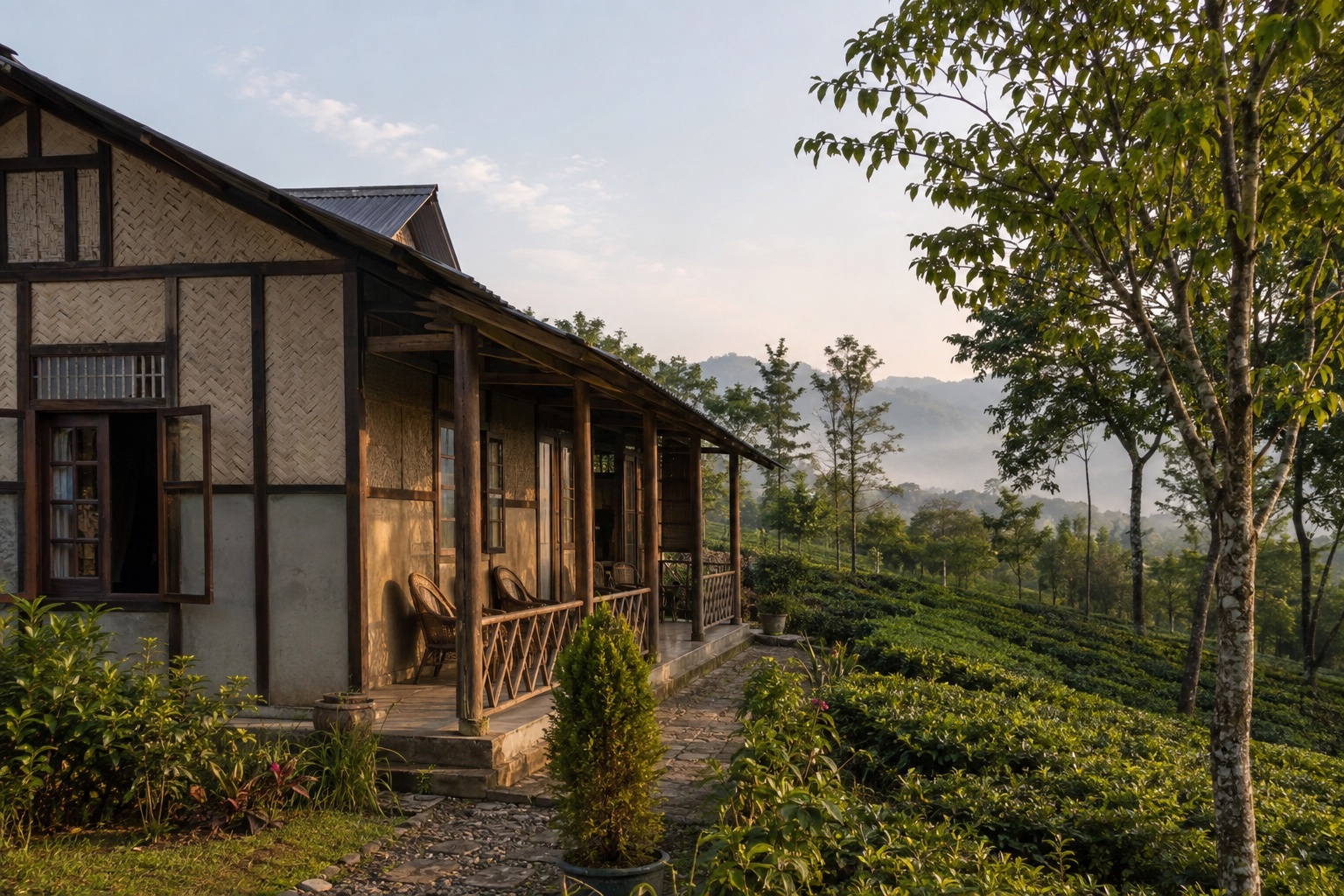
The 2022-23 official scheme defines Aamaar Aalohi homestays as private residential houses in tourist destinations offering rooms for tourist accommodation.
The published scheme repeatedly requires at least two guest rooms/bedrooms with attached toilet/bathroom facilities.
ATDC is the implementing/registration body identified by the published 2022-23 scheme, with its Paltan Bazar Guwahati office specified.
Scope: Source-checked regulatory and business-planning guidance. It does not approve a particular title, building, tax position, food activity or operating structure.
01 / Executive finding
The practical starting point
- The last complete Assam homestay instrument presently downloadable from the Department of Tourism/ATDC is the “AAMAAR AALOHI Homestay Scheme 2022-23”. It defines a homestay as a private residential house in a tourist destination offering rooms to tourists, and sets registration, inspection, operating and subsidy conditions. However, it cannot safely be described as conclusively controlling after June 2026 because a newer 2026 accommodation-regulation instrument has reportedly been approved but its notified primary text was not located. [S1, pp. 1, 7–9; S17, discovery-only]
- There is a serious current-law gap. On 23 June 2026, PTI reported that the Assam Cabinet approved the *Assam Tourism Accommodation (Development and Registration) Rules, 2026*, including single-window registration and automatic renewal every three years. Searches of the Assam Tourism Department, ATDC, Assam Government and official Gazette repositories did not locate the notified Rules, notification/order number, commencement provision or operative portal. Cabinet approval alone is not sufficient evidence that those reported provisions are legally in force. [S7, Gazette repository; S17, discovery-only]
- Under the 2022-23 scheme text, location is a threshold restriction: a homestay should be in a tourism area, within a radius of 30 km from a tourism area “as notified” by the Tourism Department. The actual current list/map of such notified tourism areas was Not stated in the current official material reviewed. This is one of the most important address-screening issues before property acquisition. [S1, p. 5, Requirement 1]
- The published Assam sources are not aligned on rural versus urban eligibility. The current Department webpage calls Aamaar Aalohi a rural homestay scheme aimed at rural and semi-urban areas, while the scheme PDF says selected existing houses will be classified as “Rural & Urban Homestays” and states that the scheme is operative throughout Assam. [S2, portal text; S1, pp. 4, 7]
- A current permanent-domicile or permanent-residence test is not expressly located. The scheme uses concepts such as “private residential houses”, staying with “local families”, proprietor/house owner and “resident members” of the host family, but the located 2022-23 text does not expressly state that the registered proprietor must permanently reside in the property or prescribe a domicile certificate. [S1, pp. 1, 3, 7, 14]
- The minimum published accommodation threshold is two guest rooms with attached toilet/bathroom facilities. The scheme repeatedly refers to a minimum of two rooms/bedrooms. No current maximum number of guest rooms, beds or guests was located. [S1, pp. 3–4]
- The scheme's room-size text is defective and must not be silently “corrected”. It states that a single room should not be below 100 sq ft but gives the parenthetical “109.30 Sq mtr”; it then states that a double room “should be less than 120 sq.ft. (11.15 Sq mtr)” despite describing minimum room standards. Written ATDC clarification is required before publishing room dimensions as settled requirements. [S1, p. 6, Requirement 8(c)]
- The published 2022-23 registration authority is ATDC Ltd. Applications are directed to Assam Tourism Development Corporation Ltd., 4th Floor, Asom Paryatan Bhawan, A.K. Azad Road, Paltan Bazar, Guwahati 781008. The scheme's Selection Committee includes the senior-most Secretary of Tourism, MD ATDC, Director of Tourism or representative, an India Tourism representative and GM ATDC. [S1, pp. 4, 9–10]
- The 2022-23 instrument states a ₹1,000 registration/application fee and ₹500 yearly renewal fee, with one-calendar-year validity and renewal three months before expiry. The attached application package calls the ₹1,000 demand draft non-refundable. These figures are not safe to publish as the definitive 2026 regime until the June 2026 Rules are located, because the reported new regime would use a three-year renewal cycle. [S1, pp. 8, 15; S17, discovery-only]
- Company, LLP, partnership, lessee and professional-management-company eligibility as the tourism registration holder is Not stated in the material reviewed. The subsidy-side Community Tourism Organisation may be a registered society, cooperative, community-based organisation or another appropriate legal structure, but that does not establish that a company or LLP may replace the individual house proprietor as homestay registration holder. [S1, pp. 1, 7]
- Foreign-guest compliance has materially changed at central level. The current Immigration and Foreigners Rules, 2025 expressly include a “home stay” within accommodation and require the keeper to maintain foreigner/OCI records electronically for at least one year and transmit Form III — “Earlier Form C” — electronically within 24 hours of arrival and departure. Assam's 2022 PDF still tells owners to submit Form C to the nearest police station, so the old national-form mechanics in that scheme should not be reproduced without qualification. [S8, Rule 17, p. 28; Form III, p. 33; S1, p. 9]
- There is not enough primary evidence to publish a definitive 2026 Assam registration guide. The missing notified 2026 Rules, missing current online registration portal/process, unresolved annual-versus-three-year renewal position, conflicting subsidy percentages, rural/urban inconsistency, missing notified-tourism-area list and defective room-size provisions are material, not cosmetic gaps. [S1–S4, S7, S17]
02 / Document chronology
Use the current rules and implementation
Tourism Policy of Assam, 2017
The later Assam Tourism Policy 2022 expressly states that it replaces the five-year Tourism Policy of Assam, 2017. The 2017 policy must therefore not be presented as the current umbrella tourism policy. [S5, p. 17]
Legacy Aamaar Aalohi implementation material
ATDC's still-live How-to page contains an older scheme structure: it uses an eligibility date of 01 January 2017, an age range beginning at 26, an 80% construction subsidy and construction-type amounts around ₹6 lakh/₹8 lakh. The page remains publicly accessible but is inconsistent with the subsequently published 2022-23 scheme. [S4] Status: legacy/inconsistent implementation material; do not use alone as current authority.
Assam Tourism Policy, 2022
This became Assam's umbrella tourism policy and expressly replaced the 2017 policy. It supports community homestays under Amar/Aamaar Aalohi, training, standards and eventual single-window clearance reform. [S5, pp. 17, 24, 30, 50]
AAMAAR AALOHI Homestay Scheme 2022-23
The 17-page scheme establishes the most complete official homestay requirements currently located. It contains a definition, registration standards, application material, fees, inspection, operating obligations and a community-based subsidy framework. [S1] No express statement was located saying that this document rescinds every earlier Aamaar Aalohi scheme/version.
2023 ATDC application cycle
ATDC's current webpage lists:
- press notice ATDC.3361/2021/Pt-I/1188-94 dated 07 July 2023;
- first extension ATDC.3544/2023/1784-90 dated 31 July 2023;
- second extension ATDC.3544/2023/2151-07 dated 17 August 2023. [S3] These establish a 2023 application round, not that applications are currently open in September 2026.
23 June 2026 — reported Cabinet approval
PTI reports that Cabinet approved the *Assam Tourism Accommodation (Development and Registration) Rules, 2026*, with single-window registration and automatic three-year renewal. [S17] Primary instrument status: Not stated in the current official material reviewed. The official Gazette is published by the Directorate of Printing & Stationery; the public 2026 index/search material reviewed did not expose the tourism Rules. [S7] Practical conclusion: it cannot presently be determined from located primary sources whether the 2026 Rules have been notified/commenced, whether they supersede all or part of Aamaar Aalohi, or whether Aamaar Aalohi survives as a separate incentive/classification scheme.
03 / Category definitions
Choose the right accommodation category
| Category | Location | Eligible owner/applicant | Residence requirement | Operator allowed | Capacity | Food position | Source |
|---|---|---|---|---|---|---|---|
| Homestay — Aamaar Aalohi | Tourist destinations; S1 additionally says within 30 km of a tourism area notified by Tourism Department | Scheme refers to proprietor/house owner; subsidy route involves CTO/group members | Private residential-house/local-family concept; express permanent-residence rule Not stated in the material reviewed | Third-party operator substitution Not stated in the material reviewed | Minimum two guest rooms with attached toilet; maximum Not stated in the material reviewed | Bed-and-breakfast contemplated; food or self-cooking provisions | [S1, pp. 1, 3–7] |
| Bed & Breakfast | Not stated in the material reviewed | Not stated in the material reviewed | Not stated in the material reviewed | Not stated in the material reviewed | Not stated in the material reviewed | Not stated in the material reviewed | No separate current Assam definition located. |
| Guest house | Not stated in the material reviewed | Not stated in the material reviewed | Not stated in the material reviewed | Not stated in the material reviewed | Not stated in the material reviewed | Not stated in the material reviewed | New 2026 framework reportedly covers guest houses, but primary Rules not located. [S17, discovery-only] |
| Hotel | Not stated in the material reviewed in current homestay instrument | Not stated in the material reviewed | No homestay-style residence conclusion can be imported | Not stated in the material reviewed | Not stated in the material reviewed | Separate hospitality/food law | Separate category referred to in S1 operating-record comparison; detailed Assam definition not located in homestay materials. |
| Resort | Not stated in the material reviewed | Not stated in the material reviewed | Not stated in the material reviewed | Not stated in the material reviewed | Not stated in the material reviewed | Not stated in the material reviewed | Reportedly within 2026 accommodation framework; primary Rules absent. |
| Motel | Not stated in the material reviewed | Not stated in the material reviewed | Not stated in the material reviewed | Not stated in the material reviewed | Not stated in the material reviewed | Not stated in the material reviewed | Not stated in the current official material reviewed. |
| Lodge | Not stated in the material reviewed | Not stated in the material reviewed | Not stated in the material reviewed | Not stated in the material reviewed | Not stated in the material reviewed | Not stated in the material reviewed | Not stated in the current official material reviewed. |
| Serviced apartment/accommodation | Not stated in the material reviewed | Not stated in the material reviewed | Not stated in the material reviewed | Not stated in the material reviewed | Not stated in the material reviewed | Not stated in the material reviewed | Reported 2026 category only; primary Rules missing. |
| Farm stay | Not stated in the material reviewed | Not stated in the material reviewed | Not stated in the material reviewed | Not stated in the material reviewed | Not stated in the material reviewed | Not stated in the material reviewed | No separate Assam definition located. |
| Tented accommodation | Not stated in the material reviewed | Not stated in the material reviewed | Not stated in the material reviewed | Not stated in the material reviewed | Not stated in the material reviewed | Not stated in the material reviewed | Reported 2026 category only; primary Rules missing. |
| Heritage hotel/property accommodation | Not stated in the material reviewed | Not stated in the material reviewed | Not stated in the material reviewed | Not stated in the material reviewed | Not stated in the material reviewed | Not stated in the material reviewed | Reported 2026 category only; primary Rules missing. |
Practical rule: none of these adjacent categories should be described using definitions borrowed from Ministry of Tourism classifications or another state unless Assam's post-2026 primary instrument expressly adopts them.
04 / Eligibility decision tree
Check whether the applicant and property qualify
Start with the exact property address and local-body category. A. Is the address within a Tourism Department-notified tourism area or within the published 30-km radius?
- Yes, documented through an official notification/map → continue.
- No → does not appear to fit the published homestay definition under S1's location requirement.
- Official notification/list cannot be identified → Confirm this in writing with the authority. [S1, p. 5] B. Is the property rural, semi-urban or urban?
- Rural/semi-urban → aligns with S2's current webpage description; continue.
- Urban → S1 expressly refers to “Rural & Urban Homestays”, while S2 calls the scheme rural/semi-urban → Confirm this in writing with the authority. [S1, p. 4; S2] C. What is the property interest?
- Individual proprietor owns the residential house → continue.
- Joint/inherited title → consent/document rule Not stated in the material reviewed → Not established in the published material.
- Long-term lease only → applicant route Not stated in the material reviewed → Confirm this in writing with the authority.
- Company/LLP owns or leases it → registration-holder eligibility Not stated in the material reviewed → Confirm this in writing with the authority.
- No property selected yet → property cannot be screened → Not established in the published material until a site is identified. D. Who will live at the property?
- Owner/family resides there and hosts guests → most closely follows the “private residential house” and “local families” concept → continue.
- Owner lives elsewhere but caretaker stays → caretaker substitution is not expressly recognised → Confirm this in writing with the authority.
- Entire house is commercially operated without resident host → Consider another accommodation category. E. Who will operate it?
- House proprietor/host → most clearly contemplated by S1.
- Management company acting only as service provider while eligible proprietor remains registration holder → legal acceptability/extent of delegation Not stated in the material reviewed → Confirm this in writing with the authority.
- Management company/LLP seeks to become the registered homestay instead of the proprietor → Not established in the published material. F. How many rooms are proposed?
- At least two guest rooms with attached toilets/bathrooms → continue.
- Fewer than two → does not appear to fit the published homestay definition/STANDARD under S1.
- Large room inventory → no maximum located; classification as homestay versus hotel/guest house cannot be assumed → Confirm this in writing with the authority. [S1, pp. 3–4] G. Existing, proposed, under construction or running?
- Existing/running residential property meeting standards → This appears to fit the published route, subject to the remaining checks, subject to address and applicant structure.
- Existing house seeking Aamaar Aalohi capital assistance for additional units → must satisfy the CTO/group, land, subsidy-selection and construction conditions → This appears to fit the published route, subject to the remaining checks if all are met.
- Bare land only/new stand-alone commercial development with no existing residential-house context → Aamaar Aalohi subsidy text contemplates identification of existing houses/premises with scope for additional construction; independent greenfield homestay route is Not stated in the material reviewed → Consider another accommodation category or Confirm this in writing with the authority. [S1, p. 3] Use these branches as a starting test and confirm the result for the exact property.
05 / Applicant and operating structures
Set the ownership and operating structure
| Structure | Supported route | Main obstacle | Source | Question requiring clarification |
|---|---|---|---|---|
| Resident individual owner | Closest fit: private residential house, proprietor/owner, local-family hosting | No explicit permanent-residence definition; current 2026 Rules unavailable | [S1, pp.1,3,7,14] | Must owner permanently reside, or is residence by family sufficient? |
| Joint/inherited ownership | Possible only if ATDC accepts one proprietor or joint applicants | Co-owner-consent and succession procedure Not stated in the material reviewed | S1 | What title/consent documents are required? |
| Owner living elsewhere | No clear supported registration route found | Residential-host concept; no absentee-owner provision | S1 | Can a non-resident owner retain registration? |
| Owner using caretaker | Caretaker may assist operationally as a practical matter, but substitution as legal host not established | “Caretaker” category Not stated in the material reviewed | S1 | May a resident caretaker satisfy host-presence requirements? |
| Long-term lessee | No general route located | S1 speaks of proprietor/house owner; subsidised unit cannot be leased for seven years | [S1, p.7] | Can a registered leaseholder apply for an unsubsidised homestay? |
| Company | No explicit registration-holder eligibility located | CTO corporate/entity language cannot be equated to house proprietor eligibility | [S1, pp.1,7] | Can a company own/register a homestay, and must a resident host still be designated? |
| Partnership firm / LLP | No explicit route located | Same issue as company | S1 | Is an LLP/firm an “appropriate legal structure” only for a CTO, or also a homestay proprietor? |
| Professional operator / management company | S1 recognises tie-ups with service providers and other agencies, but not transfer of registration-holder responsibility | Operating delegation limits undefined | [S1, p.8, clauses (j)–(l)] | Which statutory/registration duties must remain with the proprietor? |
| Capital-only participant | May fund/acquire/contract commercially, but cannot itself satisfy property/applicant conditions without a permitted structure | No investor category | S1 | Which ownership/contract structures will ATDC recognise without changing the homestay's eligible character? |
| Landowner proposing new construction | Aamaar Aalohi subsidy route contemplates an existing house/premises plus ≥1 Katha land and at least two new rooms | Pure greenfield non-subsidy route is not established; local building permission remains separate | [S1, p.3] | Can a new standalone building on vacant land register as a homestay under the 2026 Rules? |
A management agreement, lease, LLP or shareholding arrangement cannot by itself manufacture applicant eligibility that the tourism rules do not grant.
06 / Property and classification standards
Prepare the property for inspection
| Topic | Mandatory / classification / guidance / unclear | Requirement | Applies when | Source | Confidence |
|---|---|---|---|---|---|
| Location | Mandatory in S1 | Tourism area or within 30-km radius of tourism area notified by Tourism Department | All S1 homestays | [S1, p.5, Req.1] | HIGH within S1; currentness MEDIUM |
| Access | Mandatory | Suitable tourism access; themed village/adventure/wildlife properties require security/accessibility arrangements | All | [S1, p.5, Req.2] | HIGH |
| Building condition/layout | Mandatory | House/accommodation layout and condition suitable for homestay operation | All | [S1, pp.5–6] | HIGH |
| Land area | Subsidy condition | At least 1 Katha available on same premises | New subsidised construction | [S1, p.3] | HIGH |
| Title | Subsidy/application | Miyadi Patta/title/Namjari documentation | Capital-subsidy route | [S1, p.7; form pp.14–15] | HIGH |
| Minimum guest rooms | Mandatory | At least two rooms/bedrooms | Existing and new S1 units | [S1, pp.3–4] | HIGH |
| Maximum guest rooms | Unclear | Not stated in the material reviewed | — | — | LOW |
| Maximum beds/guests | Unclear | Not stated in the material reviewed | — | — | LOW |
| Total building rooms vs guest rooms | Unclear | Not stated in the material reviewed | — | — | LOW |
| Attached toilet/bathroom | Mandatory | Guest rooms to have attached toilet/bathroom | All | [S1, pp.3–4] | HIGH |
| Single room size | Conflict | Text says not less than 100 sq ft but parenthetical says “109.30 Sq mtr” | Single room | [S1, p.6, 8(c)] | LOW — defective text |
| Double room size | Conflict | Text says double room “should be less than 120 sq.ft. (11.15 Sq mtr)” within a minimum-size paragraph | Double room | [S1, p.6, 8(c)] | LOW — clarification required |
| Bedroom ventilation/privacy | Mandatory | Clean, spacious, ventilated, maintained; windows curtained/blinded; privacy/security | Guest rooms | [S1, p.6] | HIGH |
| Cooling/heating | Conditional standard | Fan/AC/blankets according to climate; exception contemplated for special situations such as eco-lodge | Guest rooms | [S1, p.6] | HIGH |
| Internet/Wi-Fi | Unclear | Not stated in the material reviewed | — | — | LOW |
| Hot water | Unclear | Separate mandatory hot-water rule Not stated in the material reviewed | — | — | LOW |
| Water | Mandatory | Clean, hygienic and uninterrupted water supply | All | [S1, p.7] | HIGH |
| Power backup | Mandatory in S1 wording | “Power back up with Solar charging facility must be provided” | All S1 units | [S1, p.7, Req.11] | HIGH within S1 |
| Front sitting/common area | Mandatory standard | Clean, spacious, ventilated, lit, furnished guest sitting area/hall | All | [S1, p.6] | HIGH |
| Dining area | Standard | Clean, maintained, adequate seating; crockery/cutlery/tableware | Where dining is provided | [S1, pp.6–7] | HIGH |
| Food/self-cooking | Mandatory operational choice in text | If food served, display/list meals and charges; otherwise self-cooking facility with utensils | All | [S1, p.7] | HIGH |
| Parking | Mandatory wording | Proper parking arrangement with adequate security | All | [S1, p.6, Req.6] | HIGH |
| Reception/counter | Unclear | No separate reception-area requirement; certificate/rate list to be displayed at “counter (in premises)” | Operations | [S1, p.9] | MEDIUM |
| Signage | Subsidy-specific mandatory; general unclear | Scheme name/prescribed inscription on subsidised units; prohibition signage required operationally | Subsidy/operations | [S1, pp.7,9] | HIGH |
| First aid | Mandatory | First-aid arrangements | All | S1, p.7 | HIGH |
| Stair/path lighting | Mandatory | Paths, stairs/elevator areas to be properly lit | All | S1, p.7 | HIGH |
| Waste | Mandatory | Garbage to be kept in covered bins | All | S1, p.7 | HIGH |
| Medical access | Standard | Contact with doctor/hospital for guest sickness | All | S1, p.7 | HIGH |
| Vehicle assistance | Guidance | Vehicle arrangement described as preferred | Operations | S1, p.7 | HIGH as guidance |
| Accessibility | Guidance | Property should “preferably” be disability-friendly | All | S1, p.7 | HIGH that it is preference, not expressed mandatory standard |
| Fire | Adjacent/unclear | No general fire-NOC clause located in S1; state fire law/service must be tested by building type/use | Property-specific | [S14] | MEDIUM |
| Structural certificate | Unclear | Not stated in the material reviewed in S1 | — | — | LOW |
| Sanitation | Mandatory | Cleanliness/sanitation standards continuously maintained | Operations | [S1, p.9] | HIGH |
| Classification grade/points | Unclear | S1 says certificate will follow evaluation “as per the Mark sheet”, but operative mark sheet/grade bands were Not stated in the material reviewed in the reviewed 17-page publication | Registration | [S1, p.8] | LOW |
07 / Documents and declarations
Assemble the application file
A critical distinction is required: the detailed form attached to S1 is titled for new community-based homestays seeking capital/operational/promotional subsidy and existing homestays seeking operational/promotional subsidy. It must not automatically be described as the complete document list for every standalone unsubsidised registration. [S1, p.10]
| Document | Who provides/signs | Format/stamp requirement | Validity period | When required | Source | Unresolved issue |
|---|---|---|---|---|---|---|
| Prescribed homestay application | Proprietor/applicant | Prescribed form; general digital format not located | Application-specific | Registration | [S1, p.7] | Standalone 2026 form not located |
| CTO details/registration | Community Tourism Organisation | Registration number/entity particulars | NOT STATED | Subsidy/CTO application | [S1, pp.1,10] | Which legal forms currently accepted? |
| DPR/project proposal | CTO | Detailed project proposal | Application-specific | New subsidy units | [S1, p.4] | Current DPR format not located |
| Voter ID | Individual member | Self-attested copy | NOT STATED | Subsidy form | [S1, pp.13–15] | Whether mandatory for non-subsidy registration unknown |
| PAN | Individual member | Self-attested copy | NOT STATED | Subsidy form | S1 | Same |
| Aadhaar | Individual member | Self-attested copy | NOT STATED | Subsidy form | S1 | Same |
| Age proof | Individual | HSLC admit card specified | NOT STATED | Subsidy eligibility | [S1, pp.13–15] | Form contains conflicting age reference elsewhere |
| Education proof | Individual | Highest qualification/HSSLC certificate | NOT STATED | Subsidy eligibility | [S1, pp.13–15] | Exempted education categories stated in scheme |
| Professional certificate | Applicant | Copy, if any | NOT STATED | Subsidy form | S1 | Appears optional where none exists |
| Caste/category certificate | Relevant applicant | Copy | NOT STATED | Subsidy relaxation | S1 | Only where category benefit claimed |
| Unemployment certificate | Applicant | Latest certificate from District Employment Exchange | “Latest” | Subsidy form | [S1, pp.14–15] | Appears difficult to reconcile with an existing operating homestay; universal applicability should not be assumed |
| Character certificate | Applicant | From SDO(C), Circle Officer, local MLA, President Zilla Parishad or President Gaon Panchayat | NOT STATED | Subsidy form | [S1, p.15] | Whether all issuing alternatives remain accepted in 2026 |
| Roadmap | Applicant | Sketch or Google map from prominent place/main road | NOT STATED | Subsidy form | S1, p.15 | Digital/file specification not provided |
| Land document | Owner/applicant | Certified deed/patta/Namjari; Miyadi Patta specifically referenced for capital subsidy | NOT STATED | Capital subsidy/property verification | [S1, p.7; pp.14–15] | General lessee/joint-owner rules absent |
| NOC for homestay | Applicant | Circle Officer identified in form notes | NOT STATED | Subsidy form | S1, pp.14–15 | Legal basis/scope and current 2026 form not located |
| Police verification | Applicant | Police Verification Report | NOT STATED | Subsidy selection | [S1, pp.14–15; S4] | No staff/caretaker verification rule located |
| Tourist-attraction photographs | Applicant | At least three photos requested for nearby attractions | NOT STATED | Subsidy application | [S1, p.12] | File format/size absent |
| Site photographs | Applicant | Photographs of desired site | NOT STATED | Subsidy form | S1, pp.14–15 | Number/format not stated |
| Passport photographs | Applicant | One on form plus two additional, self-attested, form number on back | NOT STATED | Subsidy form | [S1, p.15] | Paper-process indication |
| ₹1,000 demand draft | Applicant | DD in favour of MD, ATDC Ltd., Guwahati | Application | Application package | [S1, p.15] | New 2026 payment route unknown |
| Application copies | Applicant | Two sets: one original + one photocopy | Application | Subsidy form | S1, p.15 | Portal replacement unknown |
| Self-addressed envelope | Applicant | One | Application | Subsidy form | S1, p.15 | Legacy/paper-process feature |
| Training certificate | Selected applicant and spouse | ATDC-certified training | Scheme-specific | Before subsidy assistance | [S1, p.7] | S4 describes training differently for existing units |
| Seven-year agreement/MOU | Beneficiary and ATDC | Form/stamp value Not stated in the material reviewed | Seven years | After subsidy selection | [S1, p.7] | Full MOU form not in reviewed publication |
| Affidavit | — | Not stated in the material reviewed | — | — | — | Do not invent |
| Stamp-paper requirement | — | Not stated in the material reviewed | — | — | — | Do not invent |
| Structural certificate | — | Not stated in the material reviewed in tourism scheme | — | — | — | May arise under building law |
| Completion/occupancy certificate | — | Not stated in the material reviewed in tourism scheme | — | — | — | Local building authority must be checked |
| Fire NOC | — | Not stated in the material reviewed as universal homestay upload in S1 | — | — | [S14] | Applicability building-specific |
Applicant declarations
The subsidy application requires declarations that information is correct; the applicant/family has not obtained financial loan/assistance under a government-sponsored Tourism Department self-employment scheme; no criminal case is pending; incorrect information may cause cancellation; and scheme rules/terms will be followed if selected. [S1, p.16] No universal post-June-2026 online declaration set was located.
08 / Application and inspection process
Follow the application and inspection process
Process supported by the 2022-23 source set
| Step | Responsible person/authority | Input/document | Resulting record/action | Stated time | What does not happen automatically |
|---|---|---|---|---|---|
| 1. Address eligibility screening | Applicant / ATDC | Exact property address and tourism-area status | Eligibility assessment | None | Being in Assam alone does not establish eligibility; 30-km/notified-area condition remains |
| 2. Choose route | Applicant | Existing unit vs new subsidised CTO project | Correct application route | None | A running property is not automatically registered |
| 3. CTO formation where subsidy sought | Applicants | Minimum 10-unit/community grouping and legal entity | Eligible subsidy applicant structure | None | Formation does not guarantee subsidy |
| 4. Prepare application | Proprietor/CTO | Prescribed form, DPR where applicable, documents | Application file/reference | Advertisement/application period | Submission does not create registration |
| 5. Pay fee | Applicant | S1 states ₹1,000; attached form specifies DD | Fee record/DD | At application | Payment does not guarantee inspection or approval |
| 6. Scrutiny/shortlisting | ATDC | Application, DPR/testimonials | Shortlist/query | No general statutory deadline located | Complete papers do not guarantee shortlisting |
| 7. Property inspection | ATDC-appointed inspection team / Selection Committee framework | Ready premises | Inspection report | Committee “would ensure” inspection within 30 days of submission | The 30 days is phrased as an administrative process expectation, not a guaranteed approval period. [S1, pp.7–8] |
| 8. Quality evaluation | Selection Committee | Inspection report/standards | Recommendation/classification | None | Inspection does not guarantee certificate |
| 9. Rectification | Owner | Corrections and supporting documents | Reconsideration | Agreed period of less than three months | Deficiency notice is not approval |
| 10. Training | ATDC/applicant | Attendance/certification | Training record | Scheme-specific | Subsidy route cannot skip mandatory training for shortlisted applicant/spouse |
| 11. Registration decision | ATDC | Evaluation/mark sheet | Certificate or refusal | No total approval period located | Certificate download process Not stated in the material reviewed |
| 12. Appeal | Proprietor → senior-most Secretary, Tourism Department | Written appeal | Appeal decision | Within 30 days of official communication | Appeal does not suspend/refute refusal automatically |
| 13. Renewal | Owner/ATDC | Renewal form, documents, fee, reinspection/re-evaluation | Renewed classification under S1 | Apply three months before expiry | Renewal under S1 is not automatic |
Sources: [S1, pp.4, 7–9]
Existing-homestay process conflict
S4's still-live ATDC page describes a four-stage existing-homestay process: application, Standard and Quality Assurance Committee inspection, Selection Committee shortlisting for training, and final registration based partly on training performance. S1 does not present the same sequence for every existing-unit registration. [S4] Status: The official sources are not aligned.
Live 2026 process
A public Assam online single-window registration portal corresponding to the reported 2026 Rules was Not stated in the current official material reviewed. Therefore the following cannot currently be verified:
- account-creation eligibility;
- OTP/Aadhaar/PAN requirements;
- entity-type dropdowns;
- digital file formats/sizes;
- portal declarations;
- current fee/payment gateway;
- online inspection scheduling;
- query-response workflow;
- certificate download;
- auto-renewal mechanics.
09 / Fees, timelines, validity and renewal
Confirm fees, timing and certificate validity
| Item | Verified published position | Nature | Source | 2026 status |
|---|---|---|---|---|
| Registration/application fee | ₹1,000 | Scheme fee | [S1, p.8] | Currentness unresolved |
| Refund position | ₹1,000 DD described as non-refundable in attached application package | Form condition | [S1, p.15] | Universal 2026 scope unresolved |
| Renewal fee | ₹500 yearly | Scheme fee | [S1, p.8] | Currentness unresolved |
| Classification fee | Not stated in the material reviewed separately | — | — | Unknown |
| Inspection fee | Not stated in the material reviewed separately | — | — | Unknown |
| Inspection timing | “within thirty (30) days of submitting the application” | Administrative scheme statement/target | [S1, pp.7–8] | Not a guaranteed approval period |
| Deficiency cure | Agreed period less than three months | Rectification period | [S1, p.8] | Currentness unresolved |
| Appeal | Within 30 days of official communication | Scheme appeal period | [S1, p.8] | Currentness unresolved |
| Registration validity | One calendar year | S1 classification/licence validity | [S1, p.8] | Potentially displaced by unlocated 2026 Rules |
| Renewal filing | Three months before expiry | S1 | [S1, p.8] | Potentially displaced |
| Reported 2026 renewal | Automatic renewal every three years | DISCOVERY ONLY | [S17] | DO NOT PUBLISH AS OPERATIVE UNTIL PRIMARY RULES ARE LOCATED |
| Subsidy MOU | Seven years | Subsidy contractual period, not registration validity | [S1, p.7] | Separate from registration |
No guaranteed end-to-end registration processing time was located. No rule was located stating that payment, lapse of the inspection target or portal submission results in deemed homestay approval.
10 / Operating duties after registration
Run the registered homestay correctly
Rates, billing and display
S1 requires a bill book/homestay pad for tourist bills and requires the registration certificate and rate list issued by the Corporation to be displayed in the premises. It separately recommends advance display/specification of meal types and charges. [S1, pp.8–9]
Guest register
The homestay should maintain a guest register containing name, address, contact details, passport or national identity number, arrival/departure particulars and guest signature. Transactions should receive valid receipts and records should be maintained. [S1, p.7] S1 further says the letting register should use the same format as hotels/guest houses/tourist lodges and be available for government/ATDC inspection. [S1, p.9] Assam-specific retention period: Not stated in the material reviewed.
Domestic guest reporting
S1 says homestay holders shall submit details of tourists/guests to the nearest police station on a day-to-day basis for both domestic and foreign tourists. [S1, p.9] A newer state police/tourism circular modifying that obligation was Not stated in the material reviewed. Current local implementation should be confirmed before publication.
Foreign guests
Current central law is clearer and newer. Rule 17 of the Immigration and Foreigners Rules, 2025:
- expressly includes “home stay” within “accommodation”;
- requires every foreigner including OCI cardholder to provide and sign specified particulars;
- requires the keeper to maintain those particulars electronically for at least one year;
- requires electronic transmission of Form III within 24 hours after arrival;
- requires electronic departure information within 24 hours after departure. [S8, Rule 17, p.28] Form III is expressly labelled “Earlier FORM ‘C’”. [S8, Form III, p.33] The Bureau of Immigration portal now identifies itself as “Online Form III” and states the obligation applies to foreigners including OCI cardholders. [S9]
Tourism statistics
S1 requires a monthly report regarding guest data to ATDC Ltd. [S1, p.9] Current file format, portal and reporting deadline within each month: Not stated in the material reviewed.
Staff, caretaker and police checks
An applicant Police Verification Report appears in the subsidy application package. [S1, pp.14–15] A general requirement for police verification of:
- every employee;
- caretaker;
- manager;
- outsourced housekeeping staff; or
- management-company personnel was Not stated in the material reviewed IN S1.
Training
Shortlisted subsidy candidates and their spouse require ATDC homestay training before becoming eligible for assistance. Registered homestay owners are also required by S1 to attend ATDC periodic training, with cancellation stated as a consequence of failure. [S1, pp.7–8] No staff-localisation quota was located.
Food and sanitation
The proprietor must maintain cleanliness, sanitation and food quality. If meals are supplied, a list of food/meals and charges is contemplated; otherwise S1 calls for a self-cooking facility. [S1, pp.7,9] This does not substitute for FSSAI compliance.
Safety and maintenance
Published standards include first aid, illuminated access/stair areas, covered garbage bins, uninterrupted hygienic water and solar-charging power backup. Changes in facilities, refurbishment, upgrading or extensions are to be notified in writing to ATDC within 30 days. [S1, pp.7–8]
Inspection, complaints and cancellation
Surprise inspection is contemplated. Failure to maintain standards, hygiene, appropriate conduct or absence of malpractice may lead to cancellation after a reasonable rectification opportunity. Guest complaints are to be investigated and may result in cancellation if established. [S1, p.8] No detailed published complaint-hearing procedure or monetary penalty schedule was located.
Insurance
Mandatory homestay insurance: Not stated in the current official material reviewed. Business recommendation, not regulation: property, public-liability, employee, business-interruption and relevant guest-risk cover should be evaluated with an insurer after the final operating structure is known.
11 / Adjacent approvals and dependencies
Close the approvals outside Tourism
| Topic | What tourism registration resolves | What it does not resolve | Likely authority | Official source located | Property-specific question |
|---|---|---|---|---|---|
| Land title | Tourism application may inspect title/land documents | Marketable title, encumbrances, succession, conversion, tenancy legality | Revenue/Circle Office/local land authority | S1 title/NOC requirements | Who owns the land and what use is recorded? |
| Land/building use | Nothing beyond tourism-category suitability | Permissible development/use | Development authority/ULB/TCP/local body | [S13] | Is lodging use permissible at this survey/holding? |
| Building sanction | Does not grant building permission | Sanctioned plan, setbacks, FAR, height, structural and occupancy requirements | Applicable planning/municipal authority | S13 | Was existing construction sanctioned and is proposed alteration permissible? |
| Completion/occupancy | Not resolved | Completion/occupancy certificate requirements | Local building authority | S13 | Does this building require/hold completion or occupancy approval? |
| Fire | S1 establishes general guest safety only | Fire NOC, system design, evacuation requirements | Fire & Emergency Services, Assam | [S14] | Does building height/use/area trigger NOC? |
| Food | Tourism classification permits/anticipates meal service | FSSAI registration/licence | FSSAI/FoSCoS and state food-safety authorities | [S10–S11] | What food-business KOB and scale apply? |
| Police | S1 imposes guest reporting and applicant verification | General criminal/police permissions outside scheme | Local police | S1 | What current digital/local daily-reporting procedure is accepted? |
| Foreign guests | Tourism registration does not satisfy immigration reporting | Rule 17/Form III reporting | Bureau of Immigration/Registration Officer | [S8–S9] | Has accommodation registration for Form III been completed? |
| Environment | No environmental clearance | ESZ/forest/wildlife and site-specific restrictions | MoEFCC/Assam Environment & Forest/competent authority | [S15] | Is the site inside an ESZ, protected-area buffer or notified forest constraint? |
| Local body/trade licensing | Tourism certificate is separate | Trade/establishment/local licence if applicable | Municipality/Town Committee/Panchayat/council | Property-specific source not selected | Which local body controls the address? |
| GST | No tax registration | GST liability, invoice content, rates, place-of-supply/entity issues | GST authorities/CBIC | [S16] | Who earns room/food/management revenue and through which platform? |
| Udyam | Nothing | MSME classification/registration | Ministry of MSME | [S12] | Which operating entity, if any, should register? |
| Water | Tourism standard requires hygienic uninterrupted supply | Connection category, extraction, quality permissions | Local water/local body/groundwater authority as applicable | Property-specific | Source, connection and commercial use? |
| Electricity | S1 calls for backup | Tariff category, load sanction, electrical safety | Electricity distribution authority | Property-specific | Does commercial lodging change tariff/load? |
| Property tax | Nothing | Assessment/use classification | Local body | Not stated in the material reviewed without address | Does homestay use alter assessment? |
| Waste/sewerage | S1 requires covered waste bins | Municipal waste contract/septic/sewer approval | Local body/pollution authority where applicable | Property-specific | What disposal system is legally permitted? |
| Protected locations | No override | ESZ/zonal master plan, forest/wildlife/heritage controls | Relevant competent authority | S15 | Exact coordinates and protected-zone status? |
Food-business dependency
FSSAI's current official page states that every Food Business Operator must be licensed or registered under section 31 of the Food Safety and Standards Act, with registration intended for petty/cottage food businesses within the prescribed small-business threshold and licensing required beyond it. [S10] A homestay that prepares/sells meals must therefore determine its correct FoSCoS Kind of Business and licence/registration category. Tourism approval is not an FSSAI licence.
GST
Official CBIC guidance after the 2019 threshold changes identifies ₹20 lakh as the general service-supplier registration threshold and ₹10 lakh only for Manipur, Mizoram, Nagaland and Tripura; therefore Assam is not in that reduced service-threshold group. This remains subject to CGST Act exceptions, aggregate-turnover rules, later notifications and the actual supplier structure. [S16] This guide does not publish a definitive September-2026 accommodation GST rate. Rate treatment and ITC have undergone subsequent hospitality changes and should be verified notification-by-notification at contracting stage.
Udyam
Udyam registration is free, paperless and based on self-declaration; the current official portal also states that no renewal is required. [S12, portal “Must Know”] Udyam registration does not prove that an entity is an eligible Assam homestay proprietor.
12 / Incentives, subsidy and funding
Evaluate incentives without assuming sanction
A. Aamaar Aalohi capital subsidy — 2022-23 scheme text
Official scheme name: AAMAAR AALOHI Homestay Scheme 2022-23. Published eligible structure: new homestays forming part of Community Based Organisations/Community Tourism Organisations. Capital-subsidy beneficiaries are a group/cluster of at least 10 homestay units near a tourist place. [S1, pp.1,3,5] Property conditions: existing houses/premises with scope for construction; at least one Katha land on the same premises; minimum two bedrooms with attached bathroom and furnished accommodation. [S1, p.3] Amount in S1: 90% of total project cost, with the shortlisted CBO receiving up to ₹1 crore or 90% of project cost, whichever is lower. [S1, p.5] Release in S1: 50% of subsidy after completion of 60% of work and the remaining 50% on completion of 100% of work. [S1, p.5] Bank/loan position: Government of Assam/ATDC expressly disclaims any guarantee for loan components or beneficiaries' financial liabilities. [S1, p.5] Selection: open advertisement → application/DPR → inspection → Selection Committee decision. It is therefore selective, not automatic. [S1, p.4] Current application window: NOT CONFIRMED OPEN. S3 lists the latest located application notices from 2023.
Critical subsidy conflict
The still-live ATDC How-to page instead states:
- 80% project assistance;
- 20% beneficiary/bank contribution;
- a 20% / 50% / 30% assistance-release sequence;
- approximate assistance amounts of ₹6 lakh for Assam-type and ₹8 lakh for stilted Assam-type cottages. [S4] This contradicts S1's later 90%/₹1-crore-CTO/50-50 framework. Status:
The official sources are not aligned. Publication consequence: no subsidy percentage, construction amount or drawdown schedule should be marketed as current until ATDC supplies a written confirmation of the operative scheme.
B. Operational subsidy — S1
Registered Community Based Tourism Organisations may apply for up to ₹2.5 lakh in a year, subject in S1 to hosting at least 250 room nights for each group. [S1, p.5] Existing homestays may form a CTO with at least 10 members and apply, subject to selection, periodic review and verification. [S1, p.5] Current application window: NOT CONFIRMED OPEN.
C. Marketing support — S1
Registered Community Based Tourism Organisations may apply for marketing support; shortlisted applicants are described as eligible for a maximum ₹2.5 lakh, subject to 50% of total promotional cost in a calendar year. [S1, p.5] This is application/selection-based assistance, not an entitlement.
D. Seven-year subsidy restrictions
A selected beneficiary must execute an agreement with ATDC valid for seven years. During that stipulated period the subsidised unit is not to be sold, leased or transferred to another party; use other than homestay may trigger recovery of the subsidy as arrears of land revenue. [S1, p.7] For project planning, this is particularly important where a future deal contemplates:
- a property lease;
- sale during the investment period;
- transfer to an SPV;
- management rights coupled to possession; or
- change in ownership.
Broader policy incentives
Assam Tourism Policy 2022 says that tourism incentives historically included accommodation and homestays and contemplated review/replacement of incentive structures. That policy statement is not an operative subsidy schedule and should not be converted into a claim of current financial entitlement. [S5, p.50, §7.8]
13 / Business implications
Translate the rules into a workable project
Before selecting or acquiring a property
the project team should establish, in writing where necessary:
- exact latitude/address, village/town, police station, district and local-body jurisdiction;
- whether ATDC accepts the address under the 30-km/notified-tourism-area condition;
- whether the property is rural, semi-urban or urban and whether the current post-2026 regime accepts that category;
- legal title, Patta/Namjari status, co-ownership and encumbrances;
- whether any lease or proposed property-holding SPV is compatible with homestay applicant rules;
- who will physically reside and host;
- who is intended to be registration holder;
- number of guest rooms/beds and whether the scale risks classification as another accommodation type;
- protected-area/ESZ/environmental status;
- existing building sanction/use and ability to renovate legally. A property should not be acquired on the assumption that “homestays are permitted throughout Assam” without resolving S1's 30-km tourism-area language.
Before construction or renovation
The project team must separate:
- ATDC homestay standards;
- Aamaar Aalohi subsidy-specific design approval;
- land-use/planning approval;
- building permission;
- structural safety;
- fire compliance;
- sanitation/septic/sewerage;
- environmental restrictions;
- electrical/water permissions. For subsidised new units, S1 additionally requires ATDC approval of design/estimates and ties design to the local hill/plain/riverine, heritage, ethnic and cultural context. [S1, p.7] Assam's building regime itself has been amended after the 2022 Unified Byelaws, including a 2026 amendment, so a design team must use the version applicable to the precise jurisdiction rather than an old standalone PDF. [S13]
Registration holder versus operating entity
The located source does not establish that the tourism registration holder and a professional operating entity may freely be different persons. S1 permits/mentions marketing or service-provider tie-ups, but that is not equivalent to authorising an LLP or management company to assume the statutory role of proprietor. [S1, p.8] Accordingly, commercial documentation should not be finalised around a separation of owner/registration holder/operator until ATDC confirms the structure.
What an LLP or management agreement cannot solve
An LLP agreement, lease or hotel-management-style contract cannot cure:
- an ineligible property location;
- an applicant-residence requirement if one exists in the 2026 Rules;
- lack of legal title/authorised possession;
- building-use illegality;
- protected-area restriction;
- room/capacity misclassification;
- Aamaar Aalohi seven-year no-transfer/no-lease conditions;
- FSSAI/GST/foreign-guest duties allocated by law to a particular person.
Property assessment and commercial planning
A project acquisition/onboarding memorandum should record at least:
- title and possession model;
- host identity;
- proposed registration holder;
- management entity;
- local authority;
- tourism-area eligibility evidence;
- existing certificate and expiry;
- room inventory;
- approved plan versus actual building;
- fire status;
- FSSAI status;
- Form III/foreign-guest readiness;
- protected-area status;
- subsidy history and seven-year MOU restrictions;
- outstanding ATDC inspection deficiencies;
- guest/reporting records;
- pending police/local-body issues;
- renewal date;
- any proposed renovation requiring ATDC notification or building approval.
Questions to answer before proposing business terms
No ownership percentage, capital contribution, revenue share, guaranteed income, guaranteed approval or subsidy assumption should be quoted until the following are settled:
- Who legally owns the property?
- Who is allowed to hold Assam homestay registration?
- Must that person/family reside on site?
- Can the project team operate under a management agreement?
- Is the proposed site inside an eligible tourism area?
- Is the property within the homestay room/capacity category?
- Are the post-June-2026 Rules operative?
- Does the property carry an Aamaar Aalohi subsidy/MOU transfer restriction?
- Which entity will contract with guests and OTAs?
- Which entity is FSSAI/GST/employer/foreign-guest-reporting responsible?
14 / Official-source conflicts
Resolve conflicting official instructions
Conflict 1 — capital subsidy
Source A: S1, AAMAAR AALOHI Homestay Scheme 2022-23, p.5. Proposition: new qualifying CBO homestays receive 90% of project cost, subject to maximum ₹1 crore or 90% of project cost, whichever is lower; release 50% after 60% work and 50% after full completion. Source B: S4, ATDC's current How-to webpage. Proposition: new units receive 80% assistance, beneficiary arranges 20%, and assistance is released 20%/50%/30%; approximate ₹6 lakh/₹8 lakh construction support is quoted. Date/hierarchy assessment: S1 is expressly titled 2022-23 and is the guidebook now linked by the current ATDC programme page. S4 contains explicit 2017 eligibility references and appears legacy, but remains on an official current website. Status: The official sources are not aligned. Affected: all applicants relying on capital assistance. Authority for written answer: Managing Director, ATDC and Department of Tourism.
Conflict 2 — rural versus urban scope
Source A: S2 current Tourism Department scheme page. Proposition: “Rural Homestay Scheme”, rural and semi-urban focus. Source B: S1 pp.4 and 7. Proposition: existing houses “will be classified as Rural & Urban Homestays”; scheme operative in entire Assam. Hierarchy: neither located source expressly explains the discrepancy. Status: The official sources are not aligned. Affected: urban municipal properties, particularly Guwahati and other towns. Authority: ATDC/Department of Tourism.
Conflict 3 — room dimensions inside S1 itself
Source A/B: S1 p.6 Requirement 8(c). The text states:
- single bedroom not less than 100 sq ft, but gives parenthetical “109.30 Sq mtr”;
- double bedroom “should be less than 120 sq.ft. (11.15 Sq mtr)” in a paragraph expressed as minimum standards. No corrigendum was located. Status:
OFFICIAL TEXT INTERNALLY DEFECTIVE. Affected: every proposed room design. Authority: ATDC standard/classification authority.
Conflict 4 — age criterion inside S1/application material
S1 p.4 and p.13 state an applicant age of 18–40, with relaxation up to 45 for specified categories. [S1, pp.4,13] The same application at p.10 says: > Age as on 01/01/2017 — Eligible for 26 to 40 years. [S1, p.10] Status: OFFICIAL TEXT INTERNALLY NOT ALIGNED. This is relevant to subsidy applicants, not necessarily ordinary unsubsidised existing-homestay registration.
Conflict 5 — foreign guest Form C mechanics
Source A: S1 p.9 instructs submission of Form C/passport details to nearest police station. Source B: current G.S.R. 596(E), Immigration and Foreigners Rules, 2025, Rule 17 requires electronic Form III [Earlier Form C] to the Registration Officer through the designated portal/mobile application within 24 hours. Hierarchy: current central statutory rules control the current central foreigner-reporting form/mechanics. Assam may nevertheless impose a separate tourism/police reporting condition; the current status of its daily police submission should be confirmed rather than assumed repealed. Status: central foreign-reporting conflict is resolved in favour of current Rule 17; the separate Assam daily-police-report requirement remains UNRESOLVED.
Conflict 6 — one-year versus reported three-year renewal
Source A: S1 p.8 — one calendar year, renewal application three months prior. Source B: S17 PTI report — Cabinet-approved 2026 Rules reportedly provide automatic renewal every three years. S17 is not a primary official source. The reported rule cannot therefore be treated as operative. Status: PRIMARY CURRENT SOURCE Not stated in the material reviewed, rather than a resolved legal conflict.
Conflict 7 — Fire & Emergency Services fee/current-law material
The current Fire Safety NOC service page says the service is free of cost and still describes the NOC using the Assam Fire Service Rules 1989 framework, while another current official page states that a fee has been introduced for NOC/renewal through the EODB payment gateway. [S14] Status: OFFICIAL IMPLEMENTATION SOURCES NOT ALIGNED. This becomes relevant only after establishing that the particular homestay requires a Fire NOC.
16 / Source register
Official source register
| ID | Issuing body | Document or portal | Document/order number | Published | Effective | Language | Status/currentness | Official URL | Pages/sections reviewed | Notes |
|---|---|---|---|---|---|---|---|---|---|---|
| S1 | Department of Tourism, Govt. of Assam / ATDC | AAMAAR AALOHI Homestay Scheme 2022-23; official filename amar_alohi_scheme.pdf; ATDC duplicate amar_alohi_form.pdf | NOT STATED IN PDF | Scheme year 2022-23; exact publication date NOT STATED | NOT STATED | English | PRIMARY / FORM. Currently published, but post-June-2026 currentness unresolved | Official Tourism Department PDF | All 17 pages | Main claim source. |
| S2 | Department of Tourism, Govt. of Assam | Aamaar Aalohi Homestay Scheme webpage | N/A | Last reviewed 19 Feb 2026 | N/A | English | IMPLEMENTATION / current official webpage | Aamaar Aalohi scheme page | Full public page | Calls scheme rural/semi-urban. |
| S3 | Assam Tourism Development Corporation Ltd. | Aamaar Aalohi (Livelihood Scheme) page | Includes notices ATDC.3361/2021/Pt-I/1188-94; ATDC.3544/2023/1784-90; ATDC.3544/2023/2151-07 | Notices July–Aug 2023 | As applicable | English | IMPLEMENTATION | ATDC Aamaar Aalohi page | Full page and download register | Current page still points to 2022-23 guidebook. |
| S4 | ATDC | “Amar Alohi scheme (Home stay)” How-to page | NOT STATED | Current official page; substantive text appears legacy | NOT STATED | English | IMPLEMENTATION — CONFLICTING/LEGACY CONTENT | ATDC how-to page | Full page | Uses 2017 age reference and 80% subsidy, inconsistent with S1. |
| S5 | Department of Tourism, Govt. of Assam | Assam Tourism Policy, 2022; filename annexure_-a_-_tourism_policy_2022_assam_0.pdf | Not stated in the material reviewed in reviewed PDF text | 2022 | NOT STATED | English | PRIMARY POLICY | Assam Tourism Policy 2022 PDF | Entire 68-page PDF; especially pp. 17, 24, 30, 32, 34, 48–50 | Expressly replaces Tourism Policy of Assam, 2017. |
| S6 | Department of Tourism, Govt. of Assam | Communication/contact directory | N/A | Last reviewed 28 Aug 2026 | N/A | English | CONTACT | Tourism Department communication page | Full page | State and destination-office contacts. |
| S7 | Directorate of Printing & Stationery, Govt. of Assam | Publication of Assam Gazettes; Extraordinary-2026 index | N/A | Gazette repository current page reviewed 2026 | N/A | English/Assamese | PRIMARY REPOSITORY | Assam Gazette publication page · Extraordinary 2026 index | Public indexes | 2026 tourism rules not located in indexed/searchable material reviewed. |
| S8 | Ministry of Home Affairs, Government of India | Immigration and Foreigners Rules, 2025 | G.S.R. 596(E) | 1 Sep 2025 | 1 Sep 2025, Rule 1(2) | Hindi/English | CENTRAL — CURRENT | Official Gazette PDF | Full rules; particularly Rule 17 and Form III | Supersedes listed older central immigration/foreigner rules to stated extent. |
| S9 | Bureau of Immigration / NIC | Online Form III portal | N/A | Current portal | Current | English | CENTRAL PORTAL | Online Form III portal | Public login/signup notice | Authentication not undertaken. |
| S10 | FSSAI | Food-business registration page | FSS Act 2006, ss.31(1)–(2) referenced | Page updated 6 Aug 2026 | Current | English | CENTRAL | FSSAI Registration page | Full public page | FBO registration/licensing principle and petty-FBO threshold. |
| S11 | FSSAI | Food Safety and Standards (Licensing and Registration of Food Businesses) Regulations, 2011 | Gazette regulations | 2011, as amended | As amended | English | CENTRAL REGULATION | Official FSSAI regulation PDF | Registration provisions, Schedule references | FoSCoS KOB must be determined from actual activity. |
| S12 | Ministry of MSME, Government of India | Udyam Registration Portal | Relevant MSME notifications linked on portal | Current data snapshot 3 Sep 2026 | Current | English | CENTRAL | Official Udyam portal | Registration/current classification material | Udyam is separate from tourism approval. |
| S13 | Guwahati Development Department / GMDA / Town & Country Planning | Assam Unified Building Construction (Regulation) Byelaws 2022 and amendments through 2026 | Base file identified as No. 688, DoHUA-ECF-236697/2 dated 15-10-2022; amendment particulars property-dependent | 2022–2026 | As notified | English | ADJACENT PRIMARY | Current Acts & Bye-Laws index · 2026 Amendment page | Currentness/index review | Full property-specific building-law analysis deferred until address/jurisdiction known. |
| S14 | Fire & Emergency Services, Assam | Fire Safety NOC service material; payment-gateway notice | Service page cites Rule 18, Assam Fire Service Rules 1989; newer Act/Rules also hosted | Service page last reviewed 29 Aug 2026 | Current service | English | ADJACENT IMPLEMENTATION — INTERNAL CURRENTNESS ISSUES | Fire Safety NOC page · Fee/payment notice | Public service pages | One page says free; another says fee introduced. Homestay-specific applicability not established. |
| S15 | Environment, Forest and Climate Change Department, Assam / MoEFCC | ESZ notification repository; Amchang ESZ amendment | Example: S.O. 2715(E), 11 Jul 2024 | Various | Notification-specific | English/Hindi | ADJACENT PRIMARY | Assam environment notification index · Amchang ESZ amendment | Repository plus example notification | Used only to establish address-specific environmental dependency. |
| S16 | CBIC, Government of India | GST statutory/guidance material | CGST Act 2017 and subsequent notifications | Current law with amendments | Current | English | CENTRAL TAX | Official CBIC GST update | Registration-threshold guidance | Exact accommodation GST treatment must be refreshed at transaction stage. |
| S17 | PTI report carried by ThePrint | Report of Assam Cabinet decision of 23 Jun 2026 | Refers to *Assam Tourism Accommodation (Development and Registration) Rules, 2026* | 23 Jun 2026 | NOT ESTABLISHED | English | Background source only — NOT AUTHORITY FOR AN OPERATIVE REQUIREMENT | PTI report | Full report | Used only to identify the missing newer primary instrument. |
Review and corrections
Keep the guide current.
Sources were checked on . Recheck the live application route before filing because portals and implementation instructions can change.
Send a correction with the relevant official source. Browse all states and Union territories.