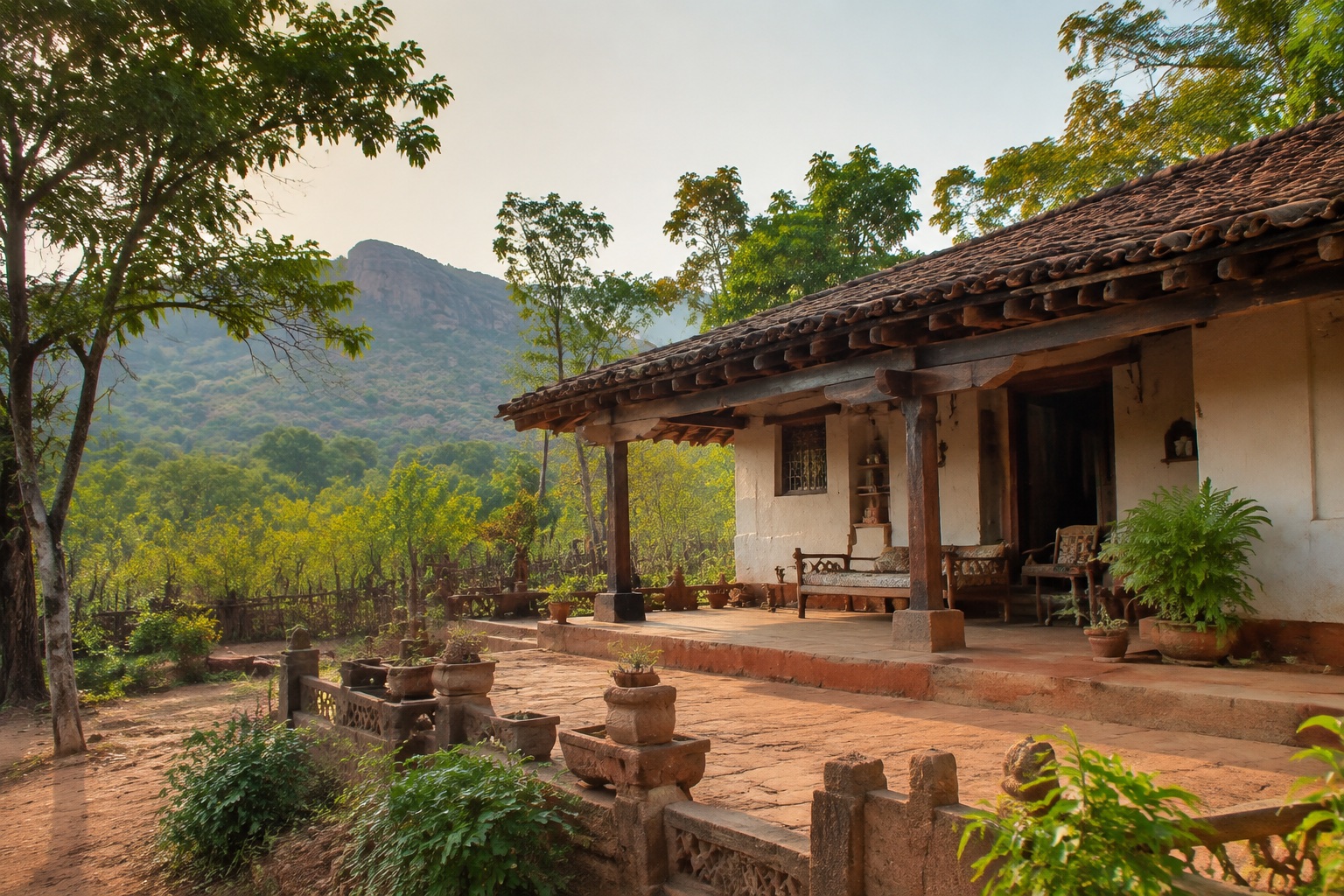
Before you choose the property
Start with the rules that actually shape the project.
CTB currently operates a public Homestay Registration form collecting manager, ownership, police-clearance, rooms, property facilities, tariffs and supporting-document information.
Current Government implementation material expressly permits up to nine rooms for a homestay unit.
That same State implementation material expressly describes homestay registration as lifetime and states no NOC requirement for homestay registration, subject to the scope conflicts documented above.
Scope: Source-checked regulatory and business-planning guidance. It does not approve a particular title, building, tax position, food activity or operating structure.
01 / Executive finding
The practical starting point
- Chhattisgarh currently operates a public Chhattisgarh Tourism Board (CTB) Homestay Registration form. It asks for the homestay category, an authorised manager, Aadhaar, address, ownership type, police-clearance status, room details, tariffs, ownership proof and other property information. [S1, portal fields]
- The Government of Chhattisgarh's current Invest Chhattisgarh/OneClick reform page makes three unusually clear current implementation statements: no NOC requirement for homestay registration; homestay registration for lifetime; and up to 9 rooms permitted for a homestay unit. These are strong current implementation statements but the underlying Tourism notification/order was not located, so they should not yet be presented as clause-level notified law. [S2, Tourism reform bullets]
- A current official definition establishing exactly who may be the applicant, whether the owner must ordinarily reside at the property, whether a resident family member is sufficient, or whether a non-resident owner may rely on a caretaker/operator was Not stated in the current official material reviewed. [S1; S2]
- The current CTB portal expressly asks for the “Name of Person Authorized to Manage” and separately requests a background note concerning the “Owner or Representative.” This supports the existence of a manager/representative role operationally, but it does not establish that a management company, LLP, lessee or caretaker may itself hold the tourism registration. [S1, portal fields]
- The present publicly verifiable capacity ceiling is up to 9 rooms. A current maximum bed/guest-capacity figure and any minimum-room requirement were Not stated in the material reviewed. The older scheme's 1–5 room/10-bed restriction therefore must not be carried into a 2026 public guide as current. [S2, Tourism reform bullets; S5, legacy scheme pp. 10, 17]
- CTB is the operative state tourism-registration body visible in the live process. Its published head-office route is 2nd Floor, Udyog Bhawan, Ring Road No. 1, Telibandha, Raipur, with telephone numbers +91-7714224600 / 18001026415 and the portal-listed email visitcg@gmail.com. A currently populated district-wise CTB contact directory was Not stated in the material reviewed. [S1, portal footer; S4]
- The live form does not display a fixed registration fee before a category is selected; instead it says that fee details will be shown after category selection. Because no application interaction, declaration or payment was undertaken, the current category-wise registration fee, inspection fee and renewal fee are Not stated in the current official material reviewed inspected here. [S1, fee field]
- The Invest Chhattisgarh statement that registration is for lifetime conflicts operationally with a live CTB Renewals page requiring a registration number and email. It is not clear whether the renewal facility exists only for legacy certificates or some current categories. The official sources are not aligned. [S2, Tourism reform bullet; S3, renewal page]
- An older government-hosted Homestay/B&B scheme contains materially different rules—among them 1–5 guest rooms/10 beds, old category-specific fees, local-authority/police documentation and fixed classification periods. Its repository metadata and content indicate an older/draft instrument. It is therefore treated only as LEGACY / Background source only, not the controlling 2026 source. [S5, pp. 9–14, 17–24]
- Tourism registration does not eliminate property-specific building, land, layout, fire, environmental or utility questions. Even the State's current business-reform page separately identifies need-based building/layout NOCs, fire processes and land/building procedures. [S2, Construction Permits]
- A Chhattisgarh homestay accommodating a foreign national or OCI holder is separately covered by the Immigration and Foreigners Rules, 2025: “accommodation” includes homestays; specified foreign-guest details must be electronically recorded and Form III information transmitted within 24 hours after arrival, with departure information within 24 hours after departure, and records maintained for at least one year. [S7, Rule 17, p. 28; Form III, p. 33]
- Where the operation is a food business, the current national FSSAI framework must be handled independently of tourism registration. From 1 April 2026, FSSAI's revised turnover bands are registration up to ₹1.5 crore, State licence above ₹1.5 crore up to ₹50 crore, and Central licence above ₹50 crore. Exact FoSCoS business classification for a particular homestay should be verified rather than inferred. [S9, paras 2–5]
- Central assistance for tribal-area homestays exists under the PM-JUGA/Swadesh Darshan sub-scheme, but the latest specific official approved-project list located, dated 5 February 2026, identified projects in Andhra Pradesh, Madhya Pradesh, Mizoram, Uttarakhand and Ladakh—not Chhattisgarh. A Chhattisgarh owner therefore must not be promised the central household grant as an open individual entitlement. [S13]
- Because the complete current State policy/notification, schedules, classification standard, fee schedule and subsidy procedure have not been reproduced from the issuing authority, there is not yet sufficient evidence for a source-audited public guide that states all Chhattisgarh homestay eligibility and incentive rules as settled.
02 / Document chronology
Use the current rules and implementation
Legacy instrument
The older Chhattisgarh Homestay/B&B document located through a government policy repository provides the most detailed historical set of definitions, forms, standards, fee tables and inspection arrangements. Among other things, it historically distinguished a homestay, where an owner-designated agent/operator could reside, from a B&B in which the owner/promoter resided with family; it applied old room/bed limits and classification periods. [S5, pp. 9–14] It must not be treated as the current 2026 rulebook because:
- the repository metadata describes an older/draft policy environment;
- current State implementation material permits up to 9 rooms rather than the old 1–5 rooms;
- current State material says registration is lifetime rather than the old fixed classification period;
- current State material states no NOC requirement for homestay registration;
- CTB's live application has itself changed materially.
July 2025 — central tribal-homestay framework
The Union Ministry of Tourism introduced the PM-JUGA/Swadesh Darshan tribal-area homestay sub-scheme. This is a funding/development programme, not Chhattisgarh's general tourism-registration law. [S13; S14]
2025 — current Chhattisgarh policy activity
Official Chhattisgarh communications refer to the State's homestay policy and implementation during 2025. [S15; S16] However, the actual current Gazette notification, policy order number, schedules and any amendments were Not stated in the material reviewed.
1 September 2025 — national foreigner-reporting regime replaced
MHA notified the Immigration and Foreigners Rules, 2025 through G.S.R. 596(E), effective on publication. The Rules expressly superseded, subject to savings, the Passport (Entry into India) Rules, 1950, Registration of Foreigners Rules, 1992 and Immigration (Carriers' Liability) Rules, 2007. [S7, Rule 1 and opening notification]
October 2025 versus January–February 2026 — policy-period inconsistency
One official State-publication index describes implementation of a 2025–30 Homestay Policy, while another later official-publication index describes a 2023–27 policy. [S18; S19] Because neither complete publication could be inspected sufficiently to establish whether one is a typographical/reference error, the conflict is not resolved here.
March–April 2026 — revised FSSAI regime
FSSAI notified amendments on 10 March 2026 and issued its implementation order on 13 March 2026. Revised turnover thresholds took effect on 1 April 2026, and the amendment framework introduced perpetual validity of FSSAI registration/licence subject to risk-based inspection. [S9, paras 2–5]
Current 2026 implementation
The live State reform page now states:
- no NOC for homestay registration;
- lifetime registration;
- up to nine rooms. [S2]
Supersession finding
Not stated in the current official material reviewed: an express current Tourism Department clause saying that the older Homestay/B&B Scheme is rescinded or superseded, identifying the exact replacement notification and effective date. Practical treatment: do not use the older scheme as current merely because it remains downloadable.
03 / Category definitions
Choose the right accommodation category
| Category | Location | Eligible owner/applicant | Residence requirement | Operator allowed | Capacity | Food position | Source |
|---|---|---|---|---|---|---|---|
| Homestay — current implementation | Exact geographic restriction Not stated in the material reviewed; live State portal is general | Not stated in the material reviewed in complete current policy | Not stated in the material reviewed | Portal asks for “Person Authorized to Manage”; legal eligibility of separate operator entity Not stated in the material reviewed | Up to 9 rooms in current State implementation material; bed ceiling Not stated in the material reviewed | Current CTB portal does not establish an FSSAI exemption | S1; S2 |
| Homestay — legacy definition | Historical scheme described statewide categories | Historical applicant defined as owner | Historical document contemplated owner-appointed resident agent/operator | Yes under legacy wording | Historical 1–5 rooms / 10 beds | Historical text contains food provisions that cannot be treated as current | S5, pp. 9–14 |
| Bed & Breakfast — current | Not stated in the material reviewed | Not stated in the material reviewed | Not stated in the material reviewed | Not stated in the material reviewed | Not stated in the material reviewed | Not stated in the material reviewed | No complete current B&B rule located |
| Bed & Breakfast — legacy | Historical scheme | Historical owner/promoter | Owner/promoter and family residence contemplated | Not established beyond legacy definition | Historical 1–5 rooms/10 beds | Legacy only | S5, pp. 9–10 |
| Hotel / Resort / Club | Separate CTB registration category | Current form separately contemplates proprietor/partner/director and organisational documents | No homestay-style residence position established | Corporate/organisational structure explicitly contemplated by separate form | Current limit Not stated in the material reviewed | Separate food/licence documentation appears in hotel form | S6 |
| Guest house | Not stated in the material reviewed | Not stated in the material reviewed | Not stated in the material reviewed | Not stated in the material reviewed | Not stated in the material reviewed | Not stated in the material reviewed | Current State definition not located |
| Motel | Not stated in the material reviewed | Not stated in the material reviewed | Not stated in the material reviewed | Not stated in the material reviewed | Not stated in the material reviewed | Not stated in the material reviewed | Current State definition not located |
| Farm stay | Not stated in the material reviewed | Not stated in the material reviewed | Not stated in the material reviewed | Not stated in the material reviewed | Not stated in the material reviewed | Not stated in the material reviewed | Current State definition not located |
| Serviced accommodation | Not stated in the material reviewed | Not stated in the material reviewed | Not stated in the material reviewed | Not stated in the material reviewed | Not stated in the material reviewed | Not stated in the material reviewed | Current State definition not located |
| PM-JUGA tribal-area homestay | Selected tribal-area clusters/projects | Scheme-specific beneficiary household/community through approved State project | Scheme-specific | Not a substitute for State registration eligibility | Central assistance contemplates construction of two new rooms per eligible household | Separate operating compliance remains | S13/S14 |
Material distinction
The fact that the current Hotel/Resort/Club form expressly asks about partners/directors/company documents while the Homestay form is organised principally around an owner/manager and ownership proof is relevant evidence—but does not itself prove that companies or LLPs are prohibited from holding homestay registration. [S1; S6]
04 / Eligibility decision tree
Check whether the applicant and property qualify
These are research classifications, not approval decisions.
Step 1 — Identify the exact property
Do you have the exact survey/property address and local-body category?
- No; only capital or an early idea exists → registration eligibility cannot yet be tested because the CTB application requires a complete postal address and ownership proof. Not established in the published material for a property-free registration route. [S1]
- Yes → continue.
Step 2 — Establish ownership/lease position
Can the proposed applicant produce the ownership evidence required by the live portal?
- Registered owner with documentary proof → continue.
- Joint/inherited title → acceptable form of co-owner authority/consent is Not stated in the material reviewed → Confirm this in writing with the authority.
- Lessee only → live portal has an “Ownership Type” dropdown but its permitted values were not publicly exposed in the retrieved page → Confirm this in writing with the authority.
- Company/LLP/operator with no title → Confirm this in writing with the authority.
Step 3 — Applicant identity and residence
Is the proposed holder an individual owner?
- Yes → continue.
- Company, LLP, partnership, trust or society → current Homestay policy support Not stated in the material reviewed → Confirm this in writing with the authority. Will the owner/family live there?
- Current mandatory residence rule Not stated in the material reviewed.
- If a separate manager/caretaker will reside instead, the current portal's manager field supports a management role but not the legal substitution of an operator for the eligible applicant → Confirm this in writing with the authority.
Step 4 — Room plan
- 1–9 proposed guest rooms → within the current published State implementation ceiling, subject to all other eligibility conditions. [S2]
- 10 or more proposed guest rooms → exceeds the current published homestay limit → does not appear to fit the published homestay definition / Consider another accommodation category.
- Bed capacity proposed but no room excess → current bed ceiling Not stated in the material reviewed → Confirm this in writing with the authority where capacity could materially affect classification.
Step 5 — Building status
Existing residential home with no major work → Check current registration eligibility, police clearance and local use requirements. If individual ownership, ≤9 rooms and truthful portal completion are otherwise possible: This appears to fit the published route, subject to the remaining checks, but current statutory definition still requires confirmation. Running unregistered homestay → Existing commercial operation does not cure registration or adjacent compliance. Confirm this in writing with the authority regarding regularisation/current category. Land only / proposed new construction → Owning land alone does not establish homestay eligibility. Building-plan/use approvals and current applicant eligibility must precede commercial commitments. Confirm this in writing with the authority. Existing building requiring expansion/change of use → Tourism registration does not establish building-law permission. Confirm this in writing with the authority.
05 / Applicant and operating structures
Set the ownership and operating structure
| Structure | Supported route | Principal obstacle | Source | Required clarification |
|---|---|---|---|---|
| Resident individual owner | Closest match to the owner-oriented current portal; can supply ownership proof and designate authorised manager | Current residence definition/requirement missing | S1 | Must owner/family actually occupy premises? |
| Joint or inherited ownership | Potentially workable if ownership proof accepted | Co-owner consent, succession papers and authorised applicant rules not published | S1 | Is consent/NOC/authority from every co-owner required? |
| Owner living elsewhere | Manager field exists | Current rule permitting non-resident owner not located | S1 | May authorised manager/caretaker satisfy residence/host requirement? |
| Owner with caretaker | Portal permits named authorised manager | Legal role of caretaker versus registration holder unclear | S1 | Must caretaker be employee, family member, resident or police-verified? |
| Long-term lessee | “Ownership Type” field may potentially accommodate more than one form, but values not exposed | Current lease eligibility not established | S1 | Is registered lease accepted? Minimum lease term? Owner consent? |
| Company | No current explicit support found in homestay form | Applicant eligibility not known | S1; contrast S6 | Can a company own/hold registration? If so, who executes declarations/Aadhaar field? |
| Partnership firm / LLP | No current explicit homestay-holder route located | Legal person versus owner-oriented form | S1; S6 | Can firm/LLP hold registration, or only provide management services? |
| Professional management company | A person can be named to manage | No evidence that a separate management company can replace eligible owner/holder | S1 | May registration holder contract operations entirely to another entity? |
| Capital-only participant | Can fund/search/develop under independently structured contracts | Cannot complete property-specific portal application without property/address/ownership file | S1 | Investment structure is separate from tourism eligibility |
| Landowner proposing new construction | Potential future route if property qualifies | Building approval + applicant eligibility + subsidy timing unknown | S1; S2 | Must tourism in-principle approval precede construction/incentive application? |
Critical structural finding
The portal distinguishes property/ownership, person authorised to manage, and owner/representative information. This is useful operational evidence. It is not sufficient evidence that the tourism-registration holder and the commercial operating entity may be unrelated legal persons. [S1]
06 / Property and classification standards
Prepare the property for inspection
| Topic | Mandatory / classification / guidance / unclear | Requirement | Applies when | Source | Confidence |
|---|---|---|---|---|---|
| Maximum guest rooms | Current implementation | Up to 9 rooms | Homestay unit | S2 | MEDIUM pending underlying notification |
| Minimum guest rooms | Unclear | Not stated in the material reviewed | All | — | LOW |
| Bed/guest maximum | Unclear | Not stated in the material reviewed | All | — | LOW |
| Total building rooms vs guest rooms | Unclear | Not stated in the material reviewed | Larger homes | — | LOW |
| Single bedrooms | Portal data field | Number and room size requested | If present | S1 | HIGH as portal requirement |
| Double bedrooms | Portal data field | Number and room size requested | If present | S1 | HIGH as portal requirement |
| Attached bathroom/toilet | Portal data field | Number of rooms with bathroom & toilet requested; current minimum standard not stated | Application | S1 | MEDIUM |
| Minimum bedroom size | Current rule Not stated in the material reviewed | Legacy figures must not be used as current | — | S5 legacy | LOW/currently unpublished |
| Minimum bathroom size | Current rule Not stated in the material reviewed | Legacy figure not current | — | S5 legacy | LOW |
| Kitchen | Current tourism standard Not stated in the material reviewed | Food service separately triggers food-safety analysis | When food offered | S9/S10 | HIGH for separate food regime |
| Lobby/lounge | Portal field | Area requested | Application | S1 | HIGH as portal field; necessity unclear |
| Dining area | Portal field | Area requested | Application | S1 | HIGH as portal field; necessity unclear |
| Road access | Portal field | Road width requested | Application | S1 | HIGH as field; minimum width not located |
| Parking | Portal field | Establishment/vicinity details requested | Application | S1 | HIGH as field; minimum spaces not located |
| Reception/front office | Current restriction Not stated in the material reviewed | Legacy scheme restricted commercial front-office style; not current | — | S5 legacy | LOW |
| Signage | Current requirement Not stated in the material reviewed | — | — | — | LOW |
| Airport/rail/bus/city distances | Portal fields | Applicant supplies distances | Application | S1 | HIGH |
| Hot water | Current standard Not stated in the material reviewed | Legacy requirement cannot be imported | — | S5 legacy | LOW |
| Electricity | Current homestay standard Not stated in the material reviewed | Utility connection remains separate | Property | S2 | MEDIUM |
| Backup power | Not stated in the material reviewed | — | — | — | LOW |
| Heating/cooling | Not stated in the material reviewed currently | Legacy category standards not current | — | S5 legacy | LOW |
| Internet | Not stated in the material reviewed currently | Legacy classification standard not current | — | S5 legacy | LOW |
| Fire equipment | Portal field | Fire fighting equipment/hydrants “if any” requested | Application | S1 | HIGH as field; legal minimum unclear |
| Fire NOC | State reform dependency | State construction system separately includes fire-NOC procedures; applicability depends building/risk | Relevant buildings | S2 | MEDIUM |
| Structural certificate | Not stated in the material reviewed as homestay document | May arise under building rules | Property-specific | — | LOW |
| Sanitation | Current detailed standard Not stated in the material reviewed | Local/food/building duties separate | Operation | — | LOW |
| Waste | Current detailed homestay rule Not stated in the material reviewed | Local regulations remain relevant | Operation | — | LOW |
| Guest safety | Detailed current classification checklist Not stated in the material reviewed | — | — | — | LOW |
| Accessibility | Homestay-specific current requirement Not stated in the material reviewed | General building/accessibility law must be checked according to property/use | Property-specific | — | LOW |
| Eco-friendly facilities | Portal field | Applicant may describe facilities | Application | S1 | HIGH as field, not shown mandatory |
| Classification grades | Current category values Not stated in the material reviewed in public rendering | Category selection is mandatory, but option values/criteria not exposed | Application | S1 | MEDIUM |
Legacy standard warning
The historical scheme contains detailed room sizes, bathroom sizes, utility and classification specifications. [S5, pp. 17–23] Those standards should remain out of the public 2026 rule table unless CTB confirms that they have been carried forward into the current policy.
07 / Documents and declarations
Assemble the application file
| Document / data | Who provides/signs | Format/stamp requirement | Validity period | When required | Source | Unresolved issue |
|---|---|---|---|---|---|---|
| Homestay name | Applicant | Online field | — | Application | S1 | — |
| Category | Applicant | Mandatory dropdown | — | Application | S1 | Current category values not exposed |
| Authorised manager name | Applicant | Mandatory field | — | Application | S1 | Manager eligibility/relationship not stated |
| Aadhaar | Applicant/current person represented by form | Mandatory field | Not stated in the material reviewed | Application | S1 | Whose Aadhaar where applicant is entity? |
| PAN | Applicant | Portal field; no star displayed | Not stated in the material reviewed | Application | S1 | Individual/entity PAN treatment unclear |
| NIDHI registration number | Applicant | Portal field; no star displayed | Not stated in the material reviewed | Application | S1 | Whether optional or conditionally mandatory |
| Complete postal address | Applicant | Mandatory online field | — | Application | S1 | — |
| Applicant | Mandatory | — | Application | S1 | — | |
| Website link | Applicant | Portal displays * | — | Application | S1 | Whether website is genuinely mandatory or UI configuration issue |
| Ownership type | Applicant | Mandatory dropdown | — | Application | S1 | Permitted values not publicly rendered |
| Ownership proof | Owner/applicant | PDF/Image, mandatory | Not stated in the material reviewed | Application | S1 | Accepted title/lease documents and co-owner treatment not stated |
| Police clearance obtained | Applicant | Mandatory select | Not stated in the material reviewed | Application | S1 | Authority/subject/recency not stated |
| Police-clearance document | Applicant | Upload field | Format not stated in retrieved interface | Not stated in the material reviewed | Application | Upload field did not show a mandatory asterisk in rendered page |
| Road width / plot / covered area | Applicant | Online data | — | Application | S1 | Supporting plan not publicly required |
| Parking details | Applicant | Online data | — | Application | S1 | Minimum parking rule not located |
| Room numbers/sizes | Applicant | Online fields | — | Application | S1 | Current minimum size criteria not located |
| Bathroom/toilet room count | Applicant | Online field | — | Application | S1 | Required ratio not located |
| Lobby/dining areas | Applicant | Online fields | — | Application | S1 | Whether mandatory not evident |
| Fire equipment | Applicant | Online description | — | Application | S1 | “if any” does not establish fire-law exemption |
| Tariffs | Applicant | INR fields | — | Application | S1 | Post-registration display/update duty not located |
| Owner/manager age/profession | Applicant | Online fields | — | Application | S1 | Mandatory status not marked |
| Family relationships | Applicant | Online field | — | Application | S1 | Whether residence eligibility turns on this is not stated |
| Owner/representative background | Applicant | Online narrative | — | Application | S1 | — |
| Truth declaration | Applicant | Portal declaration | At submission | Application | S1 | CTB reserves cancellation for discrepancy |
| Lok Seva Guarantee consent | Applicant | Portal declaration | At submission | Application | S1 | Stipulated service time not shown on public page |
| Affidavit | Not stated in the material reviewed CURRENTLY | — | — | — | S5 legacy only | Do not import old rule |
| Non-judicial stamp-paper undertaking | Not stated in the material reviewed CURRENTLY | — | — | — | S5 legacy only | Do not import old rule |
| Character certificate | Not stated in the material reviewed CURRENTLY | — | — | — | — | — |
| Co-owner consent/NOC | Not stated in the material reviewed CURRENTLY | — | — | — | — | — |
| Building-sanction plan | Not stated in the material reviewed as CTB upload | Local rules may separately require | — | Property-specific | S2 | — |
| Completion/occupancy certificate | Not stated in the material reviewed as CTB upload | Local rules may separately require | — | Property-specific | — | — |
| Site map/drawing | Not stated in the material reviewed CURRENTLY | — | — | — | — | — |
| Property photographs | Not stated in the material reviewed CURRENTLY | — | — | — | — | — |
The portal declaration allows CTB to cancel registration if information is discrepant. [S1, declaration]
Download the Chhattisgarh property and application checklist ↓
08 / Application and inspection process
Follow the application and inspection process
Current publicly reproducible sequence
| Step | Responsible person/authority | Input/document | Resulting record | Stated period | What does not happen automatically |
|---|---|---|---|---|---|
| 1. Property/category check | Applicant | Address, intended use, ≤9-room plan | Internal eligibility decision | None stated | Does not establish local building legality |
| 2. Open CTB Homestay Registration | Applicant / CTB | Public portal | Registration application form | None | No approval occurs merely by opening form |
| 3. Enter homestay/manager identity | Applicant | Name, category, authorised manager, Aadhaar/PAN/NIDHI data | Application data | None | Manager field does not itself authorise an entity operator |
| 4. Enter property data | Applicant | Address, ownership type, police status, road/areas/parking | Application data | None | Does not determine title or local land use |
| 5. Enter room/facility data | Applicant | Rooms/sizes/bathrooms/common area/fire facilities | Application data | None | Portal entry is not an engineering approval |
| 6. Enter tariffs and owner/manager details | Applicant | Tariffs/background/family relationships | Application data | None | Does not settle tax/FSSAI obligations |
| 7. Upload documents | Applicant | Ownership proof; police-clearance document field | Application file | None | Upload does not validate title or police clearance |
| 8. Category/fee stage | Applicant / portal | Category | Dynamic registration-fee information | No public period | Current amount could not be verified without form interaction |
| 9. Give declarations | Applicant | Truth declaration and Lok Seva consent | Submission declarations | Portal refers to a “stipulated time” but does not state it | Service-delay consent is not merits approval |
| 10. Submit | Applicant | Completed form | Application record expected | Not stated in the material reviewed | Submission/acknowledgment screen not inspected |
| 11. Document scrutiny/query | CTB | Submitted application | NOT PUBLICLY INSPECTED | Not stated in the material reviewed | Query/deficiency process not verified |
| 12. Inspection | CTB/authorised committee | Current checklist Not stated in the material reviewed | Inspection record | Not stated in the material reviewed | Legacy inspection committee cannot be assumed current |
| 13. Approval/refusal | CTB/competent authority | Application + any inspection | Certificate/refusal expected | Not stated in the material reviewed | Approval is not guaranteed |
| 14. Certificate download/display | Applicant/CTB | Approved application | Public workflow NOT INSPECTED | — | Download route not verified |
| 15. Renewal/legacy lookup | Applicant/CTB | Registration no. + email | Renewal checker | — | Applicability to lifetime registrations unclear |
[S1; S3]
Inspection
The old scheme described an inspection/classification committee and detailed checklist. Current CTB material inspected here did not reproduce that committee structure or checklist. Current inspecting authority, inspection checklist, advance-notice position, reinspection process and inspection fee: Not stated in the current official material reviewed.
Processing time
The current form merely obtains consent for an automatic complaint/appeal under Rule 6 of the Chhattisgarh Lok Seva Guarantee Rules, 2011 if the service is not delivered within the “stipulated time.” The actual stipulated number of days is not stated on the public form. [S1, declaration] It therefore cannot be presented as a guaranteed registration timeline.
09 / Fees, timelines, validity and renewal
Confirm fees, timing and certificate validity
| Item | Current verified position | Amount/period | Nature | Source | Confidence |
|---|---|---|---|---|---|
| Registration fee | Portal says fee depends on selected category | Not stated in the material reviewed | Portal-driven | S1 | MEDIUM |
| Classification fee | Not stated in the material reviewed | — | Unknown | — | LOW |
| Inspection fee | Not stated in the material reviewed | — | Unknown | — | LOW |
| Renewal fee | Not stated in the material reviewed | — | Unknown | — | LOW |
| Refund policy specific to application | Not stated in the material reviewed | — | Unknown | — | LOW |
| Current maximum rooms | Verified in current State reform implementation | 9 rooms | Implementation limit | S2 | MEDIUM |
| Registration validity | Current State page states lifetime | Lifetime | Implementation statement | S2 | MEDIUM |
| Renewal | Live CTB renewal lookup exists | Registration no. + email | Portal | S3 | HIGH that facility exists; LOW on who must use it |
| Application processing period | Public form refers to stipulated service time but does not state number | Not stated in the material reviewed | Likely service-standard dependent | S1 | LOW |
| Renewal window | Not stated in the material reviewed CURRENTLY | — | — | — | LOW |
| Legacy classification | Older scheme described fixed periods and renewal | NOT CURRENT | Legacy only | S5 | LOW/current use prohibited |
Legacy certificate treatment
The presence of a live renewal checker combined with a current “lifetime registration” statement strongly suggests that at least some earlier registration records may still require renewal or migration, but that explanation is an inference. Written CTB confirmation is required before telling a legacy certificate holder whether renewal remains mandatory. [S2; S3]
10 / Operating duties after registration
Run the registered homestay correctly
| Duty | Current position |
|---|---|
| Display tourism certificate | Not stated in the current official material reviewed |
| Display room rates | Tariffs are collected in the current application; post-registration display rule Not stated in the material reviewed. [S1] |
| Issue guest invoices | Homestay-specific current tourism rule Not stated in the material reviewed; general tax/accounting obligations remain separate |
| Maintain domestic guest ID copies | Current homestay-specific requirement Not stated in the material reviewed |
| Domestic guest register | Current State requirement Not stated in the material reviewed; legacy register provisions must not be assumed current |
| Record foreign guests | Mandatory under central immigration law, including homestays. [S7] |
| Foreign arrival reporting | Form III information electronically within 24 hours after arrival. [S7, Rule 17] |
| Foreign departure reporting | Departure particulars electronically within 24 hours after departure. [S7, Rule 17] |
| Foreign-record retention | At least one year. [S7, Rule 17] |
| Tourism monthly statistics | Not stated in the material reviewed CURRENTLY |
| Staff police verification | Current homestay-specific duty Not stated in the material reviewed |
| Owner/applicant police clearance | Current application explicitly asks whether obtained and provides document upload. [S1] |
| Complaint contact/display | Not stated in the material reviewed CURRENTLY |
| Incident reporting | Not stated in the material reviewed CURRENTLY |
| Food-safety compliance | Separate FSSAI/FoSCoS analysis where food business is carried on. [S9/S10] |
| GST | Separate turnover/supply/platform analysis; tourism registration does not determine liability. [S11] |
| Waste | Local/property-specific duties; current homestay rule Not stated in the material reviewed |
| Fire/safety maintenance | Property-specific law remains; detailed tourism standard Not stated in the material reviewed |
| Insurance | Mandatory tourism insurance requirement Not stated in the material reviewed |
| Maintenance of registration details | Current amendment procedure Not stated in the material reviewed |
| Renewal | Current State says lifetime, but live renewal function creates unresolved legacy/current overlap |
Foreign guests
Rule 17 of the Immigration and Foreigners Rules, 2025 specifically encompasses a “home stay” within accommodation. It requires the keeper to maintain prescribed details for foreign visitors including OCI cardholders, make records available to authorised officials, and electronically transmit prescribed information. [S7, Rule 17, p. 28] Form III captures premise details, passport/visa or OCI particulars, Indian contact information, arrival information and departure information. [S7, Form III, p. 33]
11 / Adjacent approvals and dependencies
Close the approvals outside Tourism
| Topic | What tourism registration resolves | What it does not resolve | Likely authority | Official source located | Property-specific question |
|---|---|---|---|---|---|
| Land title | Records tourism applicant's ownership proof | Marketable title, encumbrances, succession, co-owner rights | Registration/Revenue/local legal authorities | S1 | Who owns every relevant parcel/building right? |
| Land use/reassessment | Nothing conclusively | Reassessment/zoning/use eligibility | Revenue/local planning authority | S2 | Is accommodation use permitted at this survey/address? |
| Building plan | Nothing conclusively | Sanction, alteration approval, setbacks, occupancy | Municipal/local planning body | S2 | Is existing/proposed structure sanctioned for intended use? |
| Completion/occupancy | Nothing conclusively | Completion/occupancy legality | Local body | No homestay-specific source | Does existing building have required completion/occupancy record? |
| Fire | Portal records equipment information | Whether Fire NOC or other fire compliance is legally required | Fire/local building authority | S1; S2 | What fire-risk/building category applies? |
| Food | Tourism status only | FSSAI registration/licence | FSSAI/State Food Safety/FoSCoS | S9; S10 | Is food being supplied as an FBO and what Kind of Business applies? |
| Police | Portal requires police-clearance status | Scope/subject/validity of clearance | Police/CTB | S1 | Whose clearance—owner, manager, both? |
| Domestic guest records | Nothing verified | Any police/local requirements | Police/local authority | Not stated in the material reviewed | What current district instruction applies? |
| Foreign guests | Nothing | Rule 17/Form III reporting | MHA/Bureau of Immigration/FRRO | S7; S8 | Is operational Form III account configured before hosting foreigners? |
| Environment/pollution | Nothing | CTE/CTO or exemption where independently applicable | Chhattisgarh Environment Conservation Board/other regulators | S2 high-level | What activity/category/site restrictions apply? |
| Forest/wildlife | Nothing | Forest/wildlife/protected-area restrictions | Forest/Wildlife authorities | No address-specific source | Is site in/near protected or regulated land? |
| Heritage | Nothing | Protected-monument/heritage controls | ASI/State archaeology/local authority as applicable | Not stated in the material reviewed address-specifically | Is building/site notified/protected? |
| Water | Nothing | Source legality, connection/use classification | Local body/water authority | S2 only general utility reform | Is commercial/accommodation usage permitted? |
| Electricity | Nothing | Connection category/load/safety | Distribution utility | S2 | Does planned load/use require category change? |
| Property tax | Nothing | Property-use assessment | Municipality/local body | Not stated in the material reviewed | Will assessment change? |
| GST | Nothing | GST registration/rate/returns | GST authorities | S11 | Turnover, supply mix and platform structure? |
| Udyam | Nothing | MSME status | Ministry of MSME | S12 | Does operating entity qualify/want registration? |
| Shops/employment | Nothing | Employer/establishment duties | Labour Department | S2 gives general reform information | What entity employs staff and how many? |
Land/building reform caveat
Invest Chhattisgarh states that land-diversion permission has been removed in favour of land reassessment, that residential properties up to 500 sq m have a fast-track building-approval route, that layout/building approval is online, and that need-based NOCs can still apply. [S2, Construction Permits] None of those general reforms establishes that a specific homestay remains a “residential property” for every local-law purpose. That question must be addressed using the actual location and proposed use.
12 / Incentives, subsidy and funding
Evaluate incentives without assuming sanction
A. Current Chhattisgarh Homestay Policy assistance
| Item | Verified position |
|---|---|
| Official scheme name | State communications identify a Chhattisgarh Homestay Policy; exact current notification title/order Not stated in the material reviewed |
| Eligible applicant | Not stated in the material reviewed in inspectable current controlling source |
| Eligible locations | State implementation has emphasized rural/tribal/community tourism, but complete legal geographic eligibility Not stated in the material reviewed |
| Eligible expenditure | Not stated in the material reviewed |
| Capital assistance formula | Not stated in the material reviewed IN CURRENT CONTROLLING SOURCE |
| Interest subsidy | Detailed current formula/process Not stated in the material reviewed |
| Ceiling | Not stated in the material reviewed |
| Bank route | Not stated in the material reviewed |
| Application timing | Not stated in the material reviewed |
| Sanction authority | Not stated in the material reviewed |
| Open applications confirmed | NO |
| Automatic? | No basis exists to treat any benefit as automatic |
An official Janman issue indexed in government search material refers to individual financial amounts and labels the policy 2023–27, but another official publication describes a 2025–30 policy. Until the actual notified scheme and schedules are inspected, these figures should not be published as settled entitlement. [S18; S19]
B. PM-JUGA — Development of Homestays in Tribal Areas
Official Union-government material states the scheme aims to develop 1,000 homestays and contemplates assistance up to:
- ₹5 lakh for village/community requirements;
- ₹5 lakh per household for construction of two new rooms; and
- ₹3 lakh per household for renovation of existing rooms. [S13] However, this is not a walk-in cash grant automatically available to every tribal-area property owner. The programme operates through identified tourism-potential villages/clusters, State/UT proposals, DPRs, approval and fund availability. The latest specific approved-project list located, dated 5 February 2026, named Andhra Pradesh, Madhya Pradesh, Mizoram, Uttarakhand and Ladakh; Chhattisgarh was not named. [S13] Current Chhattisgarh individual applications confirmed open: NO / Not stated in the material reviewed.
C. MUDRA / institutional credit
Central-government tourism communications have referred to facilitating collateral-free institutional credit/MUDRA loans for homestays. [S13] However:
- a loan is not a subsidy;
- current bank underwriting criteria still apply;
- sanction is discretionary;
- a homestay applicant should not treat tourism eligibility as bank approval;
- a specific current Chhattisgarh homestay lending circular/product with guaranteed terms was Not stated in the material reviewed.
13 / Business implications
Translate the rules into a workable project
Before selecting or acquiring a property
The assessment file should establish, before commercial terms are proposed:
- exact property address, survey identifiers and local-body category;
- current title, co-ownership, inheritance and encumbrance position;
- whether the intended applicant owns the property or would rely on a lease/authority;
- intended registration holder;
- who will actually reside/manage/host at the property;
- proposed guest-room count, with the current 9-room ceiling;
- total existing building configuration;
- local building-use and alteration position;
- protected/forest/environmental context;
- water, electricity, sewage/waste and road access;
- whether food will be served;
- whether foreign guests will be accepted;
- whether the commercial model depends on a State or central incentive.
Before construction or renovation
A landowner should not construct nine rooms merely because the State implementation page says a homestay may have up to nine rooms. The development must independently satisfy building, land, structural, fire and other property-specific rules. Where incentive eligibility depends on expenditure being incurred after an application, approval, bank sanction or project selection, premature construction may jeopardise the benefit. Because the current Chhattisgarh incentive procedure was not located, this must be clarified before expenditure intended to qualify for assistance.
Registration holder versus operating entity
The live CTB form supports a distinction between the property/owner and a “Person Authorized to Manage.” [S1] It does not, on the evidence inspected, establish that:
- a company can become registration holder;
- an LLP can become registration holder;
- a lessee can become registration holder;
- the registration may be transferred wholesale to a professional operator; or
- the eligible owner may entirely cease any legally required residence/host role. A management agreement therefore cannot by itself cure an ineligible applicant or property.
Capital-only participant
A person starting with capital but no property can undertake:
- property search;
- diligence;
- commercial structuring;
- design feasibility;
- operating planning; and
- financing analysis. But a tourism application cannot presently be prepared truthfully to completion without a property because the CTB form requires an address, ownership type and ownership-proof upload. [S1]
Landowner
A landowner proposing a new build must first distinguish:
- landownership;
- building permission;
- tourism-category eligibility;
- operator eligibility; and
- incentive eligibility. They are different questions.
Running homestay
A running property should be audited against:
- existing tourism registration and its validity;
- whether it is a legacy certificate;
- current room count;
- ownership changes since registration;
- police-clearance file;
- foreign-guest reporting;
- food registration/licensing;
- local building/use status;
- tax/entity position.
Commercial planning
Commercial planning should include regulatory contingencies rather than assuming approval. At minimum:
- title/lease condition precedent;
- building/legal-use condition;
- tourism-category condition;
- operator-structure condition;
- current fee confirmation;
- current subsidy confirmation;
- FSSAI position;
- foreigner-reporting readiness;
- renewal/migration status for legacy properties. No fixed the project team ownership percentage, investment contribution, revenue share or income commitment follows from the tourism rules.
14 / Official-source conflicts
Resolve conflicting official instructions
Conflict 1 — maximum rooms
Source A: Current Invest Chhattisgarh/OneClick implementation page. Proposition: Homestay units are permitted up to 9 rooms. [S2] Source B: Older Chhattisgarh Homestay/B&B scheme copy. Proposition: Historical eligibility was 1–5 rooms / 10 beds. [S5, pp. 10, 17] Hierarchy/date assessment: S2 is substantially newer and is current State implementation material. S5 is legacy/draft material. No current notification expressly superseding S5 was retrieved. Status: The official sources are not aligned, although the current operational evidence favours the nine-room implementation limit. Affected properties: any proposed homestay with 6–9 rooms. Written answer required from: Chhattisgarh Tourism Board / Tourism Department, citing the current policy clause authorising nine rooms.
Conflict 2 — NOC versus police clearance/local approvals
Source A: S2 says “No NOC requirement for homestay registration.” Source B: The live CTB application still makes “Police Clearance Obtained” a mandatory selection and provides a Police Clearance Document upload. [S1] Source C: Legacy scheme required additional local/police documentation. [S5] Analysis: “No NOC requirement” may mean no separate departmental NOC as a tourism-registration prerequisite while police clearance remains a different requirement. That interpretation is plausible but not stated expressly. Status: The official sources are not aligned / SCOPE OF ‘NO NOC’ UNCLEAR. Affected properties: every new applicant, especially those relying on the reform page to omit local or police documentation. Written answer required from: CTB.
Conflict 3 — lifetime registration versus renewal
Source A: S2 says registration for lifetime. Source B: CTB currently maintains a live Renewals interface asking for registration number and email. [S3] Source C: Legacy scheme contemplated time-limited classification and renewal; its own historical materials also contain different historical periods. Analysis: The renewal interface may serve legacy certificates, but that limitation is not stated on the page. Status: The official sources are not aligned. Affected properties: all holders of older certificates and any new applicant relying on lifetime validity. Written answer required from: CTB: whether all registrations issued under the present policy are lifetime, and which certificate vintages still require renewal.
Conflict 4 — policy period
Source A: Official State publication index referring to Homestay Policy 2025–30. [S19] Source B: Later official State-publication index referring to Homestay Policy 2023–27. [S18] Analysis: Complete inspectable source text necessary to determine whether this is a publication error, separate instrument or amendment was unavailable. Status: The official sources are not aligned. Affected properties: principally applicants relying on incentive periods/application windows. Resolution: obtain current notified policy/order and any amendment from Tourism Department/e-Gazette.
Conflict 5 — historical food “licence” treatment versus present national FSSAI regime
The older State scheme contains historical language suggesting limited food/restaurant-licence treatment. The current national FSSAI system governs food businesses and has been materially amended in 2026. [S9] Hierarchy conclusion: the historical State tourism language must not be treated as a waiver of current national food-safety legislation. Status: hierarchy resolves the broad point; exact FoSCoS business classification still requires case-specific confirmation.
Internal legacy conflict — classification period
The legacy document historically referred in one place to a three-year classification period while a renewal form referred to a further two-year period. This inconsistency is an additional reason not to reuse old renewal text in the present guide.
16 / Source register
Official source register
| ID | Issuing body | Document or portal | Document/order number | Published | Effective | Language | Status/currentness | Official URL | Pages/sections reviewed | Notes |
|---|---|---|---|---|---|---|---|---|---|---|
| S1 | Chhattisgarh Tourism Board | Homestay Registration portal | Not stated | Not stated; accessed 05 Sep 2026 | Live | English | PORTAL — current | CTB Homestay Registration | Entire publicly rendered form | Key current application evidence. No submission made. |
| S2 | Department of Commerce & Industries, Government of Chhattisgarh | Invest Chhattisgarh — OneClick, “Tourism” reforms | Not stated | Current 2026 site | Current implementation | English/Hindi UI | IMPLEMENTATION — current | Invest Chhattisgarh OneClick | Tourism; Construction Permits; utilities; contact | Explicitly states no NOC, lifetime registration, maximum 9 rooms. |
| S3 | Chhattisgarh Tourism Board | Renewals | Not stated | Not stated; accessed 05 Sep 2026 | Live | English | PORTAL — current | CTB Renewals | Full public page | Requests registration number and email. |
| S4 | Chhattisgarh Tourism Board | Downloads/contact routes | Not stated | Current site | Live | English | CONTACT / PORTAL | CTB Downloads | Download categories/contact routes | Several underlying official-contact/download pages returned no populated data during review. |
| S5 | Government repository/NITI for States; document attributed to Chhattisgarh tourism framework | *Chhattisgarh State Homestay and Bed & Breakfast Establishment Scheme and Guidelines* | Exact notified order not established from copy | Legacy; repository metadata references older policy/draft | Not treated as current | English | Background source only / LEGACY | Legacy government-hosted PDF | Definitions, eligibility, fees, application, classification, operations, standards, forms | Filename GSSNAR000097.pdf; Material conflicts with 2026 implementation. |
| S6 | Chhattisgarh Tourism Board | Hotel Registration | Not stated | Live 2026 | Current portal | English | PORTAL — adjacent category | CTB Hotel Registration | Public application | Says Hotel/Resort/Club registration is currently not being accepted; application separately contemplates proprietor/partner/director documentation. |
| S7 | Ministry of Home Affairs, Government of India | *Immigration and Foreigners Rules, 2025* | G.S.R. 596(E); Gazette No. 552 | 01 Sep 2025 | 01 Sep 2025 | Hindi/English | PRIMARY / CENTRAL — current | MHA Immigration and Foreigners Rules 2025 | Rule 17; Form III; commencement/supersession | Official filename Immigration_and_Foreigners_Rules_2025_16092025.pdf; |
| S8 | Bureau of Immigration / Indian FRRO | Form C / Form III reporting portal | Portal | Current | Current | English | CENTRAL / PORTAL | Indian FRRO Form C portal | Public reporting information | Operational foreign-guest reporting route. |
| S9 | Food Safety and Standards Authority of India | Revised turnover-threshold order | F. No. RCD-01002/1/2021-Regulatory-FSSAI-Part(1) | 13 Mar 2026 | 01 Apr 2026 | English/Hindi | CENTRAL / CURRENT | FSSAI revised threshold order | pp. 1–4; paras 1–5 | Official filename includes Order dated 13thMarch2026_Revised Turnover threshold.pdf; |
| S10 | FSSAI | FoSCoS portal | Portal | Current | Current | English | CENTRAL / PORTAL | FoSCoS | Registration/licensing portal | Exact homestay Kind-of-Business selection not independently fixed by CTB material. |
| S11 | Central Board of Indirect Taxes & Customs | CGST Act — Section 22 and official GST material | CGST Act, 2017 | As amended/current portal | Current subject to amendments | English | CENTRAL | CBIC CGST Act | Section 22 and related liability framework | Tourism registration does not settle GST liability. |
| S12 | Ministry of MSME, Government of India | Udyam Registration portal | Portal | Current | Current | English/Hindi | CENTRAL / PORTAL | Official Udyam portal | Eligibility/current MSME limits | Voluntary/separate MSME framework; not a substitute for tourism registration. |
| S13 | Ministry of Tourism / Government of India / PIB | PM-JUGA tribal-area homestay implementation statements | Scheme under Swadesh Darshan | Guidelines July 2025; implementation releases through Feb 2026 | Current scheme subject to sanction/funds | English | CENTRAL / SCHEME | Official PM-JUGA homestay release | Assistance structure and implementation | Chhattisgarh not in latest specific approved-project list located as of 05 Feb 2026. |
| S14 | Ministry of Tourism, Government of India | *Development of Homestays in Tribal Areas* guidelines | PM-JUGA / Swadesh Darshan sub-scheme | Jul 2025 | Scheme-specific | English | CENTRAL / SCHEME; full PDF retrieval incomplete | Official guideline search result | Indexed 11-page guideline metadata plus official implementation releases | Full PDF could not be inspected end-to-end through the research interface; |
| S15 | Department of Public Relations, Government of Chhattisgarh | Official State communication referring to “Homestay Policy 2025” | Not stated | 2025 | Implementation communication | Hindi | IMPLEMENTATION | Official Chhattisgarh DPR item | Homestay-policy implementation reference | Confirms State policy activity, not clause-level eligibility. |
| S16 | Department of Public Relations, Government of Chhattisgarh | Jashpur community-tourism/homestay implementation item | Not stated | 14 Sep 2025 | Project-specific | Hindi | IMPLEMENTATION | Official Jashpur implementation item | Community homestay project | Demonstrates implementation in identified villages; not evidence that general registration is limited to them. |
| S17 | Revenue & Disaster Management Department, Government of Chhattisgarh | State e-Gazette route | Portal | Current | Current | Hindi/English interface | PRIMARY-SOURCE ROUTE / RETRIEVAL BLOCKED | Chhattisgarh Revenue Department Gazette route | Gazette-link route | e-Gazette endpoint did not yield the required current homestay notification through this research environment. |
| S18 | Government of Chhattisgarh, *Janman* | Jan–Feb 2026 issue — indexed homestay-policy description | Not established | Jan–Feb 2026 | Unclear | English | Background source only — full PDF not inspectable | Official Janman search result | Search-indexed passage only | Describes policy as “2023–27” and mentions financial benefits; not relied on for settled amounts. |
| S19 | Government of Chhattisgarh, *Janman* | Oct 2025 issue — indexed policy description | Not established | Oct 2025 | Unclear | English | Background source only — full PDF not inspectable | Official Janman search result | Search-indexed passage only | Describes implementation as “Chhattisgarh Homestay Policy 2025–30”; conflicts with S18 period label. |
Review and corrections
Keep the guide current.
Sources were checked on . Recheck the live application route before filing because portals and implementation instructions can change.
Send a correction with the relevant official source. Browse all states and Union territories.