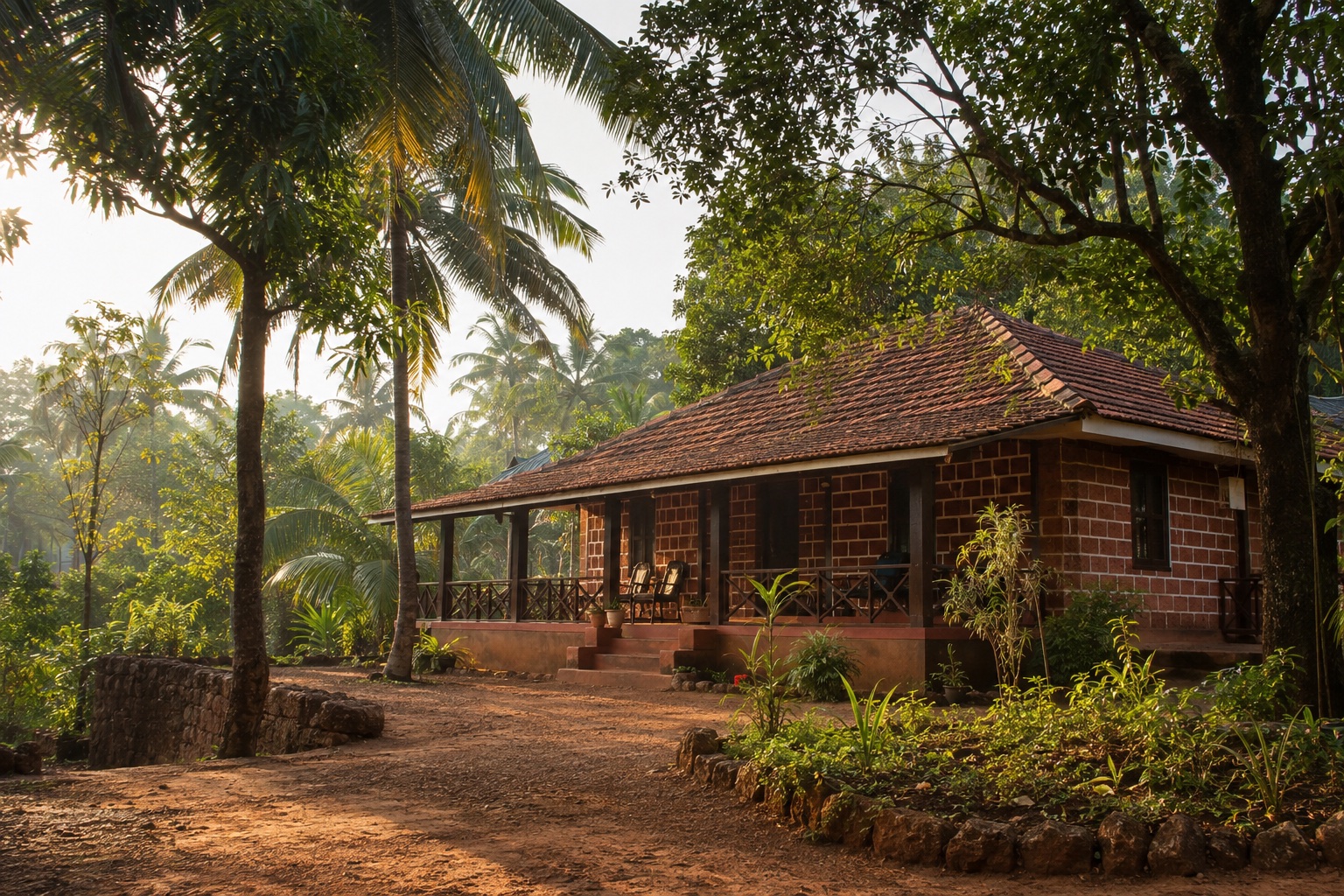
Before you choose the property
Start with the rules that actually shape the project.
The current Maharashtra Homestay definition is an owner-present/local-family accommodation model.
The current Homestay application fee is ₹2,500 through GRAS, with ownership proof, local-police character certificate, two neighbour NOCs, building permission/completion evidence and Mahabooking registration among the core mandatory documents.
Homestay registration is a separate current state service handled by the concerned Deputy Director, Directorate of Tourism, through a direct departmental portal route.
Scope: Source-checked regulatory and business-planning guidance. It does not approve a particular title, building, tax position, food activity or operating structure.
01 / Executive finding
The practical starting point
- Maharashtra presently treats Homestay as a distinct tourism-accommodation category under the Maharashtra Tourism Policy 2024, alongside B&B, Vacation Rental Homes, Tourist Apartments and other accommodation units. The current Directorate of Tourism website separately offers “Registration of Homestays under the Tourism Policy-2024,” while the February 2026 Citizen Charter identifies the concerned Deputy Director, Directorate of Tourism, as the service officer. [S1, §14.3, pp. 21–22; S3, registration menu; S4, p. 8, item 11]
- The current public Homestay application describes a Homestay as accommodation where tourists stay with a local family, generally in a private room in that family's home, and expressly says the homeowner is present. This is presently the strongest operational definition located. [S2, pp. 2–3]
- A Maharashtra domicile, permanent-resident certificate, minimum duration of state residence, or district-domicile condition for an ordinary Homestay applicant was Not stated in the current official material reviewed. This must not be confused with the separate AAI women-centred incentive, which does impose Maharashtra-residency conditions on that scheme's beneficiaries. [S2, pp. 0–9; S6, Guidelines]
- A current numeric minimum or maximum number of Homestay guest rooms, beds or guests was Not stated in the material reviewed. The original July 2024 Policy grouped “Homestays” with B&B/Vacation Rental Homes and stated a minimum of one lettable room; the current amended consolidated policy removed “Homestays” from that combined Annexure-C definition. The July 2025 Homestay application asks how many rooms are proposed but gives no numeric threshold. The old one-room rule should therefore not be republished as a settled current Homestay limit. [S1A, Annexure C, p. 116; S1, Annexure C, p. 62; S2, p. 0]
- The current form is specifically for an existing Homestay. It requires either construction permission or a construction-completion certificate, and the declaration states that construction is complete, the premises are habitable and the property complies with building, zoning and local-body requirements. No equivalent pre-construction Homestay-registration route was located. [S2, pp. 1, 4, 8]
- The verified state Homestay application fee is ₹2,500 through GRAS. Mandatory attachments marked in the form include Aadhaar, PAN, ownership proof, local-police character certificate, NOCs from two neighbouring residents, construction permission or completion certificate, GRAS challan, signed declaration/terms and a Mahabooking registration copy. [S2, p. 1]
- Mahabooking pre-registration is mandatory before the state Homestay application under the current terms. The resulting registration number must be put in the application; the operator is also instructed to take bookings through the portal and maintain digital guest records through its inventory system. [S2, pp. 4, 6–7]
- The operating terms additionally require NIDHI registration in the relevant accommodation category followed by Directorate data verification and display of the resulting Pledge certificate. A valid Green Leaf Rating registration must also be obtained and maintained. The exact Maharashtra procedure, timing, fee and competent committee for Green Leaf Rating were not located in the Homestay materials. [S2, pp. 5–7; S9, NIDHI+]
- The form recognises an “operator” operationally and includes business-entity options such as partnership, private company and LLP. Its declaration also contains owner/operator/tenant language. However, no current provision was located establishing that a company, LLP, tenant, caretaker or professional manager may replace the owner whose presence is part of the published Homestay definition. Registration-holder/operator separation therefore requires written Directorate clarification. [S2, pp. 0, 2–3, 7–8]
- The current official materials are not aligned on Vacation Homes: the amended Tourism Policy's Annexure C still combines B&B/Vacation Rental Homes around owner/family residence, whereas the July 2025 application defines a Vacation Home as an entire private residential property rented as one unit with no host participation. This matters directly to owners who will not reside at the property. [S1, Annexure C, p. 62; S2, pp. 2–3]
- No current Homestay-specific processing period, certificate-validity term, renewal window, renewal fee, inspection fee or formal appeal procedure was located. The 2026 Citizen Charter confirms the service and officer but does not provide a Homestay completion deadline. [S4, p. 8; S2, pp. 0–9]
- A Homestay that accommodates foreign nationals is independently subject to the Immigration and Foreigners Rules, 2025. Current Rule 17 requires the keeper of accommodation—including a Homestay—to submit Form III information within 24 hours of arrival and departure and preserve the electronic accommodation record for at least one year. The Maharashtra form's older “C-Form” wording predates those Rules. [S8, Rule 17, p. 27; S2, p. 4]
- Serving food creates a separate FSSAI/FoSCoS dependency. Tourism registration does not itself constitute a food-business licence or registration. The applicable FoSCoS Kind of Business must be chosen from the actual food operation rather than automatically treating every Homestay as a hotel or restaurant. [S7–S7A]
- Maharashtra Tourism Policy incentives can extend to Homestays, but they require separate registration/eligibility/sanction processes and contain material internal inconsistencies concerning the qualifying investment look-back and the expansion threshold. No subsidy, reimbursement or eligibility certificate should be represented as automatic. [S1, §§14.3–14.4, 29.5, Annexure C]
- There is sufficient current primary evidence to prepare a public guide provided that the unresolved room limits, entity/operator route, renewal/validity position, Vacation Home conflict, Green Leaf implementation and incentive conflicts remain visibly qualified rather than filled by inference.
02 / Document chronology
Use the current rules and implementation
- Pre-2024 framework. Maharashtra Tourism Policy 2024 itself refers to earlier Tourism Policies, including 2016, and contains transition rules for earlier incentive registrations. The 2016 framework was not relied upon to derive current Homestay requirements. [S1, §3]
- 18 July 2024 — Tourism Policy of Maharashtra 2024. The original GR introduced Homestays among eligible accommodation units. Its original Annexure C combined “Bed & Breakfast/Homestays/Vacation Rental Homes” and stated a minimum one lettable room. [S1A, Annexure C]
- Current consolidated amended file dated 17 June 2025. The Directorate now publishes
Final-Amended-policy-17.06.25.pdf. It retains Homestay as an eligible Category-2 accommodation but changes Annexure C so that the combined definition reads “Bed & Breakfast/Vacation Rental Homes,” omitting “Homestays.” A separate amending GR/corrigendum expressly documenting that deletion was Not stated in the current official material reviewed. [S1, §14.3; Annexure C] - July 2025 — standalone Homestay application package. This provides a separate definition and operating regime for Homestay, Tourist Villa, Vacation Home and Tourist Apartment. It requires the owner to be present for Homestay but establishes no numeric room threshold. [S2, pp. 2–7]
- 1 September 2025 — Immigration and Foreigners Rules, 2025. These superseded the Registration of Foreigners Rules, 1992 and replaced the state form's older C-Form terminology with the current Form III framework. [S8, Rule 17]
- 28 February 2026 — Tourism Citizen Charter. Confirms Homestay as a separate G2B/direct-portal service and the concerned Deputy Director, DoT, as nodal/service officer. B&B remains separately classified as a G2C service through the concerned MTDC Regional Manager. [S4, p. 8]
- 1 April 2026 — revised FoSCoS Kind-of-Business eligibility. This is relevant where the Homestay serves food and must be applied independently of tourism registration. [S7A]
- 24 June 2026/current — Directorate website/contact material. The current public site continues to list Homestay registration under Tourism Policy 2024 and separately lists B&B registration/renewal. [S3, S5] Supersession finding: the current amended policy and July 2025 application should be used for current Homestay analysis. The original July 2024 PDF remains useful only to expose document history; its old one-room Homestay wording should not be silently carried forward.
03 / Category definitions
Choose the right accommodation category
| Category | Location | Eligible owner/applicant | Residence requirement | Operator allowed | Capacity | Food position | Source |
|---|---|---|---|---|---|---|---|
| Homestay | Local residential settlements; comparison table also refers to residential settlements/agri-tourism contexts | Application offers individual/proprietorship, partnership, Pvt Ltd, LLP, public company, cooperative, trust, SHG, JFMC and “other”; how those entity options interact with the resident-owner definition is unresolved | Owner present; tourist stays with local family, normally in private room in their home | Operator role/signature recognised; whether operator may replace resident owner or be certificate holder is NOT ESTABLISHED | Numeric min/max rooms/beds Not stated in the material reviewed | Local food is described as expected; form asks whether breakfast/lunch/dinner can be supplied on request. FSSAI remains separate | [S2, pp. 0, 2–3, 6–8] |
| Bed & Breakfast | Not stated in the material reviewed in a current standalone scheme | Current standalone B&B scheme eligibility Not stated in the material reviewed | Current amended Annexure C says traveller resides with owner/family in their usual residence | Current standalone operator rule Not stated in the material reviewed | Current Annexure C says minimum 1 lettable room | Detailed current B&B food rule Not stated in the material reviewed | [S1, Annexure C p. 62; S4, p. 8] |
| Vacation Home / Vacation Rental Home | Attractions, natural areas, forest/agri-tourism contexts in S2 | S2 refers to private residential property used by owner or tenant | S2 says no host participation; whole property rented | Private operation implied; exact certificate-holder rule unresolved | Not stated in the material reviewed | Not stated in the material reviewed | [S2, pp. 2–3]. Conflict: S1's combined B&B/Vacation definition instead describes owner/family residence. |
| Tourist Villa | Natural/scenic/tourism contexts | Current entity-specific eligibility Not stated in the material reviewed beyond common application | No host participation in comparison table | Operator recognised by common terms | Not stated in the material reviewed | Chef service is an example of a high-end amenity, not a licence exemption | [S2, pp. 2–3] |
| Tourist Apartment | Larger residential/commercial buildings; S2 also describes rural/semi-urban context | Current common application; society NOC expressly required | Usually no host participation | S2 says privately managed | Studio or 1/2/3/4 BHK types described; numerical guest cap Not stated in the material reviewed | Not stated in the material reviewed | [S2, pp. 3, 5] |
| Agro Tourism Unit | Farm/rural/peri-urban setting | Relevant farm/agri applicant under Tourism Policy | Homestay residence condition not automatically imported | Separate Agri-Tourism registration service exists | Minimum land 1 acre and minimum 2 lettable units under Annexure C | Farm/local-food experience contemplated; FSSAI still separate where applicable | [S1, Annexure C pp. 61–62; S4, p. 8] |
| Eco Tourism Unit | Environmentally sensitive/nature-oriented tourism locations | Current policy-qualified tourism project | No Homestay owner-residence rule located | Not stated in the material reviewed | Current Annexure C requires minimum 2 lettable rooms with attached bathrooms for the defined unit | Separate food law applies if food is provided | [S1, Annexure C] |
| Hotel | No Homestay-specific location restriction | Hotel project | No owner-residence requirement | Professional operation inherent in category | Minimum 10 lettable rooms with attached bathrooms; central hotel-category standards referenced | Hotel/FSSAI rules are separate | [S1, Annexure C, Hotel definition] |
| Resort | Listed as eligible accommodation | Detailed current applicant rule Not stated in the material reviewed | Not stated in the material reviewed | Not stated in the material reviewed | Current detailed definition/threshold Not stated in the material reviewed IN REVIEWED SOURCES | Separate food law applies | [S1, §14.3] |
| Serviced Apartment / Apartment Hotel | Listed as Category-2 accommodation | Detailed current applicant rule Not stated in the material reviewed | Not stated in the material reviewed | Not stated in the material reviewed | Not stated in the material reviewed | Separate food law applies | [S1, §14.3] |
| Guest House | — | Not stated in the material reviewed AS A CURRENT MAHARASHTRA HOMESTAY-ADJACENT TOURISM REGISTRATION CATEGORY | — | — | — | — | Not stated in the material reviewed |
| Farm stay | — | No separate “Farm Stay” registration category was located; Agro Tourism is the relevant state category that must be examined | — | — | — | — | [S1, S4] |
The most important categorical distinction is therefore not the marketing description of a property but whether the resident owner is actually present. Whole-property/non-hosted inventory appears to be directed toward another accommodation category rather than the current Homestay definition.
04 / Eligibility decision tree
Check whether the applicant and property qualify
- Fix the exact address first.
- Identify district, municipal corporation/municipal council/Nagar Panchayat/Gram Panchayat or other local body, planning authority and whether the land is subject to CRZ, forest, eco-sensitive, heritage, cantonment or special-planning controls.
- If those facts are not known: Not established in the published material for property-level eligibility.
- Establish title and possession.
- If the applicant can provide current ownership evidence and there is no title dispute, proceed.
- If ownership is joint/inherited or disputed and the applicant cannot truthfully make S2's no-dispute declaration: Confirm this in writing with the authority.
- If only a lease exists: S2 contains tenant language but ownership proof remains mandatory; Confirm this in writing with the authority.
- Identify who the applicant will be.
- Resident individual owner: proceed.
- Company/LLP/firm/trust or professional manager: business categories exist in the form, but certificate-holder eligibility is not resolved; Confirm this in writing with the authority.
- Identify who will live at the property.
- Owner/local family will normally live in the home and guests occupy private room(s): This appears to fit the published route, subject to the remaining checks.
- Owner lives elsewhere and only caretaker/manager is present: does not appear to fit the published homestay definition unless DoT confirms otherwise.
- Entire property is to be rented without host participation: Consider another accommodation category; Vacation Home is the obvious published comparison category, but its official definitions conflict and therefore require written confirmation.
- Identify who operates the business.
- Owner operates it: supported.
- Owner remains resident but a professional operator handles distribution, housekeeping or guest operations: operator role is recognised, but certificate-holder/contracting split is not stated; Confirm this in writing with the authority before relying on the structure.
- Operator substitutes completely for absent owner: does not appear to fit the published homestay definition on present evidence.
- Set the room and bed plan.
- Current form asks number of proposed rooms and room areas.
- Current Homestay minimum/maximum room, bed and guest limits: Not established in the published material.
- Do not import the original 2024 one-room clause without written confirmation.
- Establish development status.
- Existing completed/habitable lawful building: proceed.
- Running Homestay: current application expressly asks present-use/start-year/tourist history; LIKELY FITS THE APPLICATION ROUTE, subject to definition and documents.
- Proposed new building or unfinished conversion: current Homestay application requires completed/habitable premises; Not established in the published material for pre-construction Homestay registration. Complete land/building approvals first. Incentive-related provisional eligibility is a separate process and is not Homestay approval.
- Verify building and local permissions.
- Construction permission or completion certificate available, lawful zoning/use and necessary NOCs obtainable: proceed.
- Otherwise: Confirm this in writing with the authority or This does not appear to fit the published route until cured.
- Prepare state application prerequisites.
- Mahabooking pre-registration, police character certificate, two neighbour NOCs, title evidence and mandatory documents available: proceed.
- Missing any mandatory starred item: This does not appear to fit the published route until supplied. Use these branches as a starting test and confirm the result for the exact property.
05 / Applicant and operating structures
Set the ownership and operating structure
| Structure | Supported route | Main obstacle | Source | Clarification required |
|---|---|---|---|---|
| Resident individual owner | Strongest match: owner-present local-family Homestay; title proof and personal documents supplied | Must satisfy property/building/NOC requirements | [S2, pp. 0–9] | Current numeric room/bed limits, validity and renewal |
| Joint/inherited ownership | Potentially possible if valid ownership proof can be supplied | S2 declaration says no ownership dispute; co-owner-consent rule not stated | [S2, pp. 1, 8] | Whether every co-owner must consent/sign and what inheritance records are accepted |
| Owner living elsewhere | No current Homestay route established | Published Homestay definition says owner present | [S2, pp. 2–3] | Whether any limited absence/caretaker arrangement is accepted; otherwise alternative category |
| Owner + caretaker | Caretaker can potentially assist operations, but no substitution right located | “Owner present” remains categorical feature; staff/caretaker verification rules not located | [S2, pp. 2–3, 6–7] | Whether full-time owner presence is required and whether caretaker can be designated operator |
| Long-term lessee | S2 declaration contains tenant language | Mandatory ownership proof and owner-present definition create ambiguity | [S2, pp. 1, 8] | Can lessee be applicant/certificate holder? Required lease term, owner NOC and residence arrangement |
| Company / partnership / LLP | These entity types are selectable in the application and business PAN/registration may be supplied | No clause explains how a juridical person satisfies “homeowner present” | [S2, p. 0] | Whether entity is applicant, operator, contracting party or certificate holder; whose residence satisfies definition |
| Professional operator / management company | S2 expressly provides owner and operator roles/signatures and allocates duties to both | No source proves certificate may be held by manager rather than resident owner | [S2, pp. 6–8] | Permitted management agreement; identity of registration holder; liability allocation |
| Capital-only participant, no property selected | No Homestay application possible yet | Application requires particular completed property, address, title/building evidence and Mahabooking registration | [S2, pp. 0–1, 8] | Select and diligence property before determining structure |
| Landowner proposing new construction | Development may proceed through planning/building regime; Tourism Policy incentive PEC may be considered separately | Current Homestay form declares construction completed/habitable | [S1, incentive provisions; S2, p. 8] | Land use, building approval, future Homestay limits; do not treat PEC as Homestay approval |
| Running Homestay | Current “existing Homestay” application directly accommodates running properties and asks start year/tourist counts | Must regularise missing approvals/docs and satisfy current operating conditions | [S2, p. 0] | Incentive expansion threshold conflict if applying for revamp/addition |
06 / Property and classification standards
Prepare the property for inspection
| Topic | Mandatory / classification / guidance / unclear | Requirement | Applies when | Source | Confidence |
|---|---|---|---|---|---|
| Homestay model | Mandatory definitional feature | Tourist stays with local family, ordinarily in private room; homeowner present | Homestay | [S2, pp. 2–3] | HIGH |
| Guest-room count | Unclear | Number must be declared | Application | [S2, p. 0] | HIGH for disclosure; LOW for limit |
| Minimum guest rooms | Unclear | Not stated in the current official material reviewed | Homestay | S1/S2 comparison | LOW |
| Maximum guest rooms | Unclear | Not stated in the material reviewed | Homestay | — | LOW |
| Beds / guest capacity | Unclear | Not stated in the material reviewed | Homestay | — | LOW |
| Total building rooms vs guest rooms | Unclear | Certificate-specific additional guest rooms require permissions; no total-building formula located | Changes/additions | [S2, p. 5] | MEDIUM |
| Room area | Portal/form declaration | Each proposed room's area in sq ft must be supplied | Application | [S2, p. 0] | HIGH |
| Numeric room-size minimum | Unclear | Not stated in the material reviewed | Homestay | — | LOW |
| Attached toilet | Portal/form declaration | Yes/no for each room | Application | [S2, p. 0] | HIGH as field; LOW as universal prerequisite |
| Bathroom/toilet standard | Mandatory qualitative | Guest rooms, toilets and bathrooms must be clean; hygiene maintained | Operations | [S2, pp. 4, 6] | HIGH |
| Kitchen | Portal field + hygiene obligation if present | Kitchen yes/no disclosed; kitchens used for guests must be hygienic | Food operation | [S2, pp. 1, 6] | HIGH |
| Dining hall | Portal/form declaration | Yes/no | Application | [S2, p. 1] | HIGH as field |
| Common areas | Mandatory qualitative | High cleanliness/hygiene | Operations | [S2, p. 6] | HIGH |
| Ventilation | Mandatory qualitative | Guest rooms and adjacent areas must be ventilated | Operations | [S2, p. 6] | HIGH |
| Access road | Portal/form declaration | Whether an access road exists must be disclosed; no width standard located | Application | [S2, p. 0] | HIGH as field |
| Parking | Portal/form declaration | Yes/no only; universal minimum Not stated in the material reviewed | Application | [S2, p. 1] | HIGH as field |
| Reception | Unclear | Specific reception requirement/restriction Not stated in the material reviewed | Homestay | — | LOW |
| Signage | Mandatory in limited respects | DoT certificate, Mahabooking certificate, NIDHI Pledge and emergency contacts must be displayed as applicable | Operations | [S2, pp. 4–7] | HIGH |
| Maharashtra Tourism logo | Conditional | May be used for publicity after prior intimation to divisional office | If using logo | [S2, p. 4] | HIGH |
| Electricity | Mandatory operational declaration | Electricity facilities declared available and functional; detailed tariff/back-up standard not stated | Application/operations | [S2, p. 8] | HIGH qualitative |
| Water | Mandatory operational declaration | Water supply available and functional | Application/operations | [S2, p. 8] | HIGH |
| Filter/RO | Portal field | Yes/no | Application | [S2, p. 1] | HIGH as field |
| Hot water | Unclear | Not stated in the material reviewed | Homestay | — | LOW |
| Power backup | Unclear | Not stated in the material reviewed | Homestay | — | LOW |
| Heating/cooling | Unclear | Not stated in the material reviewed | Homestay | — | LOW |
| Internet/Wi-Fi | Portal field | Wi-Fi yes/no; no universal requirement located | Application | [S2, p. 1] | HIGH as field |
| Fire safety | Mandatory qualitative | Owner/operator responsible for safety measures such as fire-safety equipment; declaration asserts fire/electrical safety | Operations | [S2, pp. 6, 8] | HIGH qualitative |
| Universal fire NOC | Unclear/local dependency | Not stated in the material reviewed as a universal Homestay attachment | Depends building/use/local law | [S2] | LOW |
| CCTV | Safety example | Listed among safety measures to implement/maintain | Operations | [S2, p. 6] | MEDIUM; wording is illustrative |
| Safe locker | Safety example | Listed among safety measures | Operations | [S2, p. 6] | MEDIUM |
| First aid | Mandatory | Stocked/easily accessible first-aid kit, replenished periodically | Operations | [S2, p. 6] | HIGH |
| Emergency contacts | Mandatory | Police, ambulance, fire and nearby medical contacts prominently displayed | Operations | [S2, p. 6] | HIGH |
| Swimming pool | Conditional | Relevant permissions required; applicant/owner assumes responsibility for incidents | If pool exists | [S2, p. 4] | HIGH |
| Solid waste | Mandatory | Solid-waste management required | Operations | [S2, p. 5] | HIGH |
| Sewage | Mandatory | Sewage/wastewater management required | Operations | [S2, p. 5] | HIGH |
| Water conservation | Operating sustainability obligation | Environment-friendly measures include water conservation | Operations | [S2, pp. 6–7] | HIGH |
| Renewable/solar | Sustainability wording + form field | Solar/biogas disclosed; environmental measures encouraged/required in general wording | Operations | [S2, pp. 1, 6] | MEDIUM |
| Plastic | Mandatory prohibition in form terms | Plastic bags, bottles and similar plastic items stated prohibited | Operations | [S2, p. 5] | HIGH |
| Noise | Mandatory | Comply with noise-pollution rules and avoid disturbance | Operations | [S2, pp. 5, 7] | HIGH |
| Structural soundness | Mandatory declaration | Applicant declares property structurally sound and safety-compliant | Application | [S2, p. 8] | HIGH |
| Accessibility | Policy-level objective; Homestay standard not located | No Homestay-specific dimensional/accessibility checklist located | Homestay | [S1] | LOW |
| Star classification | Future policy mechanism | Policy states DoT “shall develop” a 1–5 star method for categories including Homestays | Future/if notified | [S1, §26, p. 24] | MEDIUM |
| Current Homestay star checklist | Unclear | Not stated in the material reviewed | — | — | LOW |
| Green Leaf Rating | Mandatory in current form | Valid Green Leaf Rating registration must be obtained and maintained | Operations | [S2, pp. 6–7] | HIGH obligation; LOW implementation detail |
| Green Leaf rating mechanics | Unclear | State/district procedure, fee, timing, rating threshold Not stated in the material reviewed | Homestay | [S12] | LOW |
07 / Documents and declarations
Assemble the application file
| Document | Who provides/signs | Format/stamp requirement | Validity period | When required | Source | Unresolved issue |
|---|---|---|---|---|---|---|
| Aadhaar | Applicant | Copy; form marks mandatory | Not stated | Application | [S2, p. 1] | Authentication method behind portal not inspected |
| Applicant PAN | Applicant | Copy; mandatory | Not stated | Application | [S2, p. 1] | — |
| Business PAN | Business, if applicable | Copy | Not stated | Application | [S2, p. 1] | — |
| Udyog Aadhaar certificate | Applicant/business if applicable | Copy | Not stated | Application | [S2, p. 1] | Current national system is Udyam; whether Udyam certificate replaces this wording should be confirmed |
| Business registration | Entity, if applicable | CIN/Shops registration/other accepted examples | Not stated | Application | [S2, p. 1] | No blanket entity-registration rule for individual owner |
| Ownership proof | Owner/applicant | 7/12 extract, property-tax receipt, property card or other ownership evidence listed | Not stated | Mandatory application attachment | [S2, pp. 0–1] | Treatment of lessee/joint owner unresolved |
| Address evidence | Applicant/property | Electricity bill/water bill/other | Not stated | Application fields | [S2, p. 0] | — |
| Google Maps/geolocation | Applicant | Location entry/link | Current | Application field | [S2, p. 0] | Exact portal format not inspected |
| Property/room photographs | Applicant | Minimum 5 photographs | Current images implied; no age rule | Application | [S2, p. 1] | File format/size Not stated in the material reviewed |
| Local police character certificate | Applicant | Certificate from local police station | Validity Not stated in the material reviewed | Mandatory | [S2, pp. 1, 5] | Exact police format and age of certificate not specified |
| Two neighbouring-resident NOCs | Two neighbouring residents | NOC; form does not prescribe stamp paper | Validity Not stated in the material reviewed | Mandatory | [S2, p. 1] | Who qualifies as “neighbouring resident” not defined |
| Construction permission or completion certificate | Competent local/building authority | Copy | Not stated | Mandatory | [S2, pp. 1, 4] | Older buildings lacking either document need written local/DoT clarification |
| GRAS challan | Applicant | Proof of ₹2,500 fee payment | Application-specific | Application | [S2, p. 1] | Refund treatment Not stated in the material reviewed |
| Signed declaration | Applicant | Signed current form | Application-specific | Mandatory | [S2, pp. 8–9] | Whether e-sign accepted in portal not inspected |
| Signed terms and conditions | Applicant | Signed | Application-specific | Mandatory | [S2, pp. 4–7] | — |
| Owner/operator signatures | Owner and operator where applicable | Form signatures | Application-specific | Operating-duty declaration | [S2, pp. 7–8] | Legal status of operator unresolved |
| Mahabooking registration copy | Applicant | Portal-generated copy/certificate | Current | Before Homestay application | [S2, pp. 1, 4] | Full Mahabooking T&C not audited here |
| NIDHI registration/Pledge | Owner/operator | NIDHI registration; Pledge downloaded after DoT data verification | Current | Post/parallel registration obligation | [S2, p. 5] | Exact sequencing relative to DoT certificate needs clarification |
| Green Leaf Rating | Establishment | Valid registration/rating | Must remain valid | Operations | [S2, pp. 6–7] | Maharashtra application mechanism Not stated in the material reviewed |
| FSSAI/FoSCoS certificate/licence | FBO | FoSCoS | Depends licence/registration | If food business | [S7, S7A] | Correct Kind of Business depends actual operation |
| Foreign-guest Form III records | Keeper of accommodation | Electronic reporting | Accommodation records ≥1 year | If foreigner/OCI stays | [S8, Rule 17] | State form still says C-Form/passport copy |
Affidavit/stamp-paper finding for ordinary Homestay: a general Homestay affidavit on specified stamp paper was Not stated in the material reviewed in S2. Do not import the AAI scheme's ₹100 notarised women-owned-business affidavit into ordinary Homestay registration.
Download the Maharashtra property and application checklist ↓
08 / Application and inspection process
Follow the application and inspection process
| Step | Responsible person/authority | Input/document | Resulting record | Stated time period | What does not happen automatically |
|---|---|---|---|---|---|
| 1. Address and category screening | Owner/adviser | Address, local-body category, title, proposed operation | Internal eligibility decision | None | Tourism category does not establish land/building permission |
| 2. Confirm completed property | Owner/local authority | Construction permission or completion certificate; lawful building status | Building evidence | None | State Homestay form is not a building regularisation process |
| 3. Establish resident-host model | Owner | Actual residence/operating facts | Category choice | None | Company/manager cannot be assumed to cure absent resident owner |
| 4. Obtain local documents | Applicant | Ownership proof, police character certificate, two neighbour NOCs and any relevant departmental NOCs | Supporting file | None | DoT does not obtain them automatically |
| 5. Pre-register on Mahabooking | Applicant/operator | Property/business data | Registration number/copy | Not stated in the material reviewed | Homestay application is not complete merely by Mahabooking registration |
| 6. Prepare public Homestay form | Applicant | Identity, business, property, room, facilities, food/payment and history fields | Application package | None | Facility disclosure does not itself prove compliance |
| 7. Pay application fee | Applicant | ₹2,500 through GRAS | GRAS challan | None | Payment does not guarantee acceptance/approval/refund |
| 8. Submit through DoT/direct portal route | Applicant | Completed application + attachments | Submitted service/application | Homestay-specific service period Not stated in the material reviewed | Submission is not approval |
| 9. Document scrutiny/query | Concerned Deputy Director/DoT | Submitted file | Query/acceptance/status | Not stated in the material reviewed | Authenticated query workflow not publicly inspected |
| 10. Inspection | DoT officers | Property and declarations | Inspection findings | Not stated in the material reviewed | No public Homestay inspection checklist or guaranteed inspection date located |
| 11. Decision | Concerned DoT authority | Application/inspection | Certificate or adverse decision | Not stated in the material reviewed | No guaranteed approval period |
| 12. Certificate display | Owner/operator | DoT certificate | Displayed registration | After issue | Certificate does not replace adjacent approvals |
| 13. NIDHI/Pledge | Applicant + DoT verification | NIDHI accommodation registration/data verification | Pledge certificate | Not stated in the material reviewed | NIDHI alone does not constitute Maharashtra registration |
| 14. Mahabooking operations | Owner/operator | Inventory/bookings/guest data | Digital booking/guest records | Continuous | Registration does not relieve other record/reporting duties |
| 15. Green Leaf | Owner/operator + relevant implementing machinery | Rating registration | Valid Green Leaf status | Not stated in the material reviewed | Procedure not established in Homestay form |
| 16. Change notification | Registration holder/operator | Major structural, ownership or operating change | Notice to authority | “Timely”/prompt; no fixed days stated | Change is not automatically approved |
| 17. Complaint/compliance action | Concerned Deputy Director | Complaint/inquiry/inspection | Possible cancellation | Not stated in the material reviewed | Complaint itself is not stated to equal cancellation; inquiry/guilt provisions apply |
The Directorate expressly retains inspection authority, but a current Homestay-specific inspection checklist was Not stated in the current official material reviewed. [S2, p. 9]
09 / Fees, timelines, validity and renewal
Confirm fees, timing and certificate validity
| Item | Verified amount/period | Nature | Source | Status |
|---|---|---|---|---|
| Homestay application fee | ₹2,500 | State application fee via GRAS | [S2, p. 1] | HIGH |
| Classification fee | Not stated in the material reviewed | — | — | Unresolved |
| Inspection fee | Not stated in the material reviewed | — | — | Unresolved |
| Renewal fee | Not stated in the material reviewed | — | — | Unresolved |
| Refund of ₹2,500 on refusal/withdrawal | Not stated in the material reviewed | — | — | Unresolved |
| Homestay processing period | Not stated in the material reviewed | No statutory/administrative Homestay-specific target located | [S4, p. 8] | Unresolved |
| Registration validity | Not stated in the material reviewed | — | [S2/S4] | Unresolved |
| Renewal window | Not stated in the material reviewed | — | [S2/S4] | Unresolved |
| Renewal process | Not stated in the material reviewed | B&B has a separate renewal service; this cannot be imported into Homestay | [S3/S4] | Unresolved |
| Non-operation | More than 1 continuous year after registration | Form declares registration automatically cancelled | [S2, p. 9] | HIGH |
| Major property/ownership/operating change | “Timely” notification | Notification duty | [S2, p. 9] | HIGH duty; exact period absent |
| Incentive EC application after operations | Within 180 days of operations | Incentive process, not Homestay-registration deadline | [S1, incentive provisions] | HIGH |
| Provisional Eligibility Certificate — ordinary incentive unit | Up to 5 years, with possible 1-year extension in stated conditions | Incentive certificate only | [S1, incentive provisions] | Must never be represented as Homestay certificate validity |
| PEC — mega/ultra project | Up to 7 years | Incentive certificate only | [S1] | Not Homestay registration validity |
Legacy certificates: no current official table explaining how pre-2024 Homestay certificates migrate, renew or convert was located. Tourism Policy transition provisions concern policy/incentive eligibility and should not be presented as a Homestay-certificate renewal rule.
10 / Operating duties after registration
Run the registered homestay correctly
Certificate and platform duties
- Display the Directorate of Tourism certificate prominently. [S2, p. 4]
- Maintain Mahabooking registration, display its certificate and take bookings through the platform under the published terms. [S2, pp. 4–7]
- Register in the corresponding NIDHI accommodation category; after DoT data verification and receipt of access, download and display the Pledge certificate. [S2, p. 5]
- Obtain and maintain valid Green Leaf Rating registration. [S2, pp. 6–7]
Guest records and identity
- Keep accurate guest records digitally.
- Record identity details according to applicable rules.
- Use the Mahabooking inventory-management system for these records. [S2, p. 6]
- A general domestic-guest record-retention period was Not stated in the material reviewed.
Foreign guests
Current central Rule 17 applies to every keeper of accommodation and expressly encompasses a Homestay/rented accommodation. The operator must:
- collect prescribed arrival/departure particulars and signatures for foreign guests including OCI cardholders;
- preserve the electronic record for at least one year;
- send Form III information within 24 hours after arrival; and
- send departure information within 24 hours after departure. [S8, Rule 17, p. 27] The Maharashtra July 2025 application still refers to “C-Form” and retaining a passport copy. Because it predates the September 2025 central Rules, the current public guide should use Form III (Earlier Form C) terminology while noting the state's additional passport-copy wording until DoT updates it. [S2, p. 4; S8]
Safety and sanitation
Owner/operator duties include:
- safe environment for resident guests;
- safety measures including fire equipment and other appropriate systems;
- room, toilet, kitchen and common-area hygiene;
- ventilated guest accommodation;
- maintained first-aid kit;
- displayed police/ambulance/fire/medical emergency contacts;
- solid and sewage-waste management;
- environmental measures;
- noise-control compliance;
- avoiding disturbance to neighbours; and
- compliance with applicable state/central laws. [S2, pp. 5–7]
Food
Providing food is not immunised by Homestay registration. An establishment carrying on a food business must determine its FSSAI/FoSCoS registration/licensing category from its actual operation. [S7, S7A]
Rates, invoices and complaints
- Mandatory room-rate display rule specific to the current Maharashtra Homestay form: Not stated in the current official material reviewed.
- Homestay-specific invoice format: Not stated in the material reviewed.
- A complaint can lead to inquiry and, where the establishment is found at fault, cancellation by the concerned Deputy Director. [S2, p. 5]
- General departmental grievance escalation is available through the Tourism Department/Directorate; it should not be described as the applicant's statutory appeal unless a separate appeal provision is located.
Tourism statistics
A standalone monthly/quarterly Homestay statistics return was Not stated in the material reviewed. Digital guest/booking records through Mahabooking are required, but this should not be converted into an invented monthly filing schedule.
Staff
- A general minimum staffing rule: Not stated in the material reviewed.
- General local-employment quota: Not stated in the material reviewed.
- Staff/caretaker police-verification requirement under the Homestay form: Not stated in the material reviewed.
- Applicant's own local-police character certificate is mandatory.
- Separate incentive schemes may impose staffing conditions.
11 / Adjacent approvals and dependencies
Close the approvals outside Tourism
| Topic | What tourism registration resolves | What it does not resolve | Likely authority | Official source located | Property-specific question |
|---|---|---|---|---|---|
| Land/building use | Recognises property as registered tourism accommodation if approved | Title, zoning, NA/use status, sanctioned use, development-control compliance | Local planning/local body/revenue authority as applicable | S2 requires legality and building documentation | Is tourism accommodation permissible at this survey/CTS/property address? |
| Construction | Requires construction permission or completion certificate | Does not regularise unauthorised work | Local building/planning authority | S2 | Which certificate is valid for this building and age? |
| Occupancy | Tourism form requires completed/habitable premises | No general OC waiver located | Local authority | S2 | Is OC required/available, or is another completion record legally equivalent? |
| Fire | Requires safety and fire/electrical compliance | Universal Fire NOC for every Homestay not established | Local fire service/competent authority | S2 | Does size, height, occupancy/use trigger NOC? |
| Food | Nothing | FSSAI registration/licence | FSSAI/FoSCoS/state food authority | S7/S7A | What Kind of Business applies to the actual meal model? |
| Police | Requires applicant character certificate | Staff/caretaker verification and local guest-report rules not resolved | Local police | S2 | What format/validity does local police issue? |
| Foreign guests | Nothing beyond state terms | Form III compliance | Bureau of Immigration/FRRO | S8/S8A | Register accommodation user before accepting foreign guests |
| GST | Nothing | GST liability/registration, invoicing and returns | GST authorities | S10 | Entity, turnover, place/supply/e-commerce facts |
| Udyam | Nothing | MSME status | Ministry of MSME | S11 | Is Udyam commercially useful, and will DoT accept it for legacy “Udyog Aadhaar” field? |
| Business registration | Allows entity information where applicable | Incorporation/Shops/other entity-law obligations | MCA/local labour/business authority | S2 | Who is actual operator/employer/contracting party? |
| Water | Requires operational water supply | Source permission, commercial tariff, borewell/groundwater issues | Utility/local/groundwater authority | S2 | What water source and tariff class applies? |
| Electricity | Requires operational electricity | Tariff classification/sanctioned load | Distribution licensee | S2/S1 | Does any tourism-policy concession apply to this exact unit? |
| Property tax | Nothing | Assessment/use classification/concession | Municipality/local body | No general Homestay concession located | Does accommodation use alter assessment? |
| Solid waste/sewage | Imposes operator duty | Municipal consent, septic/sewer requirements | Local body/pollution authorities as applicable | S2 | Is the proposed system permitted and sufficient? |
| Environment | Requires broad environmental compliance | CRZ/forest/ESZ/wildlife/pollution consents | MCZMA/MPCB/Forest/Wildlife/other authority as applicable | S1/S2 | Does parcel intersect a regulated zone? |
| Coastal areas | Nothing | CRZ permission | MCZMA/competent authority | Homestay-specific exemption not located | Obtain CRZ map/status before acquisition/construction |
| Forest/ESZ | Nothing | Forest/wildlife/ESZ restrictions | Forest/Wildlife authorities | Homestay exemption not located | Is parcel within/near protected area or notified ESZ? |
| Heritage/archaeology | Nothing | Protected monument/heritage controls | ASI/state archaeology/local heritage authority | Specific Homestay waiver not located | Is building/site notified or within regulated influence zone? |
| Noise | Requires compliance | Event/amplified-sound permission | Police/local authority/pollution authority | S2 | Will events/music be part of operation? |
| Swimming pool | Requires applicant to obtain applicable permissions | Pool construction/health/safety approvals | Local authority/other competent authorities | S2 | Which pool permissions are triggered? |
| Insurance | Nothing | Insurance protection | Insurer | No mandatory Homestay insurance rule located | Public liability/property/business interruption should be evaluated commercially |
Tourism Policy and non-agricultural/development-charge language
The Tourism Policy contains broad non-fiscal benefit language concerning NA tax/permissions and development charges for eligible tourism projects. That policy language must not be treated as a self-executing building or land-use approval. S2 simultaneously requires compliance with construction, zoning and local-body law and relevant NOCs. No address-specific implementation order relieving an ordinary Homestay of those local checks was located. [S1, non-fiscal incentives, pp. 42–43; S2, pp. 4, 8]
12 / Incentives, subsidy and funding
Evaluate incentives without assuming sanction
14.1 Maharashtra Tourism Policy 2024 — fiscal incentives
Programme: Maharashtra Tourism Policy 2024 incentives for eligible tourism units. Homestay eligibility: Homestays are expressly included among Category-2 accommodation/tourism units eligible under the Policy. All eligible units must register with DoT/MoT and use the Directorate booking platform when available. [S1, §14.3] Geographic zones:
- Zone A: Municipal Corporations in Mumbai Metropolitan Region.
- Zone B: Municipal Corporations of Nashik, Pune, Chhatrapati Sambhajinagar and Nagpur.
- Zone C: rest of Maharashtra.
- STZ/STD: Specially Declared Tourism Zone/District, requiring the relevant declaration. [S1, p. 28] Verified capital-incentive rates under the current amended table:
| Zone | Ordinary/MSME threshold band | Capital incentive rate | Mega band | Ultra band | Source |
|---|---|---|---|---|---|
| A | Below/up to ₹300 crore category | 20% | ₹300–500 crore: 25% | ₹500 crore+: 30% | [S1, p. 31] |
| B | Below/up to ₹200 crore category | 25% | ₹200–300 crore: 30% | ₹300 crore+: 35% | [S1, p. 31] |
| C | Below/up to ₹125 crore category | 30% | ₹125–200 crore: 35% | ₹200 crore+: 40% | [S1, p. 31] |
| STZ/STD | Below/up to ₹50 crore category | 30% | ₹50–100 crore: 35% | ₹100 crore+: 40% | [S1, p. 31] |
For Category-2 resident-stay tourism units, the Policy states an overall capital-incentive cap of ₹40 crore, together with SGST treatment according to region/investment conditions. [S1, pp. 30–31] These ceilings are policy maxima, not amounts automatically payable to a Homestay. Other current fiscal incentives for non-mega units:
| Benefit | Zone A | Zone B | Zone C | STZ/STD | Source |
|---|---|---|---|---|---|
| Eligibility period | 5 years | 7 years | 10 years | 10 years | [S1, p. 33] |
| SGST reimbursement | 50% of net paid | 75% | 90% | 90% | [S1, p. 33] |
| Electricity-duty exemption | 50% | 75% | 100% | 100% | [S1, p. 33] |
| Stamp duty & registration charges | 50% | 75% | 100% | 100% | [S1, p. 33] |
| Mortgage stamp-duty reimbursement | 100% | 100% | 100% | 100% | [S1, p. 33] |
Quality-certification reimbursement is stated at 50%, capped at ₹2 lakh for national certification or ₹10 lakh for international certification, subject to the Policy's conditions. [S1, p. 33] Eligible capital expenditure located:
- structures/buildings;
- machinery;
- MEP;
- fixtures and furniture;
- internal roads/fences/signage/toilets/basic project infrastructure;
- waste-treatment systems;
- generators/renewable-energy/utilities. [S1, §§29.5.1–29.5.2, pp. 41–42] Excluded from eligible capital investment for capital incentive include:
- land cost, subject to separate policy/tax wording;
- intangible assets;
- expenditure covered by grants/other financial assistance;
- pre-construction/consultancy expenditure as specified;
- capitalised interest; and
- working capital. [S1, pp. 41–42] A leased building can count within eligible-capital-investment rules only where the Policy's lease conditions are met; the current provision uses a minimum 15-year building lease for the specified incentive calculation. This is an incentive rule, not evidence that a 15-year lessee may hold a Homestay registration. [S1, pp. 41–42] Sanction route:
- Obtain/apply for provisional tourism/incentive registration as required.
- For a new/expansion project seeking capital incentive, obtain the required Prior Eligibility Certificate during construction/expansion.
- Commence operations.
- Apply for eligibility certificate within the stated 180-day post-operation window.
- Directorate verifies eligibility; Final Eligibility Certificate/payment processes follow.
- Capital incentive is payable in the Policy's specified instalment mechanism after commercial operation and sanction.
- Performance-linked claims require documentary evidence such as GST/CA/bank material where applicable. The Policy expressly makes clear that a Provisional Eligibility Certificate does not automatically entitle an applicant to incentives. [S1, pp. 34–36] Current-application status: Tourism Policy 2024 and its incentive application links remain present on the current official Directorate site. Individual eligibility, budget availability, sanction and reimbursement nevertheless require separate approval.
14.2 Material incentive conflicts
Two contradictions exist inside the current consolidated policy:
- Investment look-back
- Source A: notes around the incentive section refer to investment made during the preceding 5 years for other projects and 7 years for mega/ultra projects.
- Source B: §29.5.2 states only capital investment made during the last 4 years from commercial operation qualifies.
- The official sources are not aligned.
- Expansion threshold
- Source A: the incentive notes refer to existing-unit expansion of at least 20%, including room/land/built-up measures.
- Source B: §29.5.3/Annexure C uses an expansion threshold above 50%.
- The official sources are not aligned. A running Homestay planning revamp/additional rooms should not model an incentive until DoT confirms the controlling thresholds in writing.
14.3 Existing registered Homestays
The Policy expressly contemplates existing operating registered Homestays/clusters receiving incentives for revamping/standards improvement and addition of rooms, subject to applicable eligibility conditions. [S1, p. 34] Because of the 20%/50% expansion conflict, eligibility should be treated as case-specific and separately sanctioned.
14.4 AAI Women-Centred Tourism Policy — interest reimbursement
Eligible activity: Homestay/B&B is among tourism businesses covered. Applicant: woman entrepreneur meeting the AAI Policy's Maharashtra residency and women-owned/operated business conditions. Route:
- Apply to concerned Regional Deputy Director, Directorate of Tourism.
- Submit identity/business documents.
- Submit notarised affidavit on ₹100 stamp paper declaring women ownership.
- Submit PAN, bank details, project concept and other prescribed documents.
- Food business: FDA/FSSAI-related licence required as applicable.
- GST number if required.
- Pay ₹50 GRAS application fee.
- Obtain the Directorate's eligibility/Letter-of-Intent stage.
- Apply independently to an authorised bank for loan sanction.
- Interest reimbursement is then processed subject to scheme/bank/repayment requirements. [S6] Verified assistance: tourism loan up to ₹15 lakh; interest reimbursement within the scheme limit of 12%, ₹4.50 lakh, or 7 years, as provided in the guideline ceiling structure. The bank is not required to sanction a loan merely because the Directorate accepts an AAI application. The benefit is not automatic and requires ongoing compliance/repayment. The AAI portal remained operational with registrations/approvals/claim reporting in 2026; this supports current scheme administration but does not establish funding availability for every applicant.
14.5 Best Homestay awards
Tourism Policy 2024 provides awards stated as:
- district: ₹25,000;
- divisional: ₹50,000;
- state: ₹1,00,000. [S1, awards provisions] These are competitive awards, not a property-development subsidy and not guaranteed.
14.6 Training support
The Policy contains hospitality training reimbursements including:
- reimbursement of 75% of training fee up to ₹12,000 in the stated employee-training category; and
- another specified training category capped at ₹12,500 subject to course/duration/beneficiary conditions. [S1, training provisions] Current Homestay-specific application opening and claim SOP for these training benefits was Not stated in the material reviewed.
14.7 Eco/sustainability certification support
The Policy provides sustainability/certification incentives in specified cases, including reimbursement provisions for qualifying eco-tourism/sustainability certification. Whether a particular ordinary Homestay qualifies under each sub-scheme must be confirmed from the application/SOP; the headline benefit should not be treated as universal Homestay entitlement.
14.8 Agri-tourism utility treatment
The Policy contains a domestic-electricity-rate provision for Homestays within agri-tourism industries/units. It must not be presented as a universal domestic-tariff entitlement for every Maharashtra Homestay. [S1, pp. 42–43]
13 / Business implications
Translate the rules into a workable project
Before selecting or acquiring property
the project team should establish, for each candidate:
- exact cadastral/property address and local body;
- title/encumbrance/co-owner position;
- current sanctioned land/building use;
- construction/completion/occupancy documentation;
- planning-authority status;
- CRZ/forest/ESZ/heritage/flood/other overlays;
- whether the proposed resident-owner arrangement actually satisfies the Homestay definition;
- proposed number of rooms/beds and whether DoT has confirmed current limits;
- whether an alternative category is more appropriate;
- whether food will be served;
- intended entity, employer, contracting and management structure; and
- whether incentives are commercially material enough to justify separate eligibility work. Capital alone does not create a Homestay-registration route. The current application requires a particular completed property and specific applicant/property records.
Before construction or renovation
Do not design the development around an assumed Homestay room count because a current numeric Homestay limit was not located. Separately confirm:
- planning and sanctioned use;
- setbacks/FAR/FSI and parking;
- building permission;
- fire triggers;
- sewage/waste;
- water/electricity;
- access;
- protected-zone restrictions;
- whether additional rooms require amended approval; and
- whether an incentive PEC must be obtained before expenditure/construction stages relevant to a proposed incentive. Tourism-policy incentive registration does not replace architectural or planning approval.
Registration holder versus operating entity
The sources demonstrate that an operator can exist and can share operational duties with the owner. They do not establish that the registration holder and operating company may always be different legal persons. Therefore a management company may potentially provide:
- booking/distribution administration;
- housekeeping supervision;
- staffing;
- guest communications;
- food coordination;
- records;
- maintenance; and
- compliance administration, but that operational role alone does not prove it can hold the Homestay certificate.
LLP or management agreement
An LLP, company or management agreement cannot by itself cure:
- absent resident owner;
- disputed title;
- unauthorised construction;
- missing neighbour NOCs;
- missing police certificate;
- incorrect accommodation category;
- FSSAI non-compliance;
- foreigner-reporting non-compliance; or
- local planning/environment restrictions.
Commercial planning file
A property-assessment model should separately record:
- title owner;
- proposed registration holder;
- resident host;
- operator;
- employer;
- guest contracting party;
- food-business operator;
- property lessor/lessee;
- investor;
- tax/GST position;
- all permits;
- unresolved DoT questions;
- non-contingent development cost;
- incentive-eligible cost separately from total project cost; and
- incentive assumptions as zero until separately sanctioned for conservative planning.
Questions to answer before the project team proposes business terms
At minimum:
- Who owns the property?
- Who will actually live there?
- Is that individual required to remain resident?
- Who is permitted to be the certificate holder?
- Can a company/LLP be applicant?
- Can the owner appoint a professional operator?
- Does a lessee qualify?
- How many guest rooms/beds will DoT accept?
- Is the building already legally capable of the intended tourism use?
- Which local approvals are outstanding?
- Is food part of the model?
- Will foreign guests be accepted?
- What operating entity will receive guest revenue?
- Is any incentive being assumed?
- If so, has the correct PEC/eligibility sequence been completed?
- What happens to the Homestay certificate if ownership, lease, operator or room inventory changes? No fixed equity percentage, capital contribution or income commitment can responsibly be derived from the regulatory material.
Read the Nashik city guide ↗ — Owner-present house and distinct pilgrimage/vineyard journeys.
14 / Official-source conflicts
Resolve conflicting official instructions
Conflict 1 — old Homestay minimum-room definition
Source A: original 18 July 2024 Tourism Policy, Annexure C. Proposition: “Bed & Breakfast/Homestays/Vacation Rental Homes” share a resident-owner/family model and a minimum one lettable room. [S1A, Annexure C p. 116] Source B: current amended consolidated policy dated by filename 17 June 2025. Proposition: Annexure C now reads “Bed & Breakfast/Vacation Rental Homes”; Homestay is omitted from that definition while remaining separately listed as an eligible tourism category. [S1, §14.3 and Annexure C] Source C: July 2025 standalone Homestay application. Proposition: defines Homestay separately around local family/owner presence but sets no numeric room minimum. [S2, pp. 0, 2–3] Hierarchy/date assessment: S1 and S2 are later current materials; old S1A wording should not be applied automatically. Unresolved point: the separate amendment GR/corrigendum expressly showing the legal authority for the deletion was not located. Practical effect: do not publish “minimum one room” as the current Maharashtra Homestay rule. Affected properties: every Homestay, especially single-room or high-room-count proposals. Resolution office: Tourism-4, Tourism & Cultural Affairs Department and concerned Deputy Director, DoT. Status: DOCUMENT HISTORY INCOMPLETE — CURRENT NUMERIC HOMESTAY LIMIT Not stated in the material reviewed.
Conflict 2 — Vacation Home definition
Source A: current amended Tourism Policy Annexure C. Proposition: B&B/Vacation Rental Homes use an owner/family usual-residence model. Source B: July 2025 current registration application. Proposition: Vacation Home is a whole private residential property let as one unit, and the comparison table indicates no host participation. [S2, pp. 2–3] No express amendment or hierarchy rule resolving these propositions was located. Affected properties: whole-home rentals, second homes, owner-absent accommodation and properties unsuitable for an owner-present Homestay. Resolution office: concerned Deputy Director and Tourism-4. Status: The official sources are not aligned.
Conflict 3 — entity/tenant/operator route
Source A: S2 Homestay definition requires homeowner presence. Source B: S2 application lets the applicant select partnership, Pvt Ltd, LLP, public company, cooperative, trust, SHG, JFMC and other business forms. Source C: S2 declarations/signatures recognise owner/operator and contain tenant/holder/administrator wording. [S2, pp. 0, 6–8] The documents do not explain whether those entities can independently hold the Homestay certificate or merely constitute the business/operator surrounding a resident owner. Affected properties: professionally managed properties, lease structures, institutional ownership and company/LLP projects. Resolution office: concerned Deputy Director, with Tourism-4 where policy interpretation is required. Status: Confirm this in writing with the authority.
Conflict 4 — foreign-guest reporting terminology
Source A: July 2025 Maharashtra application says C-Form and refers to passport-copy retention. [S2, p. 4] Source B: Immigration and Foreigners Rules, 2025, notified 1 September 2025, require current Form III, include OCI cardholders and prescribe 24-hour arrival/departure reporting plus one-year electronic retention. [S8, Rule 17] Hierarchy/date: later central statutory rules control the national immigration-reporting obligation. Practical treatment: describe the current process as Form III (Earlier Form C) and separately note that Maharashtra's form still instructs passport-copy retention. Status: RESOLVED BY LATER CENTRAL LAW; STATE FORM TERMINOLOGY IS STALE.
Conflict 5 — Tourism Citizen Charter regional contacts
The February 2026 Citizen Charter's regional table contains apparent email/region pairings that do not consistently match the Directorate's current contact page. The Directorate contact page reviewed 24 June 2026 presents region-specific addresses, emails and telephone numbers consistently. [S5] Practical treatment: use the later current Directorate contact page and confirm routing by phone/email where necessary. Status: OFFICIAL CONTACT SOURCES NOT FULLY ALIGNED.
Conflict 6 — eligible-capital-investment look-back
Source A: current Policy incentive notes refer to qualifying investment periods of 5 years for other projects and 7 years for mega/ultra projects in the relevant context. Source B: current §29.5.2 says capital investment made during the last 4 years from commercial operation qualifies. Same current consolidated instrument; no corrigendum resolving it was located. Affected properties: every project claiming capital investment over a multi-year construction/renovation period. Status: The official sources are not aligned.
Conflict 7 — expansion threshold
Source A: current Policy incentive notes use 20% expansion language. Source B: §29.5.3/Annexure C use an expansion level exceeding 50%. Affected properties: running registered Homestays adding rooms or undertaking major revamp. Status: The official sources are not aligned.
16 / Source register
Official source register
| ID | Issuing body | Document or portal | Document/order number | Published | Effective | Language | Status/currentness | Official URL | Pages/sections reviewed | Notes |
|---|---|---|---|---|---|---|---|---|---|---|
| S1 | Government of Maharashtra, Tourism Department | *Tourism Policy of Maharashtra 2024* — current amended consolidated copy; filename Final-Amended-policy-17.06.25.pdf | Base GR No. TDS-2022/09/CR 542/Tourism-4 | Base GR: 18 Jul 2024; consolidated filename dated 17 Jun 2025 | From publication; policy states 10 years or until new/amended policy | English | PRIMARY — CURRENT CONSOLIDATED | Current amended Maharashtra Tourism Policy 2024 PDF | §§3, 14, 26, 29; pp. 21–43; Annexure C pp. 61–65 | Separate GR/order formally making the June 2025 amendments was Not stated in the material reviewed. |
| S1A | Government of Maharashtra, Tourism Department | Original Tourism Policy 2024 PDF | GR No. TDS-2022/09/CR 542/Tourism-4 | 18 Jul 2024 | 18 Jul 2024 | English | PRIMARY — LEGACY VERSION USED FOR CHRONOLOGY ONLY | Original July 2024 Tourism Policy PDF | Annexure C, especially original p. 116 | Contains Homestay in combined B&B/Homestay/Vacation definition; current consolidated copy differs. |
| S2 | Directorate of Tourism, Maharashtra | homestay.pdf — application for registration of existing Homestay | Formal order number Not stated in the material reviewed | Uploaded Jul 2025 | Current public application | Marathi | FORM / IMPLEMENTATION — CURRENT | Current Maharashtra Homestay application PDF | Entire document, pp. 0–9 | Principal operational evidence. |
| S3 | Directorate of Tourism, Maharashtra | Official website and registration menu | N/A | Continuously updated | Current | English/Marathi | PORTAL — CURRENT | Directorate of Tourism Maharashtra | Registration menu and Tourism Policy section | Separately lists Homestay and B&B services. |
| S3A | Directorate of Tourism, Maharashtra | 100-days programme/report; Mahabooking implementation material | N/A | 2025 | Current implementation evidence | Marathi/English | IMPLEMENTATION | Maharashtra Tourism official site | Mahabooking implementation references | Mahabooking identified as Department booking platform. |
| S4 | Tourism & Cultural Affairs Department, Government of Maharashtra | Citizen Charter | GR No. TDS-2026/01/CR 17/Tourism-1 | 28 Feb 2026 | Until revised | Marathi with English service-table terms | PRIMARY / IMPLEMENTATION — CURRENT | Tourism Citizen Charter PDF | Entire charter; pp. 7–10 particularly | Homestay = G2B Gateway service, direct portal, concerned Dy. Director. |
| S5 | Directorate of Tourism, Maharashtra | Contact page | N/A | Current page reviewed 24 Jun 2026 | Current | English | CONTACT — CURRENT | Maharashtra Tourism contacts | Head office and all regional offices | Preferred over inconsistent contact mapping in Charter. |
| S6 | Directorate of Tourism, Maharashtra | AAI Women-Centred Tourism Policy application guidelines; AAI-Policy.pdf | Scheme guidelines | Current portal copy | Current scheme | English | SCHEME / IMPLEMENTATION — CURRENT | AAI Policy guidelines PDF | Application instructions, purpose, assistance, eligibility | Includes Homestay/B&B. |
| S6A | Directorate of Tourism, Maharashtra | AAI Tourism portal | N/A | Live; 2026 reports located | Current | English/Marathi | PORTAL — CURRENT | AAI Tourism portal | Registration, certificate/report areas | Evidence that scheme administration remains operational. |
| S7 | Food Safety and Standards Authority of India | Licensing/registration information | FSS Act, 2006, §31 and regulations | Updated 6 Aug 2026 | Current | English | CENTRAL — CURRENT | FSSAI registration page | FBO licensing/registration requirement | Older turnover wording on this page should not override revised FoSCoS eligibility document. |
| S7A | FSSAI / FoSCoS | Revised_2ndApril2026KindofBusinessEligibility.pdf | N/A | Revised 1 Apr 2026 | Current | English | CENTRAL — CURRENT IMPLEMENTATION | Current FoSCoS Kind of Business eligibility PDF | Food-service, restaurant, vending-establishment sections | Current thresholds and fees depend on Kind of Business. |
| S8 | Ministry of Home Affairs, Government of India | *Immigration and Foreigners Rules, 2025* | G.S.R. 596(E) | 1 Sep 2025 | Gazette publication | English | CENTRAL — CURRENT | Immigration and Foreigners Rules 2025 PDF | Rule 17 and definitions; p. 27 | Supersedes 1992 Registration of Foreigners Rules. |
| S8A | Bureau of Immigration | Form III / accommodation-registration portal | N/A | Current | Current | English | CENTRAL PORTAL — CURRENT | Foreign guest Form III portal | Accommodator notice and registration route | Portal retains legacy Form-C URL naming while current law calls it Form III. |
| S9 | Ministry of Tourism, Government of India | NIDHI+ portal | N/A | Current | Current | English | CENTRAL PORTAL — CURRENT | NIDHI+ | Accommodation registration and current notices | Maharashtra S2 separately mandates a NIDHI/Pledge step. |
| S10 | Central Board of Indirect Taxes & Customs | CGST Act material | CGST Act, 2017, §22 | Current consolidation | Current subject to amendments | English | CENTRAL — TAX | CBIC CGST Act | §22 and registration framework | GST application depends on actual supplies, turnover and compulsory-registration rules. |
| S11 | Ministry of MSME, Government of India | Udyam Registration portal | MSME notification framework | Current | Current classification from 1 Apr 2025 | English/Hindi | CENTRAL PORTAL — CURRENT | Udyam Registration | Registration and current classification information | Relevant because S2 still says “Udyog Aadhaar.” |
| S12 | Ministry of Tourism, Government of India | Parliamentary answer describing Swachhata Green Leaf Rating | Lok Sabha SQ 101 | 28 Jul 2025 | Current programme description | English | CENTRAL — IMPLEMENTATION CONTEXT | Ministry of Tourism SGLR answer | SGLR implementation description | States SGLR is implemented by DDWS with States/UTs through state/district committees. Does not establish the Maharashtra Homestay application procedure. |
Review and corrections
Keep the guide current.
Sources were checked on . Recheck the live application route before filing because portals and implementation instructions can change.
Send a correction with the relevant official source. Browse all states and Union territories.