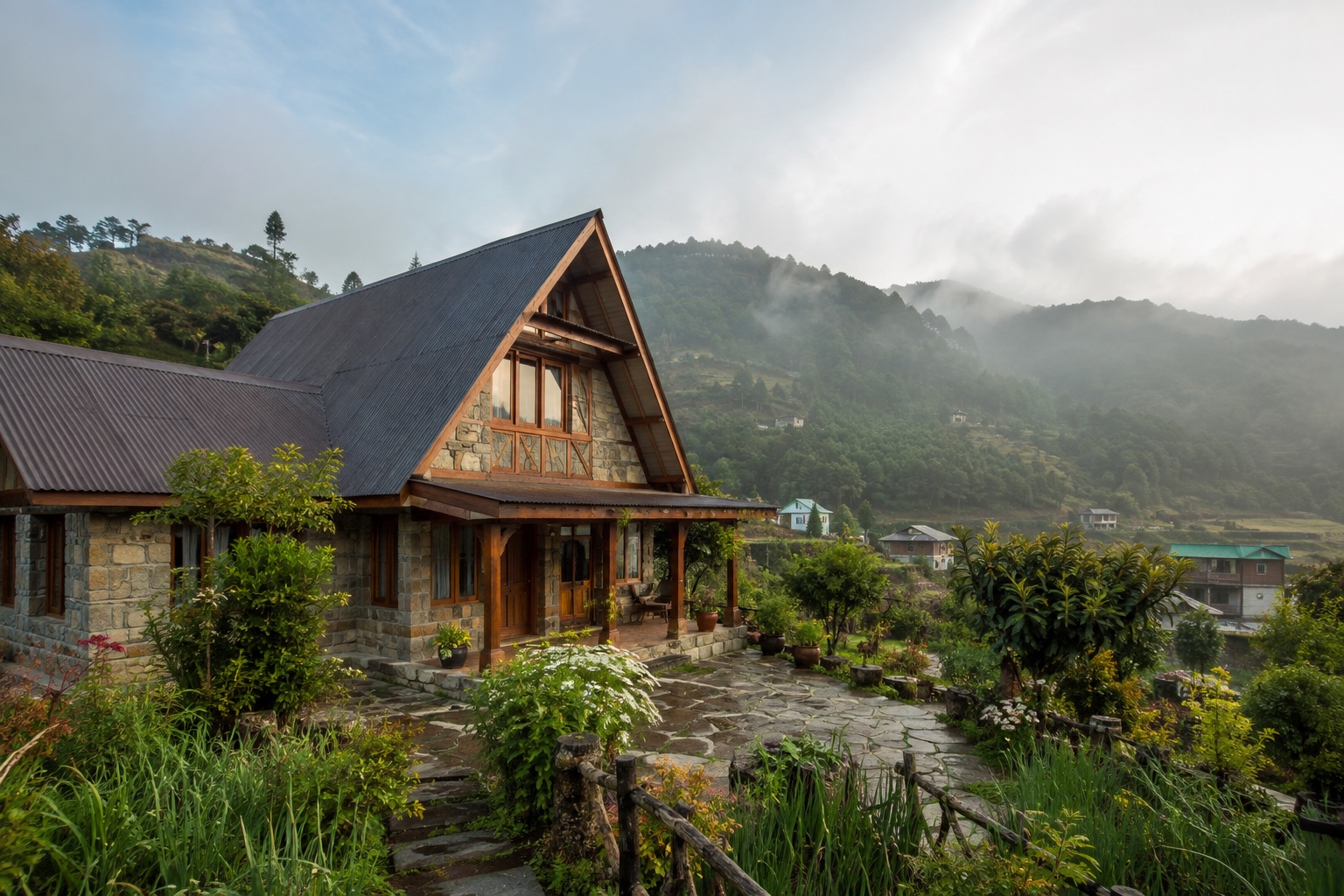
Before you choose the property
Start with the rules that actually shape the project.
The 2021 Building Bye-Laws expressly define Home Stay as not more than five rooms within their territorial extent.
The same instrument defines Guest House/Lodge as ≤10 rooms and Hotel as 10 rooms.
Meghalaya Tourism requires accommodation providers to use the online accommodation-data system for daily guest reporting.
Scope: Source-checked regulatory and business-planning guidance. It does not approve a particular title, building, tax position, food activity or operating structure.
01 / Executive finding
The practical starting point
- Meghalaya does not presently yield one located, consolidated Tourism Department instrument governing ordinary homestay eligibility, registration, classification, fees, validity, renewal, transfer and appeal. The current framework located in this research is fragmented across the Meghalaya Tourism Policy 2023, building bye-laws, accommodation-data directions, district/police NOC directions, fire rules and a separate incentive scheme.
[S1, pp. 6–7; S3, pp. 1–2; S4, press release; S6, A2.26] - Within Master Plan Areas, Municipal areas and Scheme Areas, the current Meghalaya Building Bye-Laws define a “Home Stay” as part of a building comprising not more than 5 rooms, used for boarding tourists with or without meals. This is a building-law classification, not proof of Tourism Department registration or approval.
[S6, A1.2; A2.26, Gazette pp. 130, 134] - The same building bye-laws define a guest house/lodge as not more than 10 rooms and a hotel as more than 10 rooms. Thus a proposal with six to ten rooms does not fit the located building-law “Home Stay” definition in areas where those bye-laws apply.
[S6, A2.24–A2.26, Gazette p. 134] - A major official conflict exists because the Chief Minister's Homestay Mission Component 3 defines a Boutique Homestay as at least 10 rooms, including new construction and expansions, yet requires construction to comply with the latest Meghalaya Building Bye-Laws. Exactly 10 rooms falls within the building-law guest-house/lodge definition and more than 10 within the hotel definition. No located instrument expressly reconciles the labels. The official sources are not aligned.
[S6, A2.24–A2.26; S10, §3 and §11] - The Tourism Department has directed all accommodation providers, including homestays, to register in its online accommodation-data system and use it for daily check-in/check-out recording. The 2024 OM set a 31 March 2024 registration deadline; the obligation remains reiterated in the July 2025 direction.
[S3, OM No. Tourism.5/2021/43; S4, press release] - All accommodation providers have also been directed to obtain NOCs from both the District Administration and District Police. The current official material located does not supply the application form, fee, validity, renewal procedure or appeal process for those NOCs.
[S4, lines 8–15] - For buildings in Shillong city and adjoining areas, a 26 September 2024 Home (Police) Department notification expressly makes a Fire Service Organisation NOC compulsory for hotels, lodges, homestays, resorts and business buildings. This source must not be extrapolated to every Meghalaya address.
[S8, Notification No. HPL.127/2023/43] - No general Meghalaya Tourism source was located establishing an owner/family-residence requirement, domicile condition, permanent-resident requirement, minimum rooms, bed limit or resident-host rule for an ordinary homestay. Those matters must therefore be published, at present, as
Not stated in the current official material reviewed, rather than importing standards from another state or from the incentive scheme. - Companies, LLPs, firms, lessees, caretakers and professional management companies cannot presently be stated to be eligible as the holder of an ordinary homestay registration. No current general Tourism registration rule establishing those routes was located. Component 3 separately allows a “registered entity”, but its documents use society/cooperative and President/Secretary terminology extensively, so applicability to a private company or LLP requires written clarification.
[S10, §3; Annexure-I entity form] - Construction, material alteration or change in occupancy/use in areas covered by the 2021 Building Bye-Laws can engage building-permission requirements. An Occupancy Certificate is mandatory for buildings subject to those bye-laws after completion; the authority is to communicate approval/refusal within 15 working days after the required completion filing. That 15-day period is not a homestay-registration timeline or approval guarantee.
[S6, A1.4, A9–A10] - If food is commercially prepared or supplied, tourism status does not replace FSSAI/FoSCoS compliance. The current FoSCoS eligibility document updated 1 April 2026 contains food-service registration/licence categories and fees, including “boarding houses serving food”.
[S14–S15, FoSCoS p. 7] - For foreign guests, the Immigration and Foreigners Rules, 2025 expressly include a “home stay” within accommodation. The keeper must electronically retain required guest particulars for at least one year and submit Form III—formerly Form C—within 24 hours of arrival and departure.
[S17, r.17; Form III] - Component 3's Tourism Department assistance is stated in the operative scheme text as up to ₹15 lakh—₹10 lakh EMI assistance plus a conditional ₹5 lakh National Games Accommodation Bonus—but its own application form asks for “50% of Total Cost, capped at ₹35,00,000”. The official sources are not aligned.
[S10, pp. 5, 18, 21] - The missing ordinary Tourism registration instrument and the unresolved room-category conflict are material enough that a definitive public “how to register a Meghalaya homestay” guide should not yet be published as settled law. A narrower guide clearly distinguishing building classification, mandatory operational reporting and incentive schemes could be prepared with written Tourism/Urban-authority clarification.
02 / Document chronology
Use the current rules and implementation
2011 — Previous Tourism Policy. The 2023 Policy records that the previous policy was notified as Tourism 74/2009/85 dated 1 February 2011 and says the State undertook a comprehensive relook to produce a revamped Tourism Policy. [S1, p.6] 25 March 2021 — Meghalaya Building Bye-Laws 2021. These expressly repeal the Meghalaya Building Bye-Laws 2011 and 2015 amendment while saving prior actions. [S6, H13] 2023 — Meghalaya Tourism Policy 2023. Current official Tourism/Invest Meghalaya pages continue to make it available. A formal clause saying “the 2011 policy is hereby repealed” was not located, although the document describes itself as the revamped policy replacing the policy approach formulated in 2011. 24 January 2024 — Tourism online accommodation-data OM. Introduced mandatory online provider registration and daily reporting, with 31 March 2024 deadline. [S3] 26 September 2024 — Shillong/adjoining-area Fire NOC notification. [S8] 2024–2026 — Building Bye-Law amendments. The current Urban Affairs index was reviewed through the 7 May 2026 amendment. None of the amendments reviewed replaces A2.24–A2.26's guest house/hotel/home-stay room definitions. [S7] 30 June/1 July 2025 — dual NOC requirement. Tourism directed all accommodation providers to obtain NOCs from both District Administration and District Police. [S4] 28 October 2025 — Chief Minister's Meghalaya Homestay Mission 2025, Notification No. Tourism.39/2025/2. This instrument is cited/depended upon by subsequent official material, but the controlling original was Not stated in the current official material reviewed during this research. 24 November and 2 December 2025 — priority-cluster addenda. Additional locations were inserted for the Mission. 4 December 2025 — Component 3: Boutique Homestays. Added a medium/large investment component with its own eligibility, loan structure and standards. [S10] 9 December 2025 — MIIPP (Amendment), 2025. Effective immediately. [S13] 6 February 2026 — further Mission priority-cluster additions. 6 March 2026 — Component 3 corrigendum and Tura-region cluster addition. [S11–S12] 7 May 2026 — latest Building Bye-Law amendment reviewed. It did not amend A2.26.
Unresolved chronology issue
Because Tourism.39/2025/2 dated 28 October 2025 was not located, it is not possible to reconstruct Components 1 and 2 of the current Homestay Mission to the evidentiary standard requested. Older Government statements referring to 35%, 45% or combined 70% assistance should therefore not be converted into a present entitlement.
03 / Category definitions
Choose the right accommodation category
| Category | Location | Eligible owner/applicant | Residence requirement | Operator allowed | Capacity | Food position | Source |
|---|---|---|---|---|---|---|---|
| Home Stay — building-law category | Master Plan, Municipal and Scheme Areas | Not stated in the material reviewed as tourism applicant rule | Not stated in the material reviewed | Not stated in the material reviewed | Not more than 5 rooms in all | With or without meal | S6, A1.2, A2.26 |
| Guest house/lodge | Same Building Bye-Law extent | Not stated in the material reviewed | Not stated in the material reviewed | Not stated in the material reviewed | Not more than 10 rooms in all | With or without meal | S6, A2.24 |
| Hotel | Same Building Bye-Law extent | Not stated in the material reviewed | None located in definition | Not stated in the material reviewed | More than 10 rooms | With or without meal | S6, A2.25 |
| Boutique Homestay — Component 3 incentive category | Scheme categories A/B/C across Meghalaya, subject to scheme | Eligible individual or “registered entity” satisfying scheme | Individual: Meghalaya permanent resident/domicile; representative requirements for entity | Entity route exists, but precise Pvt Ltd/LLP interpretation unresolved | At least 10 rooms | Operational standards contemplate kitchen/food | S10, §3 |
| Service apartment | Building Bye-Law extent | Not stated in the material reviewed | Not stated in the material reviewed | Not stated in the material reviewed | No room figure located in definition | Not stated in the material reviewed | S6, A2.57 |
| Bed & Breakfast | Listed as accommodation type on Tourism booking system | Not stated in the material reviewed | Not stated in the material reviewed | Not stated in the material reviewed | Not stated in the material reviewed | Not stated in the material reviewed | S2/Tourism portal label only |
| Resort | Tourism portal label; specifically named in Shillong fire order | Not stated in the material reviewed | Not stated in the material reviewed | Not stated in the material reviewed | Not stated in the material reviewed | Not stated in the material reviewed | S8; Tourism portal |
| Tented accommodation | Tourism portal label | Not stated in the material reviewed | Not stated in the material reviewed | Not stated in the material reviewed | Not stated in the material reviewed | Not stated in the material reviewed | Tourism portal label |
| Farm stay | Not stated in the material reviewed | Not stated in the material reviewed | Not stated in the material reviewed | Not stated in the material reviewed | Not stated in the material reviewed | Not stated in the material reviewed | Not stated in the current official material reviewed |
The Tourism portal's category names are operational/listing labels and are not evidence of regulatory definitions.
04 / Eligibility decision tree
Check whether the applicant and property qualify
Step 1 — Establish exact property address and local-body category. Is the parcel inside a Master Plan Area, Municipal area or Scheme Area?
- Yes: Meghalaya Building Bye-Laws 2021 apply. Proceed to room-count classification.
[S6, A1.2] - No / uncertain: identify the ADC, town committee, traditional/local authority and planning regime. Confirm this in writing with the authority.
- No applicable instrument located: Not established in the published material. Step 2 — Count the rooms proposed to be used for guest accommodation.
- 1–5 rooms: the project may fit the published building-law definition of Home Stay. This appears to fit the published route, subject to the remaining checks, subject to all other approvals.
- 6–9 rooms: exceeds A2.26 but falls within A2.24. Consider another accommodation category.
- Exactly 10 rooms: falls within building-law Guest House/Lodge, while Component 3 calls 10+ rooms a Boutique Homestay. Confirm this in writing with the authority.
- More than 10: building law calls it a Hotel, while Component 3 may call it Boutique Homestay. Confirm this in writing with the authority. Step 3 — Establish title/lease position.
- Owner with clear title: proceed to building/local authority verification.
- Joint/inherited/customary title: co-owner/community/local-rights implications must be established; general homestay consent rule Not stated in the material reviewed.
- Lessee: ordinary homestay eligibility as registration holder Not stated in the material reviewed.
- Component 3 registered entity with ≥15-year lease: scheme text expressly supports possession through ownership or qualifying lease.
[S10, §3] - Component 3 individual lessee: checklist accepts a notarized ≥15-year lease, while the main eligibility table speaks of rightful ownership or local NOC. Confirm this in writing with the authority. Step 4 — Identify the intended applicant.
- Individual owner: general ordinary-tourism eligibility Not established in the published material.
- Company/LLP/firm: general ordinary registration-holder eligibility Not established in the published material.
- Caretaker: no source located allowing caretaker to substitute for eligible holder. Confirm this in writing with the authority.
- Professional operator: management agreement alone does not establish Tourism-registration eligibility. Confirm this in writing with the authority. Step 5 — Determine who will live there. No current general Meghalaya source was located requiring the owner or owner's family to reside in an ordinary homestay. Accordingly: Not established in the published material. Do not turn absence of the rule into a statement that an absentee-owner homestay is permitted. Step 6 — Determine property status.
- Proposed/new building: building/local planning approval required where applicable.
- Under construction: verify sanction and permitted use before changing design.
- Existing house proposed for conversion: A1.4.4 expressly brings change in occupancy/use within the Bye-Laws; H10 also addresses existing buildings. Confirm this in writing with the authority on the specific conversion.
- Running homestay: verify its existing title/use/permissions, District NOCs, Mtime registration, fire position and guest reporting; do not assume past operation cures missing approval.
05 / Applicant and operating structures
Set the ownership and operating structure
| Structure | Supported route | Principal obstacle | Source | Clarification required |
|---|---|---|---|---|
| Resident individual owner | Building-law Home Stay may fit if ≤5 rooms in covered area; general online registration/NOCs apply | Ordinary Tourism applicant criteria not located | S3, S4, S6 | Is owner eligible as Tourism registration holder and is residence on premises required? |
| Joint/inherited ownership | Property can be assessed, subject to title/local authority evidence | No general co-owner-consent homestay rule located | S6 | What consent/title documents are demanded? |
| Owner living elsewhere | No general prohibition located | No affirmative permission either | — | Must owner/family reside in premises? |
| Owner with caretaker | Caretaker can operationally perform tasks only if contracts/law allow | No source makes caretaker eligible holder | — | May caretaker be declared manager while owner remains holder? |
| Long-term lessee | Component 3 entity route expressly contemplates ≥15-year lease | Ordinary route absent; Component 3 individual text/checklist inconsistent | S10 | Can an ordinary homestay be registered by a lessee? |
| Company | Component 3's “registered entity” wording may potentially encompass incorporated entities | Forms repeatedly use President/Secretary, society/cooperative and managing committee | S10 | Does “registered entity” include Companies Act companies? |
| Partnership firm | Component 3 mentions registered entities/sole proprietorship certificate in supporting-doc section | Exact partnership treatment not explicit | S10 | What constitutive and representative documents are required? |
| LLP | No express LLP reference located | Cannot infer LLP is accepted | — | Does “registered entity” include LLP? |
| Professional operator/management company | Contractual management may be commercially possible | Registration-holder/operator separation not established | — | Can holder and operator differ, and how must operator be disclosed? |
| Capital-only participant | Can fund/search but cannot complete property-specific approvals without site and eligible holder | No property/title/local authority to test | — | Select property, title structure and intended holder first |
| Landowner constructing new unit | Building/local planning route first; Component 3 may be evaluated separately | Use, classification, permits and incentive eligibility | S6, S10 | Obtain planning classification before final design |
06 / Property and classification standards
Prepare the property for inspection
| Topic | Mandatory / classification / guidance / unclear | Requirement | Applies when | Source | Confidence |
|---|---|---|---|---|---|
| Homestay room count | Classification | Not more than 5 rooms in all | Building Bye-Law jurisdiction | S6 A2.26 | HIGH |
| Minimum rooms | Unclear | Not stated in the material reviewed | Ordinary homestay | — | LOW |
| Bed/guest capacity | Unclear | Not stated in the material reviewed | Ordinary homestay | — | LOW |
| Total building rooms vs guest rooms | Unclear | A2.26 says “part of a building comprising … not more than 5 rooms”; no separate guest-vs-total formula located | Covered areas | S6 A2.26 | MEDIUM |
| Guest-house room count | Classification | ≤10 rooms | Covered areas | S6 A2.24 | HIGH |
| Hotel room count | Classification | >10 rooms | Covered areas | S6 A2.25 | HIGH |
| General habitable-floor height | Building requirement | Minimum 3.0 m | Building regulated by S6 | S6 A2.28 | HIGH |
| Sloping-roof lowest height | Building requirement | ≥2.2 m | Same | S6 A2.28 | HIGH |
| Bathroom/WC/passages minimum height | Building requirement | 2.20 m | Same | S6 A2.28 | HIGH |
| Ordinary Tourism room-area minimum | Unclear | Not stated in the material reviewed | Ordinary homestay | — | LOW |
| Ordinary attached bathroom requirement | Unclear | Not stated in the material reviewed | Ordinary homestay | — | LOW |
| Kitchen | Unclear | No ordinary homestay Tourism standard located | Ordinary | — | LOW |
| Reception | Unclear | Not stated in the material reviewed | Ordinary | — | LOW |
| Signage | Unclear | Not stated in the material reviewed | Ordinary | — | LOW |
| Access/road width | Property-specific | Building and local access provisions require project assessment | Applicable construction | S6 | MEDIUM |
| Parking | Building rule, applicability needs classification confirmation | Table D-1 states one parking space for every 3 guest rooms for “lodging establishments tourist homes, hotels”; ≤1,000 sq ft plots need not have parking insisted under Note 1 | Where authority treats homestay within that line | S6 Table D-1 | MEDIUM |
| Occupancy Certificate | Mandatory building rule | Cannot occupy regulated building without OC | Buildings subject to S6 after applicable completion process | S6 A10 | HIGH |
| Rainwater harvesting | Building sustainability | Listed for Home Stays/residential developments | New plan sanction under S6 | S6 Table G1 | HIGH |
| Waste segregation | Building sustainability | Required under Table G1 | Same | S6 Table G1 | HIGH |
| Soft cover | Building sustainability | <5,000 sq ft: min 10%; 5,001–25,000 sq ft: min 20% | Same | S6 Table G1 | HIGH |
| Groundwater recharge | Building sustainability | Listed for covered area >3,000 sq ft in 5,001–25,000 sq ft plot category | Same | S6 Table G1 | HIGH |
| Fire NOC | Mandatory local rule | Compulsory Fire Service Organisation NOC | Shillong city/adjoining areas | S8 | HIGH |
| Ordinary Internet/Wi-Fi | Unclear | Not stated in the material reviewed | Ordinary homestay | — | LOW |
| Ordinary power backup | Unclear | Not stated in the material reviewed | Ordinary homestay | — | LOW |
| Ordinary hot water | Unclear | Not stated in the material reviewed | Ordinary homestay | — | LOW |
| Accessibility | Unclear for ordinary homestay | Section E contains public-building accessibility rules but excludes residential buildings; exact ordinary homestay classification under E not resolved | Site/building-specific | S6 §E | LOW |
| Boutique room area | Scheme obligation | 240 sq ft recommended standard incorporated by mandatory-obligation clause | Component 3 beneficiary only | S10 Annexure II + §11 | HIGH for scheme |
| Boutique bathroom area | Scheme obligation | 50 sq ft; attached private western WC | Component 3 only | S10 Annexure II | HIGH for scheme |
| Boutique hot/cold water | Scheme obligation | 24-hour running hot/cold water standard | Component 3 only | S10 Annexure II | HIGH for scheme |
| Boutique Wi-Fi | Scheme obligation | Wi-Fi provision specified | Component 3 only | S10 Annexure II | HIGH for scheme |
| Boutique accessibility | Scheme standard | Outdoor areas accessible/EWCD-friendly | Component 3 only | S10 Annexure II | HIGH for scheme |
| Boutique parking | Scheme standard | Sufficient parking and adequate road width | Component 3 only | S10 Annexure II | HIGH for scheme |
Component 3's Annexure II is titled “Recommended Standards”, yet §11 says applicants “must adhere” to the recommended standards. For scheme beneficiaries they should therefore be treated conservatively as scheme obligations pending written clarification. [S10, §11; Annexure II]
07 / Documents and declarations
Assemble the application file
| Document | Who provides/signs | Format/stamp requirement | Validity period | When required | Source | Unresolved issue |
|---|---|---|---|---|---|---|
| District Administration NOC | Accommodation provider | Not stated in the material reviewed | Not stated in the material reviewed | Operating/registration layer | S4 | Application procedure unavailable |
| District Police NOC | Accommodation provider | Not stated in the material reviewed | Not stated in the material reviewed | Operating/registration layer | S4 | Application procedure unavailable |
| Mtime/provider registration | Accommodation provider | Online | Not stated in the material reviewed | All providers | S3–S5 | Current hidden form fields not inspected |
| Guest identity information | Accommodation provider | Online entry/upload | Daily | Operations | S3–S4 | State retention period not located |
| Plot ownership evidence | Applicant/property owner | Documentary proof | Property-specific | Building permission | S6 A4 | Exact customary-title document depends authority |
| Site plan | Registered professional/application file | Prescribed building-plan format | Project | Building permission | S6 A4 | Address-specific |
| Building plan | Applicant/professional | Prescribed | Project | Building permission | S6 A4 | Address-specific |
| General specifications | Applicant/professional | Prescribed | Project | Building permission | S6 A4 | — |
| Seismic certificate | Technical professional | Prescribed | Project | Building application where applicable | S6 A4 | Technical scope |
| Structural drawings | Technical professional | Prescribed | Project | Building application where applicable | S6 A4 | Technical scope |
| Completion notice/Form III | Owner + supervising architect/RTP | Prescribed form | At completion | OC | S6 A9–A10 | — |
| Fire NOC | Fire Service Organisation | Department process | Not stated in the material reviewed | Shillong/adjoining accommodation buildings | S8 | Detailed checklist not in notification |
| Component 3 individual photo ID | Individual applicant | Self-attested | Current | Scheme | S10 §6/Annexure | Aadhaar/EPIC/passport etc. |
| PAN | Individual/entity | Self-attested | Current | Scheme | S10 | — |
| Age proof | Individual | Self-attested | Current | Scheme | S10 Annexure | Needed because 18–58 eligibility |
| Land document | Applicant | Self-attested | Current | Scheme | S10 | Individual ownership/lease wording conflict |
| ≥15-year lease | Applicant where lease relied on | Checklist says notarized; §6 says registered lease | ≥15 years | Component 3 | S10 | The official sources are not aligned on form |
| Local-authority NOC | Component 3 applicant/entity | Exact format not given | Not stated in the material reviewed | Scheme application | S10 §3/§6 | Authority not universally identified |
| KYC bank passbook | Individual | Front page | Current | Scheme | S10 | — |
| Six-month bank statement | Entity | If applicable | Previous 6 months | Scheme | S10 | “if applicable” unexplained |
| Concept note | Individual/entity | No specific file type located | Application | Scheme | S10 | — |
| DPR/project cost | Individual/entity | Scheme/project format | Application | Scheme | S10 | — |
| Incorporation/registration certificate | Entity | Self-attested in checklist | Current | Scheme | S10 | Company/LLP interpretation unresolved |
| GST certificate | Entity | Self-attested if applicable | Current | Scheme | S10 | Separate GST eligibility |
| Managing-committee resolution | Entity | Copy | Current | Scheme | S10 | Company board-resolution substitution unclear |
| Photos of President/Secretary | Entity | Two each | Current | Scheme | S10 | Inapt wording for many companies/LLPs |
| Declaration | Individual or representatives | Signature; no stamp-paper rule located | Application | Scheme | S10 | Includes “new project” declaration conflicting with expansion route |
| Trade-registration certificate of existing hospitality enterprise | Individual | Valid certificate | Application according to §6 | Component 3 | S10 §6 | Appears difficult for genuine new entrant and not repeated in individual checklist |
| Form III foreign-guest report | Keeper of accommodation | Electronic | Every foreign stay | Within 24h arrival/departure | S17 r.17 | Current legal name; formerly Form C |
No general Meghalaya Tourism requirement for an affidavit on stamp paper, character certificate, police verification of owner, co-owner affidavit or notarised ordinary-homestay declaration was located.
08 / Application and inspection process
Follow the application and inspection process
A. Ordinary accommodation/homestay — only the verified sequence can presently be stated
| Step | Responsible person/authority | Input | Resulting record | Stated period | What does not happen automatically |
|---|---|---|---|---|---|
| 1. Confirm parcel jurisdiction | Owner/developer + planning/local authority | Exact site, title, existing use | Jurisdiction/use determination | None located | No tourism approval |
| 2. Determine room/category design | Owner + architect/authority | Guest-room plan | Building category | Before construction/conversion | “Homestay” label does not override building definition |
| 3. Obtain building permission/change-of-use approval where required | Owner/developer | Plans/title/technical documents | Building sanction | Property-specific | Does not grant Tourism registration |
| 4. Obtain District Administration NOC | Accommodation provider | Not stated in the material reviewed | NOC | Not stated in the material reviewed | Does not replace Police NOC |
| 5. Obtain District Police NOC | Accommodation provider | Not stated in the material reviewed | NOC | Not stated in the material reviewed | Does not replace Fire/building approval |
| 6. Obtain Fire NOC where applicable | Applicant | Fire application | Fire NOC | Not stated in the material reviewed | Not Tourism registration |
| 7. Register on Mtime/provider system | Provider | Provider/account information | Online provider account | Immediate compliance directed | No evidence that account registration alone classifies property legally |
| 8. Obtain separate food/local/tax approvals | Relevant holder | Activity-specific | Separate registrations/licences | Separate | Tourism status does not substitute |
| 9. Start only after applicable approvals | Operator/holder | Completed compliance file | Operations | — | Prior submissions do not guarantee legality |
| 10. Daily Mtime reporting | Operator | Guest check-in/out information | Daily digital record | Day-to-day | Does not satisfy foreigner reporting by itself unless systems expressly integrate |
| 11. Foreign-guest Form III | Keeper | Passport/visa/OCI/travel details | Form III report | ≤24h arrival and departure | State guest log is not evidence of automatic MHA compliance |
There is no located current general Tourism source describing a statewide sequence of ordinary-homestay application → Tourism inspection → approval → certificate download → appeal.
B. Component 3 Boutique Homestay scheme process
The scheme is much more explicit:
- register the unit on UNNATI and Invest Meghalaya portals;
[S10, §6] - submit eligibility material, concept note/DPR and financial documents;
- District Tourist Officer plus designated Sports Department official performs a site visit and joint inspection report;
- State Level Screening Committee chaired by Director Tourism verifies/scrutinises;
- evaluation includes location, DPR/design, complete documents and bank-loan eligibility;
- shortlisted applications proceed to the State Investment Committee chaired by the Chief Secretary for in-principle Single Window approval;
- bank independently evaluates lending; the scheme merely says the bank is expected to make best efforts to process/disburse within 30 days from Tourism sanction—this is not a statutory guarantee;
[S10, §7] - construction is monitored and must be completed within 12 months of loan disbursal under the scheme;
[S10, §9] - mandatory training must be completed within six months of loan disbursal;
[S10, §8] - applicable incentive claims occur after or in relation to commercial operations and separate MIIPP/UNNATI conditions. None of these scheme approvals automatically substitutes for building permission, trade licences, fire clearance or ordinary accommodation operating obligations. The scheme itself expressly requires necessary trade licences and permissions and compliance with the latest Building Bye-Laws.
[S10, §11]
09 / Fees, timelines, validity and renewal
Confirm fees, timing and certificate validity
| Item | Verified amount/period | Nature | Source | Publication treatment |
|---|---|---|---|---|
| Ordinary homestay Tourism application fee | Not stated in the material reviewed | — | — | Do not publish an estimate |
| Tourism classification fee | Not stated in the material reviewed | — | — | — |
| Tourism inspection fee | Not stated in the material reviewed | — | — | — |
| District Administration NOC fee | Not stated in the material reviewed | — | S4 | — |
| District Police NOC fee | Not stated in the material reviewed | — | S4 | — |
| Fire NOC fee | Not stated in the material reviewed in specific homestay notification | — | S8 | Ask Fire Service |
| Mtime registration fee | Not stated in the material reviewed | — | S3–S5 | Do not assume free |
| Tourism certificate validity | Not stated in the material reviewed | — | — | — |
| Tourism renewal period/window | Not stated in the material reviewed | — | — | — |
| Building OC authority response | 15 working days after receipt of completion notice/documents | Building-law administrative period | S6 A10 | Not homestay approval timeline |
| Building-permission renewal | ¼ of fees on remaining portion; validity 18 months | Building permission | S6 A15.5(vi) | Only building process |
| Component 3 bank processing | “best efforts” within 30 days after Tourism sanction | Scheme expectation, not guarantee | S10 §7 | Must be described as target/expectation |
| Component 3 construction | 12 months from loan disbursal | Scheme condition | S10 §9 | Beneficiaries only |
| Component 3 training | Within 6 months of loan disbursal | Scheme condition | S10 §8 | Beneficiaries only |
| Component 3 operation | Minimum 15 years | Scheme contractual condition | S10 §11/declaration | Not ordinary homestay licence validity |
| FoSCoS basic Registration | ₹100/year in the current relevant food-service rows | Central food registration | S15 p.7 | Only where applicable to the food business |
| FoSCoS State Licence | ₹5,000/year in identified hotel/restaurant/boarding-food rows | Central food-law system | S15 p.7 | Kind-of-Business selection must be verified |
Legacy certificates
No current official source was located explaining conversion, grandfathering or renewal treatment of older Meghalaya Tourism homestay certificates. Not stated in the current official material reviewed.
10 / Operating duties after registration
Run the registered homestay correctly
Accommodation data. The Tourism Department's system is intended for day-to-day check-in/check-out recording for accommodation providers and captures information including visitor counts, gender, origin and identity proof/visa-related information. [S3–S4] District/Police NOCs. Current Tourism direction requires both NOCs; there is no located exemption for an already running homestay. [S4] Foreign guests. Under Rule 17 of the Immigration and Foreigners Rules 2025, every keeper of accommodation must:
- record/sign prescribed foreigner/OCI particulars;
- keep the electronic particulars for at least one year;
- make them available for inspection;
- submit Form III electronically within 24 hours after arrival; and
- submit departure details within 24 hours after departure. “Accommodation” expressly includes a home stay.
[S17, r.17]Form III is expressly labelled “Earlier Form ‘C’”.[S17, Form III]Food. Where food is commercially prepared or served, determine the correct FoSCoS Kind of Business before commencement. The April 2026 FoSCoS table expressly includes “boarding houses serving food”.[S15, p.7]For the following ordinary homestay duties, the requested current state source was Not stated in the material reviewed: - mandatory room-rate display;
- prescribed invoice format;
- Tourism complaint book;
- Tourism certificate-display requirement;
- separate monthly tourism statistics beyond daily data reporting;
- domestic-guest paper register format;
- state retention period for domestic records;
- staff police verification;
- caretaker police verification;
- incident-reporting protocol;
- mandatory insurance;
- local-employment quota;
- mandatory staff-training rule;
- ordinary homestay classification reinspection;
- ordinary Tourism renewal process. Component 3 beneficiaries additionally assume scheme-specific obligations including training, prescribed standards, minimum operation period, monitoring and contractual clawback. These must not be imposed on ordinary homestays merely because both use the word “homestay”.
11 / Adjacent approvals and dependencies
Close the approvals outside Tourism
| Topic | What tourism registration resolves | What it does not resolve | Likely authority | Official source located | Property-specific question |
|---|---|---|---|---|---|
| Land ownership | Nothing established | Legal/customary title and development rights | ADC/local authority/title authority | S1/S6 | Who legally controls parcel and can grant development rights? |
| Building use | Nothing | Permitted occupancy/use | MUDA/ADC/local planning authority | S6 | Is paid accommodation permitted at this address? |
| Building sanction | Nothing | Construction/reconstruction/change-of-use approval | Building authority | S6 | Is proposed work sanctioned? |
| Occupancy Certificate | Nothing | Fit-for-occupation certification | Building authority | S6 | Does property have required OC? |
| Fire | Nothing | Fire safety/NOC | Fire & Emergency Services | S8 | Is address inside Shillong/adjoining scope or otherwise subject to fire approval? |
| District Administration NOC | Required separate layer | Does not replace other permissions | Deputy Commissioner/District Administration | S4 | Which form/checklist applies? |
| Police NOC | Required separate layer | Does not replace foreigner reporting | District Police | S4 | Which police office/process applies? |
| Food/FSSAI | Nothing | Food business licence/registration | FSSAI/FoSCoS | S14–S15 | Which Kind of Business matches operation? |
| Foreign guests | Nothing | Immigration reporting | Bureau of Immigration/Registration Officer | S16–S18 | Has keeper set up current Form III reporting? |
| GST | Nothing | GST registration/rates/returns | GST authorities | S19 | Who makes the taxable accommodation supply and what is aggregate turnover? |
| Udyam | Nothing | MSME registration | Ministry of MSME | S20 | Is Udyam commercially/scheme-relevant? |
| Water | Nothing | Connection/abstraction/wastewater approval | Local/PHE/groundwater authority | S6/S9 | Source and discharge arrangement? |
| Electricity | Nothing | Connection/use category and load | Power utility | S6 | Adequate sanctioned load? |
| Waste | Nothing | Local waste management compliance | Local authority/MSPCB where applicable | S6 Table G1 | Collection, segregation, wastewater route? |
| Environment | Nothing | Forest/protected/eco-sensitive permissions | Forest/Environment/MSPCB/local authority | S1/S9 | Is parcel near protected forest/eco-sensitive asset? |
| Heritage | Nothing | Heritage controls | Urban Affairs/local heritage authority | S6/current Urban Affairs framework | Is site/building protected? |
| Property tax | Nothing | Assessment/use classification | Local body | Not stated in the material reviewed for homestay concession | Does use change tax classification? |
| Electricity concession | Nothing | Tariff/concession | Utility/regulator | Not stated in the material reviewed | Any accommodation-specific tariff? |
| Water concession | Nothing | Tariff/concession | PHE/local body | Not stated in the material reviewed | Any current concession? |
| Insurance | Nothing | Property/public liability/business coverage | Insurer | No mandatory ordinary rule located | Scheme/lender-specific requirement? |
Invest Meghalaya's approval system itself separates pre-establishment, pre-operational clearances and commercial operation before incentive claims, supporting the conclusion that investment/tourism status is not a universal licence. [S9]
12 / Incentives, subsidy and funding
Evaluate incentives without assuming sanction
14.1 Chief Minister's Homestay Mission — Components 1 and 2
A current official Mission exists and subsequent official addenda identify the base notification as Tourism.39/2025/2 dated 28 October 2025. However, that original instrument was Not stated in the current official material reviewed during this research. Accordingly, this guide will not publish a definitive Components 1/2 subsidy percentage, ceiling, beneficiary contribution, bank route or eligibility formula. Official Government communications referring to older 35%, 45% and combined 70% subsidy arrangements cannot substitute for the missing controlling notification. Current application status: NOT CONFIRMED.
14.2 Component 3 — Development of Boutique Homestays
This programme is sufficiently documented to describe as a scheme, but not as ordinary licensing law.
Eligible applicant
Individual:
- permanent resident/domicile of Meghalaya;
- age 18–58;
- not a credit defaulter;
- literate;
- one eligible family member;
- required land/NOC position;
- adequate net worth for margin. Registered entity:
- registered and operational in Meghalaya;
- no credit default;
- designated representative satisfying individual criteria;
- possession of land through ownership or lease for at least 15 years;
- local-authority NOC;
- sufficient net worth.
[S10, §3]
Project base
- Boutique Homestay: at least 10 rooms.
- Minimum investment in building/durable physical assets: ₹75 lakh.
- Minimum scheme project cost: ₹80 lakh.
- Illustrative financing structure: 90:10 debt-equity, i.e. ₹72 lakh debt and ₹8 lakh applicant equity for the ₹80 lakh model.
[S10, §§3–4]These are scheme conditions, not market-cost estimates supplied by this guide.
Tourism Department support
The main scheme text states:
- ₹10 lakh EMI assistance, described as ₹83,333/month for 12 months after commercial operations; plus
- conditional ₹5 lakh National Games Accommodation Bonus for eligible Shillong/Tura/Jowai units operational by 1 February 2027;
- maximum Tourism Department support therefore ₹15 lakh.
[S10, pp.4–5]But the application form asks for: > “Government Subsidy Requested (50% of Total Cost, capped at ₹35,00,000)”[S10, p.18 and p.21]Status: The official sources are not aligned. No applicant should model the ₹35 lakh figure as an entitlement without a written Tourism Department determination.
UNNATI-linked benefits stated by Component 3
Component 3 states, subject expressly to UNNATI's own rules:
- capital investment incentive described as 30% of eligible building/durable physical assets;
- 3% annual interest subvention for seven years in East Khasi Hills, West Garo Hills and West Jaintia Hills;
- 5% for seven years in other districts;
- differentiated GST-linked reimbursement limits.
[S10, p.5]The general Invest Meghalaya UNNATI presentation separately describes: - Zone A capital incentive: 30%, cap ₹5 crore where GST applies;
- Zone B: 50%, cap ₹7.5 crore;
- different caps where GST does not apply;
- service-sector minimum investment ₹50 lakh.
[S9, UNNATI section]Because Component 3 gives a scheme-specific summary and says the respective UNNATI guidelines control, the headline rates must never be detached from the beneficiary's actual zone, registration timing and eligible-investment computation.
MIIPP-linked benefits stated by Component 3
Component 3 refers to:
- additional 2% interest support for specified districts;
- net-GST reimbursement;
- rainwater-harvesting, DG-set, power-connection and EPF benefits subject to MIIPP.
[S10, pp.5–6]The general MIPA page separately presents broader MIIPP incentives and criteria.[S9]
Application timing/current status
As of 05 September 2026, the live Invest Meghalaya website still displays: > “MIIPP 2024 Registrations open till 31st March 2026” That displayed date has already passed. [S9, live banner] Therefore: CURRENT MIIPP APPLICATION WINDOW: NOT CONFIRMED. A stale banner must not be treated as evidence that applications are open.
14.3 Nature of assistance
All identified assistance remains:
- subject to separate application;
- subject to eligibility;
- subject to bank credit appraisal where borrowing is involved;
- subject to scheme budget/sanction;
- subject to post-operation or reimbursement conditions where stated;
- not automatic merely because a project is a homestay.
13 / Business implications
Translate the rules into a workable project
Before selecting or acquiring property
the project team should establish at minimum:
- exact address and district;
- ADC/local planning/municipal/Master Plan/Scheme Area status;
- ownership/customary-title/lease chain;
- whether the intended guest-room count is ≤5, 6–10 or >10;
- intended accommodation category;
- whether an existing building has sanctioned plans/OC and permissible use;
- Fire NOC scope;
- local-authority and police NOC route;
- environmental/forest constraints;
- who is intended to hold every registration. A capital-only participant should not be presented with a “homestay structure” before these facts are fixed.
Before construction or renovation
The architect/design team must not treat the Tourism expression “Boutique Homestay” as a planning classification. In areas governed by the 2021 Building Bye-Laws, the five-room home-stay definition and 10-room guest-house/hotel thresholds must be resolved with the building authority before design is frozen.
Registration holder versus operating entity
No current ordinary Meghalaya Tourism source was located establishing that: property owner → Tourism holder → operator → employer → booking merchant may all be different entities. Therefore the project team should not advertise that a management agreement automatically allows the project team, an LLP, a project SPV or another operator to hold or use an owner's homestay registration.
What an LLP or management agreement cannot solve
An LLP agreement or management contract does not, by itself:
- cure defective title;
- establish permissible building use;
- convert a >5-room building into a building-law homestay;
- satisfy District Administration or Police NOC requirements;
- substitute for fire approval;
- establish Tourism-holder eligibility;
- confer subsidy eligibility;
- replace FSSAI/GST/foreigner-reporting obligations.
Property-development scope
Development scope should be conditional on:
- planning/building sanction;
- change-of-use answer;
- access/parking conditions;
- wastewater/water solution;
- local/traditional authority consent;
- any protected-area limitation;
- category-specific room design.
Commercial assessment file
Every proposed property should contain separate fields for:
- land/title risk;
- building-use category;
- current room count;
- proposed room count;
- tourism-registration evidence;
- District Administration NOC;
- District Police NOC;
- Fire NOC;
- Mtime registration;
- FSSAI;
- foreign-guest reporting setup;
- GST entity;
- Udyam if relevant;
- incentive eligibility;
- unresolved authority questions.
Before proposing business terms
the project team should first know:
- who owns the property;
- who can lawfully lease it;
- who may be registration holder;
- who will operate;
- who invoices guests;
- who employs staff;
- who assumes regulatory liability;
- who makes capital expenditure;
- whether the category permits the intended scale;
- whether an incentive requires retention/no-transfer covenants. No fixed ownership percentage, contribution or revenue commitment should be proposed from the regulatory material alone.
14 / Official-source conflicts
Resolve conflicting official instructions
Conflict 1 — five-room building-law Home Stay vs 10+ room Boutique Homestay
Source A: Meghalaya Building Bye-Laws 2021, A2.24–A2.26. Proposition: Home Stay ≤5 rooms; guest house/lodge ≤10; hotel >10. Source B: Component 3, §3 and §11. Proposition: Boutique Homestay ≥10 rooms, while buildings must comply with latest Meghalaya Building Bye-Laws. Hierarchy: S6 is a notified building regulatory instrument; S10 is an incentive-scheme addendum. No express amendment of A2.26 is contained in S10. Status: The official sources are not aligned. Affected properties: Component 3 proposals located in Master Plan, Municipal or Scheme Areas. Written answer required from: Tourism Department plus applicable building authority/MUDA/ADC.
Conflict 2 — Component 3 expansion eligibility vs “new project” declaration
Source A: §3 defines Boutique Homestay to include “newly constructed units and expansions of existing units”. [S10] Source B: Individual/entity declaration states the proposed project “is a new project” and has not received subsidy/grant from another Government scheme. [S10, p.19/p.22] Status: The official sources are not aligned. Affected properties: Existing accommodation businesses seeking Component 3 expansion. Resolution office: Director of Tourism / State Level Screening Committee.
Conflict 3 — ₹15 lakh support vs ₹35 lakh form field
Source A: Main Component 3 scheme caps Tourism Department subsidy/support at ₹15 lakh. [S10, pp.4–5] Source B: Application financial plan asks for 50% of total cost capped at ₹35 lakh. [S10, pp.18,21] Status: The official sources are not aligned. Affected properties: All Component 3 applicants. Resolution office: Tourism Department and MIPA, preferably in writing before financial modelling.
Conflict 4 — Component 3 individual ownership language vs lease checklist
Source A: Eligibility table says individual must be rightful landowner or have a valid local-authority NOC for development/operations. Source B: §6 and the individual checklist permit proof of land ownership or a lease for at least 15 years, with the checklist referring to a notarised lease. Status: The official sources are not aligned / AMBIGUOUS. Affected applicants: Individuals who do not own the land.
Conflict 5 — generic “registered entity” vs entity-form governance terminology
The main scheme recognises a generic “Registered Entity” and the checklist asks for a Registration/Incorporation Certificate. Yet the designated representative is repeatedly called President/Secretary; declarations refer to members of a “society/cooperative”; and a managing-committee resolution is requested. Status: The official sources are not aligned / INCOMPLETE FOR CORPORATE FORMS. Affected applicants: Private companies, LLPs, conventional partnerships and other entities without President/Secretary/Managing Committee structures.
Conflict 6 — Annexure II “recommended” standards vs mandatory adherence
Source A: Annexure II heading calls them “Recommended Standards”. Source B: §11 says applicants “must adhere” to DPR designs and recommended standards in Annexure II. Practical treatment: Until clarified, a Component 3 beneficiary should plan to satisfy them. They should not be represented as statewide ordinary-homestay standards.
Conflict 7 — FSSAI threshold material
The April 2026 FoSCoS Kind-of-Business document uses ₹1.5 crore as the registration threshold in multiple relevant food-service rows, while older FSSAI explanatory pages have continued to display legacy ₹12 lakh language. Status: OFFICIAL CENTRAL MATERIAL NOT FULLY ALIGNED. For a current application, the live FoSCoS eligibility determination and controlling Gazette amendment should be checked rather than publishing the older ₹12 lakh figure as settled.
Conflict 8 — state “C-form” wording vs new central Form III nomenclature
Meghalaya's July 2025 direction refers to visa/C-form uploads. The subsequently effective Immigration and Foreigners Rules 2025 renamed the accommodation report Form III [Earlier Form ‘C’]. [S4; S17] This is principally a chronology/nomenclature issue; the current central rules should govern foreigner-reporting nomenclature.
16 / Source register
Official source register
| ID | Issuing body | Document or portal | Document/order number | Published | Effective | Language | Status/currentness | Official URL | Pages/sections reviewed | Notes |
|---|---|---|---|---|---|---|---|---|---|---|
| S1 | Government of Meghalaya / Tourism Department | *Meghalaya Tourism Policy 2023*; filename tourism.pdf | Prior 2011 policy identified as Tourism 74/2009/85; exact 2023 notification number not located | 2023; reposted on Tourism notices 9 Mar 2026 | Not stated in the material reviewed | English | PRIMARY / current policy document | Official Tourism Policy PDF | Entire 31-page policy; especially §§4–5 and sustainability/community sections | Explicitly describes 2023 policy as revamped replacement approach; formal repeal clause not located. |
| S2 | Directorate of Tourism | Contacts page | — | Live, reviewed 5 Sep 2026 | Current page | English | CONTACT | Tourism contacts | State and district contacts | Current operational contacts |
| S3 | Directorate of Tourism | *Mandatory Implementation of Online Data Collection Process for Accommodation Providers in Meghalaya*; filename Mandatory-Implementation-of-Online-Data-Collection-Process-for-Accommodation-Providers-in-Meghalaya.pdf | Tourism.5/2021/43 | 24 Jan 2024 | Deadline 31 Mar 2024 | English | IMPLEMENTATION | Official OM PDF | Both pages | Registration/daily reporting, not ordinary classification approval. |
| S4 | Government of Meghalaya / Tourism Department | *Online Data Collection and NOC for registration of Home Stay/Guest House/Lodge/Inn* | Press release; underlying Directorate forwarding notice No. M/D-Tour.15/2023/Pt/40 dated 30 Jun 2025 | 1 Jul 2025; Tourism notice posted July 2025 | Immediate compliance directed | English | IMPLEMENTATION | Official Government press release | Full press release | Dual District Administration/District Police NOC requirement |
| S5 | Directorate of Tourism | Mtime Service Provider Portal | — | Live | Current | Interface | PORTAL | Official provider portal | Public endpoint only | Authenticated/form internals not inspected |
| S6 | Urban Affairs Department | *Meghalaya Building Bye-Laws 2021*; filename BuildingByeLaws.pdf | UAU.73/2016/Pt. | Notification 9 Mar 2021; Gazette 25 Mar 2021 | Gazette publication / immediate-effect wording | English | PRIMARY | Official Building Bye-Laws PDF | Full instrument, definitions, permissions, OC, parking, accessibility, sustainability, existing buildings, repeal | Main building-law source. |
| S7 | Urban Affairs Department | Building Bye-Laws 2021 current index and amendments | Multiple | 2024–7 May 2026 | Respective notification dates | English | PRIMARY / amendment check | Urban Affairs Building Bye-Laws index | Amendments/corrigenda through 7 May 2026 | Later reviewed amendments did not alter A2.26 |
| S8 | Home (Police) Department | Fire NOC notification | HPL.127/2023/43 | 26 Sep 2024 | 26 Sep 2024 | English | PRIMARY | Official Fire NOC notification | Entire one-page notification | Expressly limited to Shillong city/adjoining areas |
| S9 | Meghalaya Investment Promotion Agency | Invest Meghalaya / MIPA portal | — | Live | Current portal | English | PORTAL / IMPLEMENTATION | Invest Meghalaya | Investment process, UNNATI/MIIPP sections | Still displays expired 31 Mar 2026 MIIPP-registration banner; open status unconfirmed |
| S10 | Tourism Department | *Addendum to Chief Minister's Homestay Mission — Component 3: Development of Boutique Homestays*; filename Addendum to CM's Homestay Mission_Development of Boutique Homestays.pdf | Tourism.39/2025/13 | 4 Dec 2025 | Notification date | English | PRIMARY — INCENTIVE SCHEME | Official Component 3 PDF | Entire 28-page document and annexures | Not ordinary homestay licensing law. |
| S11 | Tourism Department | Corrigendum to Component 3 | Tourism.39/2025/41 | 6 Mar 2026; posted 11 Mar 2026 | 6 Mar 2026 | English | PRIMARY — CORRIGENDUM | Current Tourism notices index | Entire corrigendum reviewed | Addresses incentive handling where UNNATI route has procedural/technical issue; other terms unchanged. |
| S12 | Tourism Department | Priority-cluster addenda under CM Homestay Mission 2025 | Tourism.39/2025/6; /12; Pt/5; Pt/6; /42 | Nov 2025–Mar 2026 | Respective dates | English | INCENTIVE IMPLEMENTATION | Official priority-cluster notice page | Located addenda | These concern scheme priority geography, not a prohibition on homestays elsewhere |
| S13 | Commerce & Industries Department | Meghalaya Industrial and Investment Promotion Policy (Amendment), 2025 | IND.15/2026/Pt/147 | 9 Dec 2025 | Immediate | English | PRIMARY — INCENTIVES | Official MIIPP amendment PDF | Amendment document | MIIPP separate from Tourism registration |
| S14 | FSSAI | Food Safety and Standards licensing/regulation portal | FSS Licensing and Registration Regulations 2011 as amended | Current portal | Current | English | CENTRAL | Official FSSAI regulations page | Licensing framework | Food compliance is separate |
| S15 | FSSAI / FoSCoS | *Kind of Business Eligibility*; filename Revised_2ndApril2026KindofBusinessEligibility.pdf | — | Updated 1 Apr 2026 | Current system guidance | English | CENTRAL / PORTAL | Official FoSCoS eligibility PDF | All 9 pages; pp.6–7 in detail | Current operational thresholds/fees. |
| S16 | Parliament / Government of India | Immigration and Foreigners Act, 2025 | Act 13 of 2025 | 2025 | As notified | English/Hindi | CENTRAL / PRIMARY | Official India Code source inspected | §8 | Accommodation-keeper statutory framework |
| S17 | Ministry of Home Affairs | Immigration and Foreigners Rules, 2025 | G.S.R. 596(E) | 1 Sep 2025 | 1 Sep 2025, Gazette publication | English/Hindi | CENTRAL / PRIMARY | Official MHA Rules PDF | r.17; Form III | Supersedes Registration of Foreigners Rules 1992 etc. |
| S18 | Bureau of Immigration / FRRO | Accommodation/foreigner reporting portal | — | Current | Current | English | CENTRAL / PORTAL | Current Form-C/foreigner-reporting portal reviewed | Registration/reporting interface | Portal terminology may still reference “Form C”; Rules 2025 call it Form III |
| S19 | CBIC | GST registration update, service rates and IGST Act materials | Various | Current materials inspected | Current statutory framework | English/Hindi | CENTRAL | CBIC GST portal | Service-registration thresholds; Heading 9963; lodging place-of-supply | Tax treatment requires transaction-specific review |
| S20 | Ministry of MSME | Udyam Registration portal | — | Live | Current | English/Hindi | CENTRAL / PORTAL | Official Udyam portal | Current registration portal | No ordinary Meghalaya homestay source makes Udyam inherently mandatory |
| S21 | Meghalaya Tourism | Current Tourism Notices index | — | Live, reviewed 5 Sep 2026 | Current | English | DISCOVERY / CURRENTNESS CHECK | Tourism notices | Notices through Sep 2026 | No ordinary homestay rule/SOP or original 28 Oct 2025 Mission notification located |
Review and corrections
Keep the guide current.
Sources were checked on . Recheck the live application route before filing because portals and implementation instructions can change.
Send a correction with the relevant official source. Browse all states and Union territories.