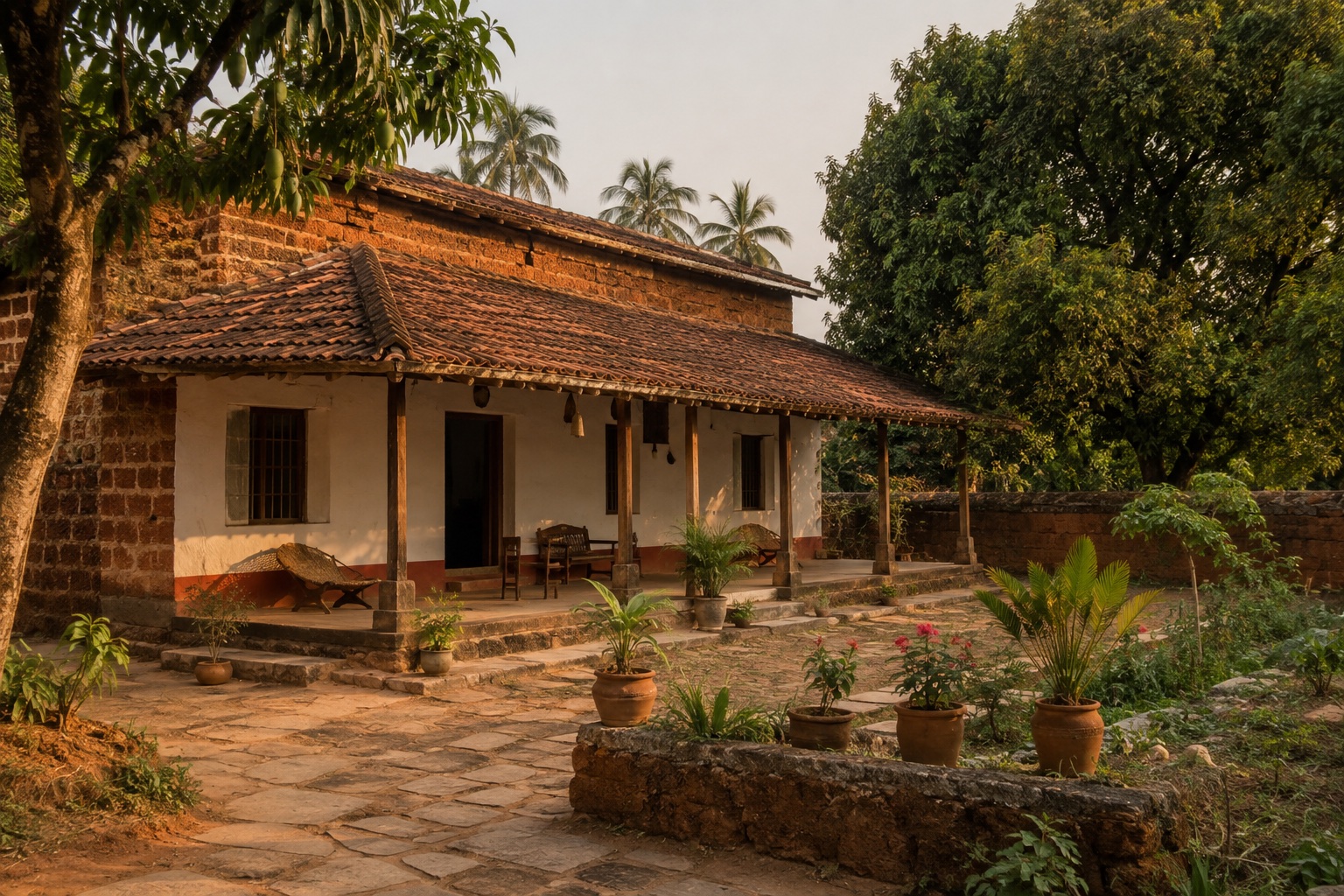
Before you choose the property
Start with the rules that actually shape the project.
Odisha's homestay definition requires the owner and/or family to physically reside and personally host guests.
Category-1 financial assistance is capped at up to 50% of eligible fixed capital investment excluding land, ₹2.5 lakh per room, four rooms and ₹10 lakh total.
The 28 April 2026 Gazette deleted the Category-2 six-room/twelve-bed scheme cap.
Scope: Source-checked regulatory and business-planning guidance. It does not approve a particular title, building, tax position, food activity or operating structure.
01 / Executive finding
The practical starting point
- Odisha currently operates under the Odisha Homestay Establishment Scheme, 2025 — Operational Guidelines, Tourism Department Notification No. 13703─TCT-COOD-Misc-0017/2025/TSM, notified 24 November 2025 and published as Extraordinary Gazette No. 5549 on 29 November 2025. The scheme states that it runs until 31 March 2030, unless earlier discontinued or replaced, and supersedes the 2021 homestay scheme and earlier related orders/guidelines. [S1, cl. 3.2, p. 5]
- A homestay is defined around a natural-person/family host: it is an accommodation unit owned and operated by an individual or family at the same premises or in immediate proximity to their residence, with the owner and/or family physically residing there and personally hosting guests. A caretaker-only or absentee-owner model is therefore not established by the published definition. [S1, cl. 3.1.1(a), p. 3]
- Category 1 is the financial-incentive route for new homestays in notified rural Gram Panchayats outside ULB jurisdiction. The incentive base is limited to four lettable rooms/eight beds, although additional rooms may be built at the owner's own cost subject to applicable norms. [S1, cl. 3.1.1.1(i)–(iii), p. 3]
- The originally notified Category-1 residence rule required the applicant to be a resident of the notified GP. However, Odisha's official eGazette records another instrument titled “Odisha Homestay Establishment Scheme, 2025” dated 05 August 2026, and a secondary regulatory alert reports that Notification No. 10641—TCT-COOD-Misc-0017/2025/TSM, dated 31 July 2026, changed eligibility to residence in the concerned Block, with preference for notified-GP residents. The official August instrument itself was not downloadable from the public eGazette table during this review. Accordingly, the current Category-1 residence rule is not publishable as settled. [S3, eGazette entry; S18, discovery-only]
- The live official Go Homestay portal still states that financial-incentive applicants “must belong to” a notified Gram Panchayat, which appears inconsistent with the later amendment reported above. This is an The official sources are not aligned / PRIMARY TEXT NOT RETRIEVED issue affecting applicants resident elsewhere in the same Block. [S4, live eligibility card]
- Category 2 covers non-financial registration. The November scheme says all other homestays across Odisha, including proposed, under-construction and existing units, may apply; the April 2026 Gazette expressly removed the former six-room/twelve-bed Category-2 limit. The live portal consequently displays “No limit”. Classification, however, remains separately framed for one to six rooms/twelve beds. [S1, cl. 3.1.1.2; S2, items 3 and 11; S1, cl. 3.7.3(b)]
- A material geographic ambiguity remains for Category 2: the controlling scheme says “across the State of Odisha”, but the live portal displays “Eligible Area — All GP”, and the April revised Category-2 application form asks for Block/GP/Village rather than ULB fields. An urban/municipal Category-2 applicant should obtain written confirmation before committing capital. [S1, cl. 3.1.1.2(i), p. 4; S2, Annex III, p. 8; S4]
- Category-1 applications carry a ₹2,000 non-refundable online fee; Category-2 applications carry a ₹1,000 non-refundable online fee. The verified renewal fee is ₹500. Following the 28 April 2026 amendment, both categories use self-renewal through the portal and renewal is processed automatically unless a specific complaint/allegation causes DHC verification; Category-2 registration is valid for five years from the agreement date, while Category-1 registration is five years from CoD. [S1, cls. 3.7.1.3 and 3.7.1.7; S2, items 8–10]
- The financial incentive is up to 50% of fixed capital investment excluding land, capped at ₹2.5 lakh per lettable room, four rooms and ₹10 lakh per homestay. It is not automatic: selection, physical completion verification and SHC approval apply, and later tranches depend on verified booking-night thresholds. [S1, cls. 5.2.1.1–5.2.1.2, pp. 22–23; S2, items 12–13]
- Registered units have unusually specific mandatory operating standards, including visitor records, power backup, hygienic kitchen and complimentary breakfast, purified water, safety arrangements, first aid, cashless payment, staff/host training, minimum 100 sq ft single/120 sq ft double room sizes, attached EWC bathrooms with at least 30 sq ft, running water and water heater, and AC/heating/cooling capable of maintaining 20–25°C. All new homestay construction must have RCC/concrete roofs. [S1, cl. 3.5.1, pp. 6–9]
- The scheme's published bed dimensions appear as “72'x78'” and “36'x78'”. The unit notation appears anomalous, but no corrigendum clarifying whether inches were intended was located. It must not be silently corrected in a public compliance guide. [S1, cl. 3.5.1(l), p. 8]
- The Department of Tourism implements the scheme through the Homestay Cell, District Homestay Committee and State Homestay Committee. The DHC is chaired by the ADM with the TDO as member-convenor; the SHC is chaired by the Director, Tourism. Appeals against DHC/Director/SHC decisions go through the Homestay Portal to the Secretary, Department of Tourism, whose decision the scheme declares final and binding. [S1, cls. 3.7.4 and 4.1–4.2, pp. 18–20]
- Sufficient evidence exists to explain the November 2025 framework and April 2026 amendment, but not to publish a definitive “current eligibility” guide on 05 September 2026 because the later August Gazette text could not be retrieved and the live portal appears not to reflect the reported change. [S2; S3; S4; S18]
02 / Document chronology
Use the current rules and implementation
31 May / 02 June 2021 — Odisha Homestay Establishment Scheme 2021. Notification 4783 established an earlier regime, including a six-room/twelve-bed scope and designated-destination incentive structure. It is now historical. [S19] 24 / 29 November 2025 — Odisha Homestay Establishment Scheme, 2025. Notification 13703/Gazette 5549 replaced the earlier framework. It introduced Category 1 financial-incentive and Category 2 non-financial routes, the Go Homestay portal workflow, mandatory standards, classification, annual reporting, incentives and committees. It expressly states a validity period through 31 March 2030 unless discontinued or replaced. [S1, cl. 3.2] 28 April 2026 — Gazette amendment, Notification 6864. The amendment:
- substituted the notified-GP list;
- omitted Category-1 cl. 3.1.1.1(ix), thereby removing the scheme-level six-metre setback;
- omitted Category-2 cl. 3.1.1.2(ii), thereby removing its six-room/twelve-bed non-financial cap;
- omitted Category-2 cl. 3.1.1.2(v), thereby removing that category's express serving-government-employee exclusion;
- revised allocation/randomisation;
- introduced ₹500 self-renewal with complaint-triggered verification;
- extended Category-2 registration to five years;
- placed classification field verification with a DoT-empanelled third party under SHC supervision;
- changed financial completion verification to the TDO's Physical Completion Certificate plus geotagged photographs;
- replaced Annexures II and III and added Category-1 Annexure XII. [S2, items 1–14] 02 May 2026 — Cycle-1 target letter. The Tourism Department issued cluster-wise targets. This is implementation material, not a permanent definition of eligibility and not evidence that the application window remains open on 05 September 2026. [S6] 31 July / 05 August 2026 — later amendment apparently issued/published. Official eGazette metadata confirms an Odisha Homestay Scheme Gazette entry dated 05 August 2026. The downloadable primary text was not retrievable. S18 reports Notification 10641 dated 31 July, changing Category-1 residence from the notified GP to the concerned Block, giving preference to notified-GP residents, and correcting a Rayagada GP entry from Kulusing to Puttasing. Until the primary text is obtained, those propositions remain unverified discovery leads rather than publishable requirements. [S3; S18]
03 / Category definitions
Choose the right accommodation category
| Category | Location | Eligible owner/applicant | Residence requirement | Operator allowed | Capacity | Food position | Source |
|---|---|---|---|---|---|---|---|
| Odisha Homestay — general definition | Same premises or immediate proximity to owner/family residence | Individual or family; lease provisions elsewhere create interpretive tension | Owner and/or family physically reside and personally host | Independent professional operator replacing host: Not stated in the material reviewed | General definition itself gives no number | Registered unit must maintain hygienic kitchen and complimentary breakfast as minimum | S1 cl. 3.1.1(a), cl. 3.5.1(d). |
| Category 1 — financial incentive | New units in notified rural GPs, outside ULB jurisdiction | Natural-person form; owner or applicant with ≥10-year lease; joint-owner NOCs | CURRENT RULE NOT SAFELY SETTLED: S1 says notified-GP resident; later inaccessible Gazette apparently changed this to concerned Block | No evidence that a company/management operator may replace resident host | Incentive limited to 4 rooms/8 beds; extra rooms at own cost subject to norms | Mandatory breakfast/kitchen rule | S1; S2; S3; S18. |
| Category 2 — non-financial | S1 says all other homestays across Odisha; portal says “All GP” | Odisha-resident individual; ownership or valid lease | Applicant must be resident of Odisha under unchanged main scheme | Corporate registration holder Not stated in the material reviewed | S2 removed scheme Cat-2 cap; portal says no limit | Mandatory breakfast/kitchen rule | S1 cl.3.1.1.2; S2 item 3; S4. |
| Gold/Silver classified homestay | Registered Odisha homestay | Classification application identifies applicant/owner; main classification clause says owner or operator of house | Underlying homestay rules continue | “Owner or operator” appears for classification, but this does not establish corporate operator eligibility for registration | Classification: min 1, max 6 rooms/12 beds | Hygienic kitchen + breakfast mandatory | S1 cl.3.7.3 and Annex VIII. |
| Hotel | Odisha Tourism Policy category | Policy's eligible Tourism Unit framework | No homestay residence condition | Commercial operation contemplated | Star-category conditions apply for policy incentive recognition | Hotel operation | S7 paras.12–13; not a homestay definition. |
| Resort | Odisha | Defined as Tourism Unit under policy | No homestay residence condition | Commercial operator contemplated | Resort standards are separate | Separate hospitality category | S7 |
| Apartment Hotel | Odisha | Tourism Unit | No homestay residence requirement | Commercial operation | Must comply with MoT Apartment Hotel guidelines; minimum 3-star for policy definition, with higher incentive condition in specified development-authority areas | Hotel-style services; in-room kitchenette/living areas contemplated | S7, p.16. |
| Heritage Hotel | Qualifying heritage property | Separate Tourism Unit | No homestay residence rule located | Commercial operation | Separate heritage requirements | Separate hotel category | S7 |
| B&B / Bed & Breakfast | — | Not stated in the current official material reviewed REVIEWED | Not stated in the material reviewed | Not stated in the material reviewed | Not stated in the material reviewed | Not stated in the material reviewed | No state definition located in reviewed material |
| Guest house | — | Not stated in the current official material reviewed REVIEWED | Not stated in the material reviewed | Not stated in the material reviewed | Not stated in the material reviewed | Not stated in the material reviewed | — |
| Farm stay | — | Not stated in the current official material reviewed REVIEWED | Not stated in the material reviewed | Not stated in the material reviewed | Not stated in the material reviewed | Not stated in the material reviewed | — |
| Generic serviced accommodation | — | Not stated in the current official material reviewed REVIEWED | Not stated in the material reviewed | Not stated in the material reviewed | Not stated in the material reviewed | Not stated in the material reviewed | Apartment Hotel is separately defined; it should not automatically be equated with generic serviced accommodation. |
Odisha Tourism Policy 2022 expressly says private house owners are encouraged to provide homestays and that the Tourism Department implements a separate homestay scheme. Homestay is not included in the policy's current enumerated definition of “Tourism Unit”; therefore general Tourism Unit corporate eligibility or capital incentives cannot automatically be imported into the Homestay Scheme. [S7, paras.11(m), 12]
04 / Eligibility decision tree
Check whether the applicant and property qualify
1. Start with the exact property address and local-body category.
- Is the property in a GP appearing in the latest notified Category-1 list and outside ULB jurisdiction?
- Yes: Category 1 may be relevant. Continue.
- No, but elsewhere in Odisha: Category 2 may be relevant, although urban/ULB portal acceptance is unresolved. → Confirm this in writing with the authority for ULB properties.
- Exact local-body status unknown → Not established in the published material until the address is mapped. 2. Establish ownership/lease.
- Clear individual title, with no ongoing dispute → continue.
- Joint ownership with written NOC from all co-sharers → continue.
- Category-1 lease of at least ten years, properly documented → textually eligible at application level, but reconcile with general “owned and operated” definition. → Confirm this in writing with the authority.
- Category-2 valid lease → textually contemplated, subject to the same definitional issue. → Confirm this in writing with the authority.
- Informal occupation/licence without qualifying ownership/lease evidence → does not appear to fit the published homestay definition on present evidence. 3. Establish applicant identity and residency.
- Natural person, ≥18, with required identity/bank documentation → continue.
- Category-2 applicant resident in Odisha → fits published November rule.
- Category-1 applicant resident in notified GP → satisfies both the original rule and current public portal card, subject to all other requirements.
- Category-1 applicant outside notified GP but inside the relevant Block → potential eligibility under the reported July amendment, but primary amendment unavailable. → Confirm this in writing with the authority.
- Company, LLP, partnership, trust or society proposes to be registration holder → Not established in the published material. 4. Determine who will live at the property.
- Owner and/or family physically lives there and personally hosts guests → continue.
- Owner lives elsewhere but qualifying family genuinely resides and personally hosts → may meet literal definition, subject to applicant/title position. → This appears to fit the published route, subject to the remaining checks if all other conditions are met.
- Nobody from owner/family resides there; only caretaker or hired manager → does not appear to fit the published homestay definition.
- Residence arrangement unclear or seasonal → Confirm this in writing with the authority. 5. Determine who operates it.
- Resident owner/family operates and personally hosts → continue.
- Owner/family remains resident host while professional staff or outsourced personnel assist → potentially compatible; revised form expressly records outsourced staff. → This appears to fit the published route, subject to the remaining checks, subject to the operator contract not displacing the host.
- Management company intends to become sole operator while owner/family is absent → does not appear to fit the published homestay definition on present evidence.
- Management company assists while owner/family remains legal applicant/host → exact contractual boundary is Not established in the published material; → Confirm this in writing with the authority. 6. Check room and bed plan.
- Category 1: financial claim is for ≤4 rooms/8 beds → continue.
- Category 1 with more rooms → extra rooms may be privately funded; local-building and classification implications remain.
- Category 2: no scheme-level maximum remains after April 2026; local-building rules still apply.
- Gold/Silver classification sought with >6 rooms/12 beds → Consider another accommodation category or require unclassified Category-2 treatment; classification annex is capped at six rooms/twelve beds. 7. Establish project status.
- New construction in Category-1 area → may pursue financial incentive if latest residence/location criteria are satisfied. → This appears to fit the published route, subject to the remaining checks.
- Proposed/under-construction/existing unit elsewhere → Category-2 text expressly contemplates these statuses. → This appears to fit the published route, subject to the remaining checks, subject to residence/geography issues.
- Existing running homestay → Category-2 rule expressly permits application. → This appears to fit the published route, subject to the remaining checks.
- Purpose-built commercially operated lodging with no resident family host → Consider another accommodation category. Use these branches as a starting test and confirm the result for the exact property.
05 / Applicant and operating structures
Set the ownership and operating structure
| Structure | Supported route | Main obstacle | Source | Question requiring clarification |
|---|---|---|---|---|
| Resident individual owner | Strongest fit: owner/titleholder resides and personally hosts | Must satisfy location, documents and facilities | S1 cl.3.1.1(a) | None beyond address-specific approvals |
| Joint/inherited ownership | Permitted where all co-sharers give written NOCs | Title must be clear; host rule still applies | S1 cl.3.1.1.1(viii), 3.1.1.2(vii); S2 forms | Form of NOC and portal upload format |
| Owner living elsewhere | Only potentially fits where family genuinely resides and personally hosts | Absentee model is inconsistent with core definition | S1 cl.3.1.1(a) | Whether a specific family arrangement satisfies “personally host” |
| Owner using caretaker | Staff may assist; caretaker substitution not supported | Residence/personal-host requirement | S1; S2 Annex III staffing | Can caretaker ever satisfy host requirement? No provision located |
| Long-term lessee | Category-1 expressly allows ≥10-year lease; Cat-2 allows valid lease | Tension with general “owned and operated” wording | S1; S2 Annex II identifies lessee as applicant | Does an eligible resident lessee qualify notwithstanding cl.3.1.1(a)? |
| Company / partnership / LLP | Not stated in the material reviewed as homestay registration holder | Forms and eligibility are framed around natural persons/Aadhaar/DOB/residence | S1/S2 | Can any juridical person hold RC or only contract with individual holder? |
| Professional management company | Support functions may be contractible; outsourced staff expressly appear in form | No authority found for company to replace applicant/resident host | S2 Annex III | Which management functions can be delegated without violating personal-host condition? |
| Capital-only participant | May finance/invest contractually, but is not thereby eligible applicant | Tourism scheme identifies applicant/host, not passive investor | S2 Annex II asks investment source | Can third-party equity/capital be used, and must it be disclosed? Not stated in the material reviewed |
| Landowner proposing construction | Category-1 new construction or Category-2 proposed unit depending location | Latest Cat-1 residence rule; building approvals | S1/S2 | Address-specific planning and building permission before commitment |
| Running homestay | Existing units expressly may register under Cat-2 | Must retrofit mandatory standards and provide required documents | S1 cl.3.1.1.2(viii) | Treatment of historical constructions where some listed documents are unavailable |
A management agreement, lease, LLP or company does not by itself cure the requirement that the homestay be a resident-host accommodation. No provision authorising a juridical entity to substitute for the eligible natural-person registration holder was located.
06 / Property and classification standards
Prepare the property for inspection
| Topic | Mandatory / classification / guidance / unclear | Requirement | Applies when | Source | Confidence |
|---|---|---|---|---|---|
| Resident host | Mandatory definition | Owner and/or family physically resides and personally hosts | All scheme homestays | S1 cl.3.1.1(a) | HIGH |
| Legal dispute | Mandatory | Premises/land not involved in ongoing dispute | All | S1 cl.3.1.1(c) | HIGH |
| Category-1 rooms/beds | Incentive condition | Max 4 rooms/8 beds eligible for financial assistance; extra privately funded rooms possible | Cat-1 incentive | S1 cl.3.1.1.1(ii) | HIGH |
| Category-2 rooms/beds | Mandatory cap removed | April amendment deletes old 6/12 scheme cap | Cat-2 | S2 item 3; S4 “No limit” | HIGH |
| Classification capacity | Classification | 1–6 rooms, max 12 beds | Gold/Silver classification | S1 cl.3.7.3(b) | HIGH |
| Room size | Mandatory | 100 sq ft single; 120 sq ft double carpet area | All registered | S1 cl.3.5.1(k) | HIGH |
| Bed dimensions | Mandatory but text anomalous | Published as 72'x78' double or 2 × 36'x78'; single 36'x78' | All | S1 cl.3.5.1(l) | LOW pending unit clarification |
| Bathroom | Mandatory | Attached hygienic toilet-bathroom, EWC, running water, water heater, toiletries; base minimum 30 sq ft | All | S1 cl.3.5.1(n) | HIGH |
| Gold bathroom | Classification | Annex VIII shows 40 sq ft Gold, 30 sq ft Silver | Classified | S1 Annex VIII | HIGH |
| Kitchen | Mandatory | Clean/hygienic kitchen in premises or close proximity | All | S1 cl.3.5.1(d) | HIGH |
| Breakfast | Mandatory | Complimentary breakfast as minimum inclusion | All | S1 cl.3.5.1(d) | HIGH |
| Potable water | Mandatory | Safe purified water for cooking and guests; purifier maintained | All | S1 cl.3.5.1(d) | HIGH |
| Hot water | Mandatory | Operational water heater; classification checklist calls for 24-hour hot/cold water | All/classification | S1 | HIGH |
| Power backup | Mandatory | Backup sufficient for lighting, ceiling fan, perishables and basic charging | All | S1 cl.3.5.1(c) | HIGH |
| Heating/cooling | Mandatory | Ceiling fan plus AC including heating/cooling to maintain 20–25°C | All | S1 cl.3.5.1(o) | HIGH |
| Electrical sockets | Mandatory | Three earthed min 6A-250V sockets and one 15A earthed socket; adapter/extension where required | All | S1 cl.3.5.1(p) | HIGH |
| New roof | Mandatory | All new homestay construction RCC/concrete roof | New construction | S1 cl.3.5.1(m) | HIGH |
| Building plan | Adjacent legal requirement / application document | Cat-1 PRC requires approval unless project falls in an exempt building-plan category; Cat-2 revised form lists Building Plan Approval | Depending building/local law | S2 Annex III/XII | HIGH that tourism expects it; address applicability requires review |
| Six-metre setback | No longer a scheme rule | Former Cat-1 clause deleted 28 Apr 2026; local planning setback may still apply | Cat-1 | S2 item 2 | HIGH |
| Safety/security | Mandatory | Necessary security measures, safety signage/warnings and emergency contacts | All | S1 cl.3.5.1(e) | HIGH |
| Fire extinguishers | Form/classification/application issue | Revised Cat-2 form asks whether available and separately lists Fire Safety Certificate | Cat-2 | S2 Annex III | HIGH as form field; legal applicability address-specific |
| Pest control | Mandatory | Adequate regular pest control | All | S1 cl.3.5.1(f) | HIGH |
| First aid | Mandatory | Adequate first-aid kit plus local doctors/medical-facility directory | All | S1 cl.3.5.1(g) | HIGH |
| Cashless payment | Mandatory | Electronic/cashless option for visitors | All | S1 cl.3.5.1(h) | HIGH |
| Staff/host training | Mandatory | At least one employed staff/owner representative completes basic DoT-designed hospitality training before commercial operation | All | S1 cl.3.5.1(i) | HIGH |
| Wages | Mandatory | Employment terms must satisfy prevailing government norms | If staff employed | S1 cl.3.5.1(j) | HIGH |
| Reception | Not stated in the material reviewed as mandatory standalone reception requirement | Lobby appears in photo requirements; separate reception-desk rule not located | — | S1 | — |
| Signage | Mandatory safety signage | Safety/warning and emergency information | All | S1 cl.3.5.1(e) | HIGH |
| Parking | Desirable | Safe parking arrangements; Annex VIII desirable | All/classification | S1 cl.3.5.2(f), Annex VIII | HIGH as desirable, not base mandatory |
| Internet/Wi-Fi | Desirable | Free/chargeable Wi-Fi | All/classification | S1 cl.3.5.2(c), Annex VIII | HIGH |
| Accessibility | Desirable, not base mandatory | Disabled-friendly facilities | All/classification | S1 cl.3.5.2(d), Annex VIII | HIGH |
| Laundry | Desirable | Laundry service/facilities | All/classification | S1 | HIGH |
| Common/lounge space | Classification/desirable | Lounge/seating in lobby appears in Annex VIII | Classification | S1 Annex VIII | HIGH |
| Waste | Portal/form + adjacent local obligation | Revised Cat-2 form lists waste arrangements and SWM user-fee receipt/registration | Cat-2/local body | S2 Annex III | MEDIUM due local applicability |
| Fire safety certificate | Portal form / adjacent law | Annex III lists FSC without “if applicable”; classification form says updated Fire/FSSAI/local clearances if applicable | Address-specific | S2; S1 Annex IX | MEDIUM/conflicting application wording |
| Approach road | Form field | Revised Cat-2 form records bituminous/pucca/kachha approach | Cat-2 | S2 Annex III | HIGH as requested information; not located as disqualifying threshold |
| Structural certificate | Not stated in the material reviewed as universal tourism upload | Building safety rules remain independently applicable | Address-specific | — | — |
| Insurance | Not stated in the material reviewed as mandatory scheme requirement | Liability/property/public-liability cover is a practical risk-management recommendation only | Operations | — | — |
The room/bathroom/utility standards above are explicit scheme standards. Parking, Wi-Fi and disabled-friendly features sit in the scheme's desirable list rather than the core mandatory list.
07 / Documents and declarations
Assemble the application file
| Document | Who provides/signs | Format/stamp requirement | Validity period | When required | Source | Unresolved issue |
|---|---|---|---|---|---|---|
| Online Category-1 application | Applicant | Portal form, Annex II as revised | Application-specific | Initial Cat-1 | S2 Annex II | Authenticated portal validations not inspected |
| Aadhaar | Applicant | Number/details; attachment where portal requires | Current identity | Initial | S1/S2 | — |
| PAN | Applicant | Main rule says valid PAN mandatory; revised Cat-1 form says optional | Current | Initial | S1 cl.3.1.1.1(v); S2 Annex II | Conflict; main text ordinarily prevails Annexures |
| Aadhaar-linked bank account | Applicant | Account/IFSC; supporting passbook/cancelled cheque contemplated in original form | Current | Initial/incentive DBT | S1/S2 | — |
| Ownership record | Owner/applicant | Mouza, Khatiyan, plot, Tahasil, Kisam and ownership document in revised Cat-1 form | Current | Initial | S2 Annex II | Exact acceptable evidence can vary |
| Registered lease | Lessee/applicant | Cat-1 minimum 10 years; revised form asks registration number/date and attachment | Must cover required term | Initial | S1/S2 | Cat-2 minimum duration not specified |
| Lessor NOC | Lessor | Attachment if applicable | Not stated in the material reviewed | Lease case | S2 Annex II | Exact form/notarisation not located |
| Co-owner NOC | All co-sharers | Written NOC; revised Cat-1 form also asks co-owner signature and ID | Not stated in the material reviewed | Joint title | S1/S2 | No prescribed stamp/notary requirement located |
| Layout plan | Applicant/technical preparer | Attached | Project-specific | Cat-1 application | S2 Annex II | Required technical scale/format Not stated in the material reviewed |
| Project cost/investment source | Applicant | Portal fields | Application-specific | Cat-1 | S2 Annex II | Third-party equity treatment not described |
| Bank-loan details | Applicant | Bank and scheme name if loan used | Application-specific | Cat-1 where applicable | S2 Annex II | Loan sanction not itself subsidy approval |
| Authenticity undertaking | Applicant | Annex IV, signed | Application-specific | Cat-1 and Cat-2 | S1 Annex IV | No stamp-paper/notarisation requirement located |
| Category-2 application | Applicant | Annex III revised; online only | Application-specific | Cat-2 | S2 | — |
| Cat-2 land documents | Applicant | ROR/sale deed/lease/NOC for joint property | Current | Initial | S2 Annex III | — |
| Trade licence | Applicant/property | Certificate | Local validity | Cat-2 revised form lists it | S2 Annex III | Whether every rural homestay must possess one at initial application requires local/DoT clarification |
| Building Plan Approval | Applicant/property | Approval | Project/local-law dependent | Cat-2 form; Cat-1 before completion unless exempt | S2 Annex III/XII | Treatment of exempt/old buildings |
| Fire Safety Certificate | Applicant/property | Certificate | Fire-law dependent | Listed in Cat-2 form | S2 Annex III | Form gives no N/A qualifier; underlying legal applicability is property-specific |
| Electricity Safety Certificate | Applicant/property | Certificate | Not stated in the material reviewed | Listed in Cat-2 form | S2 Annex III | Exact issuing authority and universal applicability need address-specific review |
| Water bill | Applicant/property | Bill | Current preferred | Cat-2 form | S2 Annex III | Alternative where no billed public supply Not stated in the material reviewed |
| Electricity bill | Applicant/property | Bill | Current preferred | Cat-2 form | S2 Annex III | — |
| SWM user-fee receipt/registration certificate | Applicant/property | Receipt/certificate | Current/local | Cat-2 form | S2 Annex III | Rural applicability/N.A. process unclear |
| Location plan | Applicant | Shows access from major roads | Project-specific | Cat-2 | S1 cl.3.7.2.2 | File format not located |
| Photographs | Applicant | Soft copies: building, façade, street, lobby, all rooms, dining, other facilities | Current representation | Cat-2 | S1 cl.3.7.2.2 | File-size/type Not stated in the material reviewed |
| Geotagged progress photos | Cat-1 applicant | Upload | Current | Construction extension | S1 Annex VI | — |
| Geotagged completion photos | TDO | Portal upload with Physical Completion Certificate | At CoD | Cat-1 incentive | S2 items 12–13 | — |
| Classification RC copy | Applicant | Current DoT certificate | Current | Classification/reclassification | S1 Annex IX | — |
| Classification geotagged photos | Applicant | Exterior, rooms, common areas | Current | Classification | S1 Annex IX | — |
| Fire/FSSAI/local clearances | Applicant | Updated certificates if applicable | Current | Classification | S1 Annex IX | Better qualifier than revised Cat-2 form, creating application ambiguity |
| Previous classification certificate | Applicant | Copy | Previous cycle | Reclassification only | S1 Annex IX | — |
| Annual booking summary | Owner | Portal/OTA/ONDC extract | Reporting FY | Annual declaration by 30 Apr | S1 Annex X | — |
| Fire/local-body renewal | Owner | Copy if applicable | Current | Annual declaration | S1 Annex X | — |
| Police/character certificate | — | Not stated in the material reviewed | — | — | — | No current scheme requirement located |
| Stamp-paper affidavit | — | Not stated in the material reviewed | — | — | — | Annex IV is a signed undertaking, not identified as affidavit |
| Staff police verification | — | Not stated in the material reviewed | — | — | — | Separate local/police requirement should be checked if applicable |
The base scheme explicitly requires Annex II/III, Annex IV and allows DoT to require additional documents. The April amendment's revised Annex III adds the eight listed Category-2 documents.
08 / Application and inspection process
Follow the application and inspection process
Category 1 — financial incentive
| Step | Responsible person/authority | Input | Resulting record | Stated period | What does not happen automatically |
|---|---|---|---|---|---|
| 1. Confirm notified area/current residency rule | Applicant/DoT | Address, GP, Block, residence | Eligibility position | Before applying | Being in a tourist area does not itself qualify |
| 2. Wait for/open application cycle | DoT | Published cycle/window | Portal application access | Window predefined by DoT | No permanent open-window right located |
| 3. Online application | Applicant | Revised Annex II, Annex IV, documents | Application ID | During notified window | Submission ≠ selection |
| 4. Fee payment | Applicant | ₹2,000 | Payment record | At submission | Fee is non-refundable; payment ≠ approval |
| 5. Preliminary routing | Homestay Cell | Application | District referral | No general SLA located | Completeness ≠ eligibility |
| 6. DHC scrutiny/field verification | DHC | Documents, property | Annex V/evaluation report | No general statutory SLA located | Field verification ≠ selection |
| 7. Defect clarification | Applicant/DHC | Requested clarification | Completed/rejected file | “Reasonable opportunity”; no numeric period located | Defects may still result in rejection |
| 8. Target/randomisation where applicable | Homestay Cell/DoT/SHC | Eligible applications, cluster target | Shortlist/result | Cycle-specific | Valid application does not guarantee target allocation |
| 9. PRC | SHC/DoT | Selected application | Category-1 PRC | — | PRC is not final construction approval |
| 10. Obtain building approval if applicable and construct | Applicant | Approved plan/exemption evidence | Completed project | 12 months from PRC initially | PRC does not override planning law |
| 11. Extension if necessary | Applicant → DHC/Director | Annex VI, progress details/geotagged photos | Extension decision | DHC may grant up to six months; cumulative period cannot exceed 24 months from PRC | Extension is discretionary, not automatic. |
| 12. Agreement | Applicant/TDO | PRC/approved project | Formal agreement | Within 2 months of PRC under published wording | Failure can lead to cancellation recommendation. |
| 13. CoD/completion verification | TDO | Completed project | Physical Completion Certificate + geotagged photos | At CoD | Completion does not guarantee incentive |
| 14. Incentive approval | SHC | TDO completion material | Approved eligible amount | No general SLA | SHC approval required |
| 15. Registration/operations | DoT/owner | CoD, agreement, compliance | Registration | 5 years from CoD | Tourism registration does not replace adjacent approvals |
| 16. Classification if sought | Applicant + empanelled third party + SHC | Annex IX/VIII | Gold/Silver certificate | Certificate to end of second succeeding FY | Classification is indicative, not government guarantee |
The portal is designed to accept applications, uploads and payments; manage inspection reports, approvals/rejections and lottery results; issue PRCs/approvals; receive extensions/renewals and grievances; and support visitor reporting. [S1, cl.3.6]
Category 2 — non-financial
The scheme provides for online submission throughout the scheme framework rather than fixed Category-1 cycles; the DHC checks completeness/eligibility, may seek further information and arrange field verification, and forwards eligible cases to DoT for registration. [S1, cls.3.7.2.1–3.7.2.4] The April 2026 amendment does not create a general guaranteed approval period. After approval, the homestay enters a formal agreement with the district TDO; registration is now five years from that agreement. [S2, item 9]
Refusal and appeal
Incomplete or ineligible Category-1 applications may be rejected after reasonable opportunity to clarify, with reasons communicated through the portal. Any applicant aggrieved by a DHC, Director Tourism or SHC decision may appeal through the Homestay Portal to the Secretary, Department of Tourism. [S1, cls.3.7.1.4(c), 3.7.4]
09 / Fees, timelines, validity and renewal
Confirm fees, timing and certificate validity
| Item | Verified amount/time | Nature | Source |
|---|---|---|---|
| Category-1 application fee | ₹2,000 | Non-refundable; online | S1 cl.3.7.1.3. |
| Category-2 application fee | ₹1,000 | Non-refundable; online | S1 cl.3.7.2.3. |
| Renewal fee | ₹500 | Self-renewal; complaints can trigger DHC verification | S2 items 8 & 10. |
| Classification fee | Not stated in the current official material reviewed | — | — |
| Inspection fee | Not stated in the material reviewed | — | — |
| Reclassification fee | Not stated in the material reviewed | — | — |
| Cat-1 initial construction period | 12 months from PRC | Scheme deadline | S2 Annex XII. |
| DHC construction extension | Up to 6 months | Discretionary | S1 cl.3.7.1.6 |
| Maximum cumulative Cat-1 construction period | 24 months from PRC | Maximum before incentive ineligibility | S1 cl.3.7.1.6(g). |
| Agreement after Cat-1 PRC | Within 2 months | Scheme requirement | S1/S2. |
| Category-1 registration validity | 5 years from CoD | Registration period | S1 cl.3.7.1.7(c). |
| Category-2 registration validity | 5 years from agreement | Replaced former 2-year rule | S2 item 9. |
| Renewal filing window | Before expiry; exact number of days Not stated in the material reviewed | Administrative | S1/S2 |
| Classification certificate | Until end of second succeeding financial year from issue | Classification validity | S1 cl.3.7.3(i). |
| Annual compliance | On/before 30 April every year | Mandatory reporting | S1 cl.3.4(g), Annex X. |
| General application processing SLA | Not stated in the material reviewed | No guaranteed approval period found | — |
| Refund after rejection | Application fees expressly non-refundable; other refund regime Not stated in the material reviewed | — | S1 |
Legacy certificates issued under the earlier 2021 scheme should not simply be assumed to have the new periods; the treatment of every historical certificate requires its own instrument/certificate review. A specific automatic conversion rule was Not stated in the material reviewed.
10 / Operating duties after registration
Run the registered homestay correctly
A registered Odisha homestay must maintain a visitor register containing guest identity/contact information and retain a copy of government-issued photo identification; the scheme expressly requires a passport for foreign nationals. [S1, cl.3.5.1(a)] For financial-incentive units, the scheme expressly requires use of the DoT Visitor Management Portal for online check-in/check-out and real-time visitor information, including upload of government-issued IDs. The scheme also supplies a visitor-management system to eligible homestays more generally, but the exact compulsory real-time rule for every unclassified Category-2 unit is not drafted with the same clarity and should be confirmed. [S1, cl.3.5.1(b); cl.5.2.2] Every beneficiary must submit the annual self-declaration through Go Homestay on or before 30 April, with booking records and operational data. Annex X asks for operational rooms/beds, guest nights, revenue, occupancy, staffing and compliance and requires booking extracts, photographs and fire/local-body renewal copies if applicable. [S1, cl.3.4(g)–(i), Annex X] Operational property standards in Section 8 remain ongoing conditions. The scheme permits a departmental penalty of up to ₹10,000 for breach of applicable government directives/SOPs; continuing non-compliance may lead to revocation and, for incentivised units, recovery. Before a penalty or cancellation, the Director Tourism must issue a show-cause notice allowing 30 days to respond and a reasonable opportunity to present the case. [S1, cl.3.4] For foreign guests, a separate central obligation applies. Rule 17 of the Immigration and Foreigners Rules, 2025 expressly includes home stay within “accommodation”; the keeper must electronically maintain the prescribed foreigner records for at least one year, transmit Form III not later than 24 hours after arrival, and transmit departure details not later than 24 hours after departure through the designated system. [S12, Rule 17, pp.27–28] Other post-registration findings:
- Rate display:
Not stated in the current official material reviewed. - Mandatory guest invoice format:
Not stated in the material reviewed. - Specific homestay complaint-register format:
Not stated in the material reviewed. - Monthly tourism statistics:
Not stated in the material reviewed; annual 30-April declaration is verified. - Domestic guest police reporting separate from the tourism portal:
Not stated in the material reviewedas a universal state requirement. - Staff/caretaker police verification:
Not stated in the material reviewed. - Incident-reporting deadline:
Not stated in the material reviewed. - Mandatory insurance:
Not stated in the material reviewed. - Local employment quota:
Not stated in the material reviewed; Annex X records local staff and the scheme regulates staff training/wages, but no quota was found.
11 / Adjacent approvals and dependencies
Close the approvals outside Tourism
| Topic | What tourism registration resolves | What it does not resolve | Likely authority | Official source located | Property-specific question |
|---|---|---|---|---|---|
| Land/title | Confirms tourism scheme evidence was accepted | Civil title validity, mutation, encumbrances, land conversion | Revenue/local land authority | S1/S2 | Is title/lease valid and land use compatible? |
| Building use / plan | Tourism scheme asks for relevant approval | Sanctioned plan, land-use conversion, occupancy/completion legality | GP/ULB/development authority | S2 Annex III/XII | Which building rules apply to exact plot? |
| Older construction | Tourism may inspect existing Cat-2 unit | Regularisation/occupancy legality | Local building authority | Partial | What evidence substitutes where historic plan unavailable? |
| Fire | Tourism form can request FSC | Whether the premises legally require FSC and technical compliance | Odisha Fire & Emergency Service | S16 + S2 | Does exact building fall in applicable fire category? |
| Food | Homestay scheme mandates breakfast/kitchen | Food-business registration/licensing | FSSAI/FoSCoS | S10/S11 | Correct Kind of Business and turnover/licence class |
| Police | Tourism portal supports visitor information | Any additional local police directions | Odisha Police/local police | Partial | Are there district-specific accommodator requirements? |
| Foreign guests | Nothing replaces central reporting | Form III/FRRO compliance | Bureau of Immigration/FRRO | S12/S13 | Accommodator registration and operating workflow |
| Environment | Tourism registration does not create environmental approval | CRZ, pollution, wetland/environment rules | Relevant state/central authority | S7 general facilitation | Is plot within regulated/coastal/ecologically sensitive area? |
| Forest/protected area | SHC includes Forest representative where unit near protected area/forest | Forest/wildlife permissions | Forest, Environment & Climate Change Department / competent wildlife authority | S1 cl.4.2.1 | Distance/status of exact site |
| Local body | Tourism registration | Trade licence, SWM, building, property-use requirements | GP/ULB | S2 form | Which certificates apply locally? |
| GST | None | GST registration, rate, invoicing, input tax etc. | CBIC/GST authorities | S14 | Entity/turnover/supply-channel analysis |
| Udyam | None | MSME registration choice/eligibility | Ministry of MSME | S15 | Is Udyam commercially useful? It is not a located homestay prerequisite |
| Water | Scheme requires running/purified water and Cat-2 form asks water bill | Connection legality, borewell/groundwater permissions where relevant | Local utility/competent authority | S1/S2 | Supply source and lawful use |
| Electricity | Scheme requires power/backup; form asks electricity and safety certificates | Connection category/load/electrical approval | Utility/electrical authority | S2 | Correct connection category/load |
| Property tax | None | Assessment/use classification | Local body | No statewide homestay concession located | Does lodging use change local assessment? |
| Coastal/CRZ | None | CRZ permission | Coastal/environment authority | S7 identifies CRZ as separate clearance | Is plot within CRZ and what zone? |
| Heritage | None | Heritage-building/site controls | Relevant heritage/local authority | Not stated in the material reviewed for universal rule | Is building/precinct protected? |
| Waste | Scheme/forms require appropriate management | Municipal/GP SWM compliance | Local body | S2 | Is SWM user-fee registration required at that address? |
The revised Cat-2 form's unqualified document list—Trade Licence, Building Plan Approval, Fire Safety Certificate, Electricity Safety Certificate, water/electricity bills and SWM receipt—should not be read to mean that the underlying laws impose every certificate on every property. For example, Annex IX itself qualifies updated Fire/FSSAI/local clearances with “if applicable,” and Category-1 PRC recognises that some built-up areas may be exempt from building-plan approval. [S1 Annex IX; S2 Annex XII] FSSAI's current turnover criteria, effective 01 April 2026, are registration up to ₹1.5 crore, State Licence above ₹1.5 crore and up to ₹50 crore, and Central Licence above ₹50 crore; the order expressly supersedes earlier turnover criteria. The appropriate business category and any non-turnover licensing trigger must still be tested in FoSCoS. [S10] Under CGST Act s.22, the general registration provision refers to aggregate turnover exceeding ₹20 lakh for suppliers in non-special-category States, but compulsory-registration provisions and the actual nature/channel of supply must also be examined; the tourism certificate itself is not a GST determination. [S14, s.22]
12 / Incentives, subsidy and funding
Evaluate incentives without assuming sanction
A. Odisha Homestay Establishment Scheme, 2025 — Category-1 capital assistance
Eligible applicant/location: eligible Category-1 beneficiary establishing a new homestay in a notified rural GP outside ULB jurisdiction, subject to the unresolved August 2026 residency amendment. Existing units are not the financial-incentive target under the located scheme text. [S1, cl.3.1.1.1; cl.5.2] Eligible expenditure: civil structure, landscaping, plumbing/masonry, interiors/furnishing, electrical installation, electronic appliances including internet equipment, furniture/fixtures, kitchen equipment, water purifier, septic tank, generator/AC, security/safety installations, one-time cooking-gas/electricity/water connections and other site-specific components approved through the DHC/SHC route. [S1, cl.5.2.1] Assistance: up to 50% of fixed capital investment excluding land, with ceilings of ₹2.5 lakh per lettable room, four rooms and ₹10 lakh total. “Up to” and the ceilings are important: ₹10 lakh is not an automatic entitlement. [S1, cl.5.2.1.1(a)] Verification/sanction route: the April amendment requires the TDO to verify completion at CoD and upload a Physical Completion Certificate and geotagged photographs. SHC grants final approval for eligible disbursement. [S2, items 12–13] Disbursement:
- 50% of approved incentive at achievement of CoD;
- 15% after Year 1, conditional on minimum 15 nights bookings per room logged in the visitor-management portal;
- 15% after Year 2, minimum 30 nights per room;
- 20% after Year 3, minimum 45 nights per room. [S1, cl.5.2.1.2] Bank route: the revised form records whether funding is own funds, bank loan or both, and asks for bank/loan-scheme details. Subsidy itself is routed to the owner's Aadhaar-linked bank account under the scheme. A bank loan is not stated to be compulsory. [S1/S2] Operation condition/recovery: incentivised units commit to operate for five consecutive years from CoD. Closure before five years creates staged recovery—100%, 80%, 50%, 25% or 10% of subsidy disbursed depending on closure year—with 9% p.a. interest under the schedule. [S1, cl.5.2.3] Current application status: NOT CONFIRMED OPEN ON 05 SEPTEMBER 2026. A Cycle-1 target letter exists, but a current application deadline/window was not located. Applicants must not spend on the assumption that the incentive window is continuously open.
B. Domestic tourism event support for registered homestays
Odisha Tourism Policy 2022 as amended in 2026 states that registered homestay owners participating in domestic tourism events may receive free exhibition space plus up to 80% of actual travel expenditure, capped at ₹50,000 for one event in a financial year, available once each year. This remains an application/approval-dependent incentive and should not be booked as guaranteed revenue or reimbursement. [S7, para.15.1.11(b), p.34]
C. PM-JUGA homestay support
The central PM-JUGA tourism sub-scheme includes homestay support of up to ₹5 lakh for village-community requirements, ₹5 lakh for construction of two new rooms per household, and ₹3 lakh for renovation of existing rooms, under its own eligibility/sanction framework. The Odisha homestay guidelines also refer to PM-JUGA-supported applicants in coordinating benefits. However, a currently open Odisha PM-JUGA homestay application route was Not stated in the material reviewed. Primary implementation reporting reviewed for February 2026 listed approved projects in other States/UTs and did not establish an Odisha beneficiary window. Consequently no Odisha property should model PM-JUGA assistance as available until a current Odisha/central sanction and application route is identified.
D. General Odisha Tourism Policy incentives
General incentives for “Tourism Units” under Odisha Tourism Policy must not automatically be applied to a homestay, because the amended policy's definition of Tourism Unit lists hotels/resorts, apartment hotels and numerous other tourism facilities but not homestays; the policy separately says homestays are promoted under a separate scheme. [S7, paras.11(m), 12] Accordingly, no general Tourism Unit electricity-duty exemption, stamp-duty reimbursement or capital-investment subsidy is treated in this guide as a homestay entitlement unless a separate official instrument expressly extends it.
13 / Business implications
Translate the rules into a workable project
Before selecting or acquiring any Odisha property, the project team should establish the exact village/GP/Block/ULB/development-authority position, whether the site falls within a notified Category-1 GP, what the current post-August Category-1 residence test is, who owns the property, who could lawfully become the applicant and which family member will genuinely reside and host. Before construction or renovation, the property assessment should separately establish title/lease validity, land-use/building-permission route, whether an exemption from building-plan approval exists, fire applicability, utility arrangements, waste requirements, coastal/forest/protected-area exposure and whether the mandatory homestay room/bathroom/RCC/utilities standards can physically be achieved. The scheme does not currently establish that the tourism registration holder and the professional operating entity may freely differ. Classification wording refers to an “owner or operator,” and the revised form recognises outsourced staff, but neither point is sufficient evidence that an LLP/company may replace the eligible resident individual as the underlying registration holder. An LLP, company, lease or management agreement therefore cannot by itself solve:
- natural-person/residency eligibility;
- resident-family-host requirement;
- property title/lease requirements;
- building legality;
- local licences; or
- incentive eligibility. A property-development mandate should be made conditional on local planning/building feasibility rather than assuming that receiving Tourism Department PRC or registration allows construction. A property assessment should record at minimum: exact administrative geography; title/co-owner status; lease duration; applicant identity/residence; resident host; total building rooms versus guest rooms; proposed classification; existing building approvals; fire/local-body/FSSAI positions; utility and waste status; capex broken into potentially eligible and clearly ineligible components; current incentive cycle; and every unresolved authority question. Before the project team proposes commercial terms, it should know:
- who can truthfully sign the application;
- who will reside and host;
- who holds title/lease;
- whether the address is Category 1, Category 2 or currently ambiguous;
- whether a company can perform the intended management role without displacing the resident host;
- which approvals are missing;
- whether subsidy applications are actually open; and
- whether any proposed capex must occur only after a particular approval or sanction milestone. No fixed ownership percentage, capital contribution, return, revenue share or guaranteed income can be derived from the regulatory sources.
Read the Puri city guide ↗ — Municipal Category 2 question, temple journey and coastal parcel.
14 / Official-source conflicts
Resolve conflicting official instructions
Conflict 1 — Category-1 residency after the August 2026 Gazette
Source A: S1/S4. November scheme and current portal say applicant must be a resident of/belong to the notified GP. Source B: S3 proves a later official Gazette entry exists dated 05 August 2026. S18, discovery-only, reports that the amendment changes residence eligibility to the concerned Block, with notified-GP applicants receiving preference. Hierarchy/date: a valid later Gazette amendment would override the earlier provision to the extent expressly amended. However, the primary August text was not retrievable. Status: The official sources are not aligned / PRIMARY TEXT NOT RETRIEVED. Affected properties: Category-1 notified-GP projects where the proposed applicant lives elsewhere in the same Block. Authority to resolve: Department of Tourism Homestay Cell / Director Tourism; if necessary Secretary, Tourism. Request a certified/eGazette copy of the 05 August 2026 instrument and written confirmation of current portal eligibility.
Conflict 2 — Category-2 statewide versus “All GP”
Source A: S1 cl.3.1.1.2(i) says all other homestays “across the State of Odisha.” Source B: S4 says Category-2 eligible area is “All GP.” S2 revised Annex III asks for District/Block/Gram Panchayat/Village fields only. Hierarchy: main scheme text expressly prevails over inconsistent Annexures, but that does not guarantee the live portal will accept an urban address. Status: The official sources are not aligned. Affected properties: municipal corporations, municipalities, NACs and other ULB locations. Resolve with: DoT Homestay Cell and relevant district TDO before acquisition/application.
Conflict 3 — “Owned and operated” versus lessee eligibility
Source A: general definition says homestay is “owned and operated” by individual/family. [S1 cl.3.1.1(a)] Source B: the same scheme expressly permits leases; S2 Annex II calls the lessee the “Applicant.” Hierarchy: both propositions arise in the scheme itself. No express clause explains how a lessee satisfies “owned.” Status: The official sources are not aligned IN WORDING. Affected properties: all lease-based homestays. Resolve with: DoT in writing, asking whether “owned” includes the eligible long-term lessee for scheme purposes.
Conflict 4 — PAN mandatory versus “optional”
Source A: S1 main text requires valid PAN for Category-1 and Category-2 applicants. Source B: S2 revised Category-1 Annex II states “PAN Number (Optional).” Hierarchy: S1 expressly states that the main scheme text prevails over Annexures when inconsistent. Working legal-research conclusion: PAN should not be treated as optional solely because the revised form labels it that way, unless the later August amendment or portal has changed the main requirement. Status: hierarchy substantially resolves toward the main-text requirement, but portal treatment should still be verified.
Conflict 5 — Fire/building/local certificates in revised Cat-2 form
Source A: S2 Annex III lists Trade Licence, Building Plan Approval, Fire Safety Certificate, Electricity Safety Certificate and SWM evidence without an express “if applicable” qualifier. Source B: S1 Annex IX describes Fire/FSSAI/local clearances as “if applicable” for classification, and S2 Annex XII expressly recognises that a proposed built-up area may be exempt from building-plan approval. Status: OFFICIAL APPLICATION MATERIAL NOT FULLY ALIGNED WITH UNDERLYING APPLICABILITY. Affected properties: exempt small construction, old buildings and premises outside mandatory FSC categories. Resolve with: district TDO/DHC, asking what portal evidence or N/A declaration is accepted.
Conflict 6 — Category-2 capacity versus classification
The April amendment removes the Category-2 registration cap and the portal says “No limit,” while classification continues to state a maximum of six rooms/twelve beds. This is best read as different scopes rather than a direct conflict: Category-2 registration may exceed six rooms after the amendment, while the published Gold/Silver classification mechanism remains capped at six rooms/twelve beds. Written confirmation is advisable for any larger project.
Conflict 7 — Rayagada notified-GP list
S2's April list shows “Kulusing” twice in the relevant Rayagada entry. S18 reports the inaccessible later amendment replaced serial 06 “Kulusing” with “Puttasing.” Status: PRIMARY CURRENT TEXT REQUIRED. Affected properties: the Rayagada/Gunupur cluster, particularly Puttasing.
16 / Source register
Official source register
| ID | Issuing body | Document or portal | Document/order number | Published | Effective | Language | Status/currentness | Official URL | Pages/sections reviewed | Notes |
|---|---|---|---|---|---|---|---|---|---|---|
| S1 | Tourism Department, Government of Odisha | Odisha Homestay Establishment Scheme, 2025 — Operational Guidelines; official filename 5549 TOURISM Deptt_0.pdf | Notification 13703─TCT-COOD-Misc-0017/2025/TSM; Gazette No. 5549 | 29 Nov 2025; notification 24 Nov 2025 | Notification date; scheme through 31 Mar 2030 unless earlier discontinued/replaced | English | PRIMARY / FORM; amended by S2 and apparently by S3 | Official Gazette PDF | Complete 53-page PDF, including Annexures I–XI | Main text expressly prevails over inconsistent Annexures. |
| S2 | Tourism Department, Government of Odisha | Amendment/corrections to Homestay Scheme; official filename 1611 TOURISM DEPTT..pdf | Notification 6864─TCT-COOD-Misc-0017/2025/TSM; Gazette No. 1611 | 28 Apr 2026 | Immediately | English | PRIMARY / FORM — CURRENT subject to S3 | 28 April 2026 Gazette amendment | All 12 pages; amendment items 1–14, revised Annexures I–III and XII | Removes Cat-1 scheme setback and Cat-2 cap/government-employee bar; changes validity/renewal/inspection/forms. |
| S3 | Directorate of Printing, Stationery & Publication / Odisha eGazette | Extraordinary Gazette archival entry: “Odisha Homestay Establishment Scheme, 2025” | Order number not exposed in public row | 05 Aug 2026 | Not stated in the material reviewed IN RETRIEVED PRIMARY TEXT | Entry English | PRIMARY-METADATA; primary document unavailable during review | Odisha eGazette Tourism archive | Archival search table | Critical currentness source; public download field was blank. |
| S4 | Department of Tourism, Government of Odisha | Go Homestay public portal | — | Live | Live | English | PORTAL | Go Homestay Odisha | Public eligibility cards; unauthenticated landing process | Still says Cat-1 applicant must belong to notified GP; Cat-2 “All GP”; Cat-2 “No limit.” |
| S5 | Department of Tourism, Government of Odisha | Guidelines/download index | — | Live | — | English | IMPLEMENTATION / MONITORING | Tourism Department guidelines page | Homestay document listings | Recheck for upload of later amendments. |
| S6 | Tourism Department, Government of Odisha | Cluster-wise target for Cycle 1 under 2025 Scheme; filename homestay.pdf | Letter 7132/TSM, File TCT-TSP-MISC-0029-2026 | 02 May 2026 | Cycle 1 | English | IMPLEMENTATION | Cycle-1 target letter | Letter and target annexure | Does not prove that an application window remains open on review date. |
| S7 | Tourism Department, Government of Odisha | *Odisha Tourism Policy 2022 & Amendment 2026* handbook | Consolidated policy; amendment footnotes | Handbook posted 2026; original policy operative from 01 Dec 2022 | 01 Dec 2022–30 Nov 2027 unless amended/superseded | English | PRIMARY/POLICY consolidation | Tourism Policy consolidated handbook | Definition, homestay, accommodation categories and incentives sections | Homestays are handled through a separate scheme and are not listed among “Tourism Units.” |
| S8 | Odisha Tourism | Government of Odisha Tourist Offices directory | — | Live | — | English | CONTACT | District tourist offices directory | State/district contact table | Current addresses, phone numbers and emails available by district. |
| S9 | Department of Tourism, Government of Odisha | State contact and officer directory | — | Live | — | English/Odia pages | CONTACT | Department contact page | Department/state escalation route | Use office titles rather than personal names where possible. |
| S10 | Food Safety and Standards Authority of India | Revised turnover threshold order | RCD-01002/1/2021-Regulatory-FSSAI-Part(1), I/36087/2026 | 13 Mar 2026 | 01 Apr 2026 | English/Hindi | CENTRAL / CURRENT | FSSAI revised threshold order | pp. 1–4 | Registration ≤₹1.5cr turnover; State Licence >₹1.5cr–₹50cr; Central >₹50cr; supersedes earlier turnover criteria. |
| S11 | FSSAI | FoSCoS | — | Live | — | English | CENTRAL / PORTAL | FoSCoS official portal | Public portal | Separate food-business registration/licensing route. |
| S12 | Ministry of Home Affairs, Government of India | Immigration and Foreigners Rules, 2025 | G.S.R. 596(E) | 01 Sep 2025 | Under notified Rules | English/Hindi | CENTRAL / CURRENT | Immigration and Foreigners Rules 2025 | Rule 17, pp. 27–28 of PDF | “Accommodation” expressly includes home stay. |
| S13 | Bureau of Immigration / FRRO | Form III/Form C accommodator portal | — | Live | — | English | CENTRAL / PORTAL | FRRO Form C portal | Public login/registration landing page | No account created. |
| S14 | CBIC, Government of India | Central Goods and Services Tax Act, 2017 | CGST Act | Current consolidated webpage reviewed | Applicable as amended | English | CENTRAL | CBIC CGST Act | s.22 and surrounding registration provisions | Tourism registration does not decide GST liability. |
| S15 | Ministry of MSME, Government of India | Udyam Registration portal | — | Live | — | English | CENTRAL / PORTAL | Official Udyam portal | Current registration guidance | Free, paperless, self-declaration; no Odisha homestay rule making Udyam compulsory was located. |
| S16 | Odisha Fire & Emergency Service | Fire-safety/FSC service materials | Odisha Fire Prevention & Fire Safety Rules, 2017 framework | Current service pages reviewed | As applicable | English | STATE ADJACENT APPROVAL | Odisha Fire & Emergency Service | FSC applicability/service material | Fire certificate applicability depends on the premises falling within the applicable fire-law framework; tourism form wording is broader. |
| S17 | Ministry of Tourism / Government of India; PIB | PM-JUGA homestay support material and implementation status | PM-JUGA sub-scheme | Current materials through review | Scheme-specific | English | CENTRAL / FUNDING | Ministry of Tourism | PM-JUGA homestay support and implementation status | No current Odisha beneficiary window was confirmed in reviewed primary material. |
| S18 | TeamLease RegTech | “Odisha Tourism Amendment to Homestay Establishment Scheme, 2025” | Reports Notification 10641—TCT-COOD-Misc-0017/2025/TSM | 27 Aug 2026; reports amendment 31 Jul 2026 | Reports immediate effect | English | Background source only — not primary authority | Discovery-only alert | Amendment summary | Used only to identify likely contents/order number of inaccessible S3. |
| S19 | Tourism Department, Government of Odisha | Odisha Homestay Establishment Scheme 2021 | Notification 4783—TCT-TSP-MISC-0023/2020/TSM; Gazette No. 775 | 02 Jun 2021; notification 31 May 2021 | Historical | English | PRIMARY — SUPERSEDED | 2021 Gazette PDF | Historical eligibility | Superseded by S1. |
Review and corrections
Keep the guide current.
Sources were checked on . Recheck the live application route before filing because portals and implementation instructions can change.
Send a correction with the relevant official source. Browse all states and Union territories.