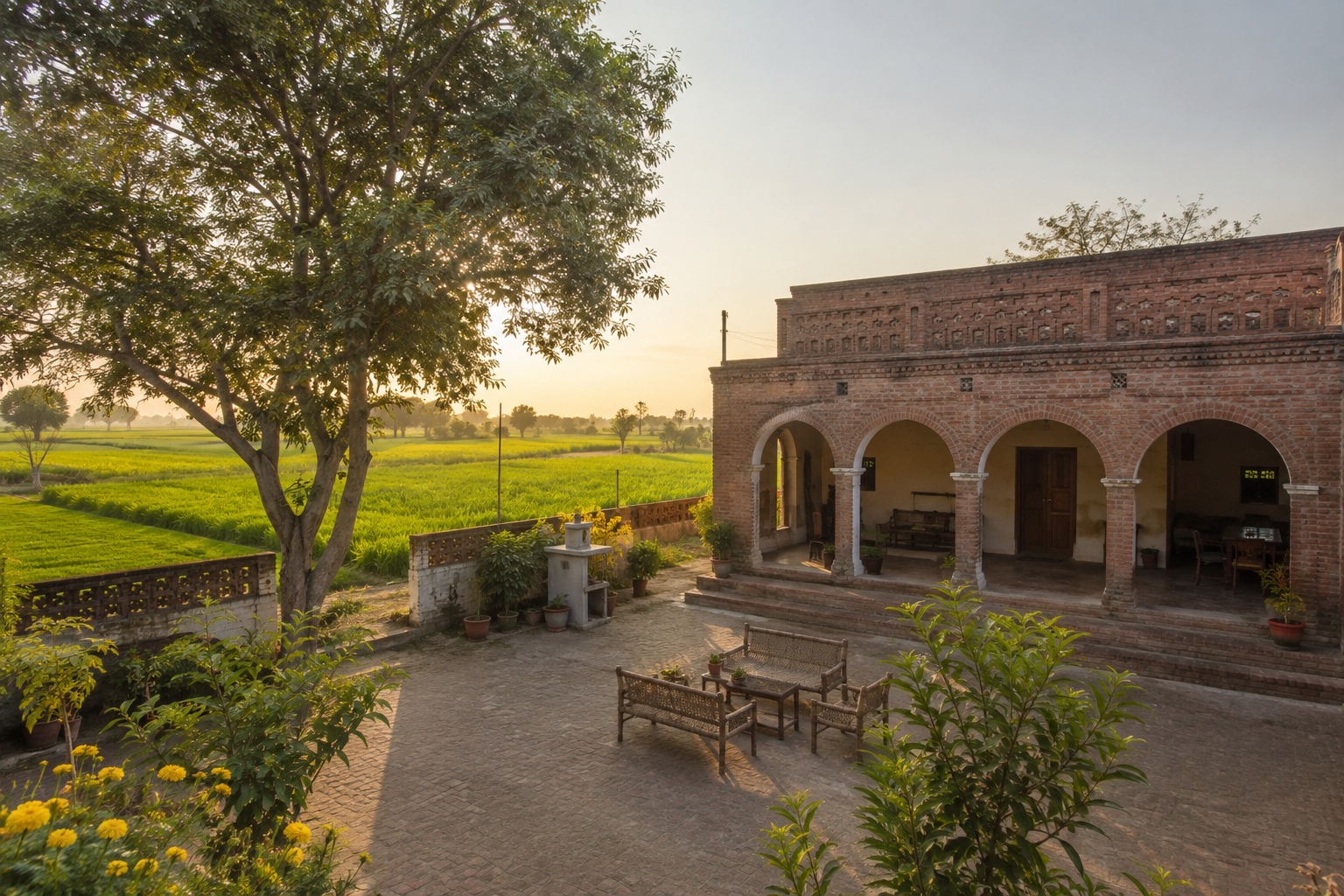
Before you choose the property
Start with the rules that actually shape the project.
Ordinary Punjab B&B/Homestay registration is governed by the 2021 scheme located, which superseded the 2013 B&B scheme.
The registered property must have a resident owner under the published scheme.
Capacity is 1–6 lettable rooms and no more than 12 beds.
Scope: Source-checked regulatory and business-planning guidance. It does not approve a particular title, building, tax position, food activity or operating structure.
01 / Executive finding
The practical starting point
- Punjab's current publicly operative Bed & Breakfast/Homestay category is governed by the Bed & Breakfast/Homestay Scheme-2021, notified by the Department of Tourism & Cultural Affairs in supersession of the 2013 scheme. No later notification expressly repealing or replacing the 2021 B&B/Homestay scheme was located. The 2026 Tourism & Hospitality Policy adds an investment-incentive layer; it does not, on the material located, replace the B&B/Homestay registration definition. [S1, pp. 1, 5; S10, cls. 1–5]
- The scheme distinguishes Bed & Breakfast from Homestay primarily by food: B&B includes breakfast, whereas Homestay is accommodation without breakfast as the standard offering, although the owner may arrange breakfast on guest request and mutually agreed charges. [S1, p. 1]
- The principal applicant route is an individual owner of a residential property. The 2021 scheme says applicants are owners of residential properties; the current service descriptor says “Individual” can apply. No current provision was located authorising a company, LLP, partnership, professional operator or management company to be the B&B/Homestay registration holder. [S1, p. 3; S3, “Who can apply”]
- Registration is available only where the owner physically resides in the same property under the substantive scheme. Annexure III goes further and requires a declaration that the owner and family actually reside there. There is no Punjab domicile or permanent-resident-of-Punjab requirement located; the critical published condition is residence in the registered property itself. [S1, pp. 3, 12]
- A registered B&B/Homestay can offer at least 1 and not more than 6 lettable rooms, capped at 12 beds. The application separately asks for the total bedrooms in the building, including the owner's rooms, so the six-room ceiling is a limit on lettable guest rooms, not a stated ceiling on all rooms in the house. [S1, pp. 3, 7, 9]
- Classification is Gold or Silver. Gold requires, among other things, a house no more than 20 years old at the first application, at least 25% open area, hygienic food-storage provision and adequate guest parking inside the premises. Silver covers properties that do not meet Gold criteria but have at least one lettable room. [S1, pp. 2–3; S2, eligibility]
- The current published application fee is ₹5,000 for Gold and ₹3,000 for Silver, stated to be non-refundable and described as applicable to registration/renewal. [S1, p. 4; S2, application fee]
- The certificate is issued by the Chief Executive Officer, Punjab Heritage and Tourism Promotion Board (PHTPB). PHTPB administers, monitors and inspects the scheme. Appeal from a CEO/PHTPB order lies to the Administrative Secretary, Department of Tourism, within 30 days. [S1, pp. 2, 5; S2, certificate issuer]
- The current public portal says the certificate duration is “Lifetime”, and an official 2024 e-certificate states that it is valid until cancellation. The 2021 notification nevertheless continues to refer to a fee for “registration/renewal”. No amendment expressly reconciling these propositions was located. The official sources are not aligned. [S1, p. 4; S2, duration; S6, certificate]
- Processing time is also inconsistent: the notification says certificate issuance within 7 working days and contains a deemed-registration clause; the current service descriptor publishes 15 days excluding government holidays; the user manual says 7–15 working days. The official sources are not aligned. [S1, p. 4; S3, service period; S4, p. 10]
- A complete application should not be prepared solely from the portal's short upload list. The notification requires the application form, facilities checklist, signed declaration, background information, an approved house layout, photographs, ownership proof and owner ID; the current portal separately makes a construction-year verification document and specific photographs mandatory. [S1, p. 3; S2, upload list; S4, pp. 4–8]
- Registration does not establish that the building is lawfully usable for the proposed activity, that construction is sanctioned, that a Fire NOC is unnecessary, that food-law registration is unnecessary, or that municipal/development-authority requirements are satisfied. Punjab separately maintains building-permit, occupancy, fire, trade-licence, property-tax and related local-government services. [S18, services; S19; S20]
- Foreign guests create a separate central-law duty. Since 1 September 2025, Rule 17 of the Immigration and Foreigners Rules, 2025 expressly includes a home stay within “accommodation”; foreigner/OCI particulars must be electronically maintained for at least one year and Form III transmitted within 24 hours of arrival, with departure details within 24 hours after departure. [S14, r.17, Gazette p.28; S15]
- The 2026 Punjab Tourism & Hospitality Policy expressly makes new Farm Stay, Home Stay and B&B units potentially eligible for fiscal incentives and places Home Stay/B&B within an overall incentive ceiling of 10% of FCI or ₹5 crore, whichever is lower. This is a ceiling, not an automatic grant, and existing units undertaking expansion are expressly excluded by the sectoral policy provision located. [S10, cls. 1, 5]
- Sufficient primary evidence exists to draft a serious Punjab public guide, but the guide must preserve the owner-residence requirement, corporate/lease uncertainty, portal/document conflicts, local-building dependencies and 2026 Farm Stay uncertainty. It should not claim that a management agreement, company ownership, land purchase, fee payment, provisional registration or incentive application guarantees an approvable homestay. [S1–S4; S10; S22]
02 / Document chronology
Use the current rules and implementation
2013 — B&B predecessor scheme
The 2021 notification expressly identifies and supersedes Punjab's Bed & Breakfast Scheme, 2013, Notification No. 10/105/2013-1TC/82824/1 dated 07 August 2013. Actions already taken under the earlier scheme are preserved/deemed under the 2021 scheme. [S1, p. 5]
2018 — Punjab State Tourism Policy
The broader Punjab Tourism Policy 2018 identifies homestays, guest houses and other small tourism enterprises as forms the State may support and discusses possible finance/incentive measures. These are policy intentions, not registration conditions or automatic entitlements. [S8, paras 38–39]
2021 — Bed & Breakfast/Homestay Scheme
Notification dated 05 March 2021 introduced the present B&B/Homestay framework and expressly superseded the 2013 instrument. [S1]
2021 — separate Farm Tourism framework
Punjab also operated a separate Farm Tourism Scheme. The current eServices portal still exposes a Farm Tourism service with Gold/Silver categories, up to nine lettable rooms/18 beds and lifetime certificate wording. [S11] This must not be confused with the 1–6-room B&B/Homestay scheme.
2025 — new central foreign-guest regime
The Immigration and Foreigners Rules, 2025 came into force on publication on 1 September 2025, superseding certain predecessor foreigner-registration rules. Rule 17 expressly covers home stays. [S14, r.1(2), r.17]
08 March 2026 — IBDP 2026 and Tourism & Hospitality Policy 2026
Punjab notified Industrial & Business Development Policy 2026 and sectoral policies, including the Punjab Tourism & Hospitality Policy 2026. The sectoral policy expressly lists new Farm Stay, Home Stay and Bed & Breakfast units as incentive-eligible categories, subject to its conditions. [S9; S10, cl.5] Nothing located in the sectoral policy expressly repeals the 2021 B&B/Homestay registration scheme.
May 2026 onward — Farm Stay Policy issue
A Department of Tourism Farm Stay Policy-2026 dated 06 May 2026 is expressly identified in NGT OA 307/2026. The 15 May order records a challenge to provisions concerning construction on certain agricultural/delisted land; on 21 July the Tribunal recorded the continuing challenge and listed the matter for 24 July. [S22] However:
- the issuing Department's current official Farm Stay Policy PDF was Not stated in the material reviewed;
- the current Punjab eServices homepage continues to list the legacy Farm Tourism Scheme;
- an official notified amendment or final NGT disposition resolving the relevant 2026 issue was Not stated in the material reviewed. Therefore the 2026 Farm Stay route should not be folded into the ordinary B&B/Homestay route. Status: OFFICIAL/PUBLIC SOURCES NOT SUFFICIENTLY ALIGNED FOR A SETTLED FARM-STAY LAND-DEVELOPMENT GUIDE.
03 / Category definitions
Choose the right accommodation category
| Category | Location | Eligible owner/applicant | Residence requirement | Operator allowed | Capacity | Food position | Source |
|---|---|---|---|---|---|---|---|
| Bed & Breakfast | Private residential property across Punjab | Published scheme: residential-property owner; current service descriptor: individual | Owner physically resides in same property; Annexure III says owner and family reside there | Separate professional operator as registration holder: Not stated in the material reviewed | 1–6 lettable rooms; max 12 beds | Breakfast is part of the B&B proposition; tariff is inclusive of daily breakfast | [S1, pp.1,3,7–12] |
| Homestay | Private residential property across Punjab | Same B&B/Homestay application framework | Same owner-residence condition | Not stated in the material reviewed | 1–6 lettable rooms; max 12 beds | Standard stay without breakfast; breakfast may be arranged on demand at mutually agreed charges | [S1, pp.1,3] |
| Farm Tourism Scheme — legacy portal category | Farm/farmhouse/rural context described by portal | Current descriptor says individual | Silver: owner-operated; Gold portal description permits management by manager | Gold: manager expressly mentioned; Silver: owner only | Up to 9 rooms/18 beds | Cooked meals and hygienic food storage | [S11] |
| Farm Stay — 2026 framework | Agricultural-land category | Current definitive official application eligibility not relied upon in this guide | Distinct from ordinary B&B/Homestay | Confirm this in writing with the authority | Judicial order quotes challenged policy as 2–9 rooms/18 beds | Distinct farm-stay framework | [S22; S23 discovery-only] |
| Tented Accommodation/Camping Site | Sites fitting separate scheme; minimum land criterion on current page | Current service descriptor says individual, while document list contemplates companies/partnerships | No B&B owner-in-house requirement identified | Entity documents contemplated in scheme | Minimum 5 / normally max 15 tents on 2 acres, with additional tents for additional area up to overall limit stated in scheme | Separate scheme | [S12] |
| Hotel / Guest house / Tourist accommodation | Separate tourism-registration service | Exact category definition Not stated in the material reviewed IN CURRENT SOURCES REVIEWED | Not stated in the material reviewed | Not stated in the material reviewed | Not stated in the material reviewed here | Separate regulatory category | [S7, services list] |
| Resort / serviced accommodation | — | Not stated in the current official material reviewed | — | — | — | — | — |
The existence of another accommodation category does not mean an applicant may simply choose whichever category produces the most convenient requirements.
04 / Eligibility decision tree
Check whether the applicant and property qualify
Step 1 — establish the starting facts
Record, before spending on design or registration:
- exact property address and local-body/development-authority category;
- ownership, co-ownership, inheritance or lease position;
- identity of proposed registration holder;
- where that person actually resides;
- whether family members reside there;
- who will handle daily operations;
- total building bedrooms;
- rooms proposed for guests;
- proposed bed count;
- whether B&B breakfast will be provided;
- whether the property is existing, proposed, under construction or already running;
- whether agricultural/protected/forest-linked land is involved.
Branch A — existing residential house + individual owner actually lives there
If there are 1–6 proposed guest rooms and no more than 12 beds: This appears to fit the published route, subject to the remaining checks subject to standards, documents and address-specific building/local compliance. [S1, pp.1–4]
Branch B — existing residential house, but owner lives elsewhere
Published registration is expressly confined to a property where the owner physically resides. does not appear to fit the published homestay definition A caretaker or manager does not cure the owner-residence condition in the B&B/Homestay scheme. [S1, p.3]
Branch C — company/LLP owns the house
Current service descriptor says the B&B/Homestay applicant is Individual, and the scheme is framed around an owner personally residing in the residential property. Confirm this in writing with the authority Do not assume a director residing there makes the company an eligible registration holder. [S1; S3]
Branch D — individual owns house but company will manage bookings/housekeeping
The owner may still satisfy the registration-holder definition, but the scheme does not expressly regulate a third-party management contract. Confirm this in writing with the authority particularly if the operator controls possession, staffing, guest contracts, food service or receipts.
Branch E — leased residential house
Annexure I asks whether the property is “owned outright or leased”, but the substantive eligibility clause says applicants are owners and registration is given where the owner resides. The official sources are not aligned — Confirm this in writing with the authority.
Branch F — more than six guest rooms or more than 12 beds
Consider another accommodation category but not the located B&B/Homestay capacity definition. [S1, pp.3,9]
Branch G — vacant land / new proposed residential construction
The scheme registers fully operational rooms of private residential properties and requires photographs/layout/property evidence. Not established in the published material for registration of a bare site as a future B&B/Homestay. Land/building approvals must precede any assumption that the eventual building can qualify.
Branch H — agricultural land intended for rural-tourism construction
There is a separate 2026 Farm Stay regulatory issue. Consider another accommodation category / Confirm this in writing with the authority especially for PLPA, delisted, Shivalik/Kandi, forest-linked or other restricted land. [S22]
Branch I — running accommodation without owner residence
If the property is in substance an independently operated lodging business with no resident owner: This does not appear to fit the published route&B/HOMESTAY DEFINITION and another category should be examined.
05 / Applicant and operating structures
Set the ownership and operating structure
| Structure | Supported route | Principal obstacle | Source | Clarification required |
|---|---|---|---|---|
| Resident individual owner | Strongest published B&B/Homestay route | Must satisfy residence, capacity, residential-property, documentation and standards | [S1–S3] | Clarify local building/fire requirements for address |
| Joint/inherited ownership | Possibly workable if applicant is an owner and resident | Consent/NOC from other co-owners not expressly specified; title record may not identify a single unrestricted applicant | [S1, Annex I/III] | Does PHTPB require all co-owner consent/signatures? |
| Owner living elsewhere | No supported B&B/Homestay route located | Express owner-residence rule | [S1, p.3] | Alternative tourism category |
| Owner using caretaker | Caretaker can assist operationally, but cannot be shown from scheme to substitute for resident owner | Owner must reside at property | [S1, p.3] | Scope permitted for caretaker/manager |
| Long-term lessee | Uncertain | Main rule requires owner; form nevertheless includes “leased” status | [S1, pp.3,7] | Whether lessee may ever be registration holder |
| Company | No ordinary B&B/Homestay applicant route located | Current service says Individual; resident-owner formulation is personal | [S1; S3] | Can company-owned residential property ever qualify? |
| Partnership firm | No supported route located | Same | [S1; S3] | Written PHTPB answer |
| LLP | No supported route located | Same | [S1; S3] | Written PHTPB answer |
| Professional operator/management company | Management services may potentially be contracted, but scheme does not establish operator eligibility or permissible delegation | Cannot replace eligible registration holder or owner residence | [S1] | Whether guest contracting, OTA account, food service and staffing may sit with operator |
| Capital-only participant | No tourism registration until eligible property/applicant structure exists | Capital is not applicant eligibility | [S1] | Property and contractual route first |
| Landowner proposing new construction | B&B registration not established for bare land | Need lawful construction and eventual resident-owner residential property | [S1; S18–S20] | Building use, planning, completion/occupancy, then tourism route |
| Running homestay acquired by new owner | Existing registration cannot simply be relied on | Change of ownership automatically cancels certificate | [S1, p.5] | New owner's fresh application sequence |
Important: an LLP agreement, shareholder agreement, lease or management agreement is a private contract. None of those instruments can alter the PHTPB eligibility definition by themselves.
06 / Property and classification standards
Prepare the property for inspection
| Topic | Mandatory / classification / guidance / unclear | Requirement | Applies when | Source | Confidence |
|---|---|---|---|---|---|
| Residential character | Mandatory | Applicant is owner of a residential property | All B&B/Homestay | [S1, p.3] | HIGH |
| Owner residence | Mandatory | Owner physically resides in same property | All | [S1, p.3] | HIGH |
| Family residence | Declaration / possible mandatory condition | Annexure III states owner and family actually reside | All applicants signing declaration | [S1, p.12] | MEDIUM due wording difference |
| Guest rooms | Mandatory | Min 1; max 6 | All | [S1, pp.3,9] | HIGH |
| Guest beds | Mandatory | Max 12 | All | [S1, pp.3,9] | HIGH |
| Total building rooms | Form field | Total bedrooms including owner's rooms disclosed; no overall building-room ceiling located | All | [S1, p.7] | HIGH |
| Gold building age | Classification | House not more than 20 years old on first registration application | Gold | [S1, p.2] | HIGH |
| Silver building age | Unclear | No maximum age located | Silver | [S1] | HIGH that none stated |
| Gold open area | Classification | At least 25% open area such as lawn/green/outside terrace | Gold | [S1, p.2] | HIGH |
| Gold parking | Classification | Adequate parking for guest inside premises | Gold | [S1, p.2] | HIGH |
| Silver parking | Desirable | “Sufficient parking” desirable in checklist | Silver | [S1, p.9] | HIGH |
| Room floor area | Mandatory classification standard | Silver: plains 120 sq ft / hills 100 sq ft; Gold: plains 200 sq ft / hills 120 sq ft | Guest rooms | [S1, Annex II] | HIGH; geographic meaning of “hills” unresolved |
| Room condition | Mandatory | Clean, airy, pest-free, no dampness, outside window | All | [S1, Annex II] | HIGH |
| Bathroom | Mandatory | Attached/private bathroom | Every guest room | [S1, pp.4,9] | HIGH |
| Bathroom size | Mandatory classification standard | Silver 30 sq ft; Gold 40 sq ft | Guest bathrooms | [S1, Annex II] | HIGH |
| Toilet | Mandatory | Western-style flush toilet; seat/lid/toilet paper | All | [S1, pp.4,9] | HIGH |
| Hot/cold water | Mandatory | 24-hour hot and cold running water | All | [S1, pp.4,9] | HIGH |
| Sewerage | Mandatory checklist item | Proper sewerage | All | [S1, Annex II] | HIGH |
| Furniture/linen | Mandatory | Proper beds/furniture and clean linen | All | [S1, Annex II] | HIGH |
| Kitchen | Mandatory where applicable to checklist | Clean, hygienic, odour/pest-free; hygienic food storage relevant | Particularly B&B/Gold | [S1, Annex II; p.2] | HIGH |
| Dining/breakfast area | Mandatory B&B checklist item | Dining area for serving breakfast | B&B | [S1, Annex II] | HIGH |
| Common guest area | Mandatory scheme condition | Guests permitted use of sitting room/common space | All | [S1, p.3] | HIGH |
| Cooling/heating | Mandatory | AC/heating according to climate, targeted room range about 20–25°C | Guest rooms | [S1, Annex II] | HIGH |
| Electricity | Mandatory | Adequate power with backup | All | [S1, p.4] | HIGH |
| Earthed socket | Mandatory | 15-amp earthed socket | Guest rooms | [S1, Annex II] | HIGH |
| Internet | Classification | Desirable Silver; mandatory Gold | By grade | [S1, Annex II] | HIGH |
| Drinking water | Mandatory | Filtered/mineral water 24 hours | All | [S1, Annex II] | HIGH |
| Refrigerator | Classification | Desirable Silver; mandatory Gold | By grade | [S1, Annex II] | HIGH |
| Working table/chairs | Classification | Desirable Silver; mandatory Gold | By grade | [S1, Annex II] | HIGH |
| Lounge/lobby | Classification | Desirable Silver; mandatory Gold | By grade | [S1, Annex II] | HIGH |
| Payment methods | Classification | Cash/cheque/DD/electronic desirable Silver, mandatory Gold | By grade | [S1, Annex II] | HIGH |
| Garbage disposal | Mandatory | Disposal in accordance with municipal laws | All | [S1, Annex II] | HIGH |
| LED/CFL lighting | Mandatory | Required by checklist | All | [S1, Annex II] | HIGH |
| Emergency numbers | Mandatory | Medical emergency, police and women helpline numbers displayed | All | [S1, Annex II] | HIGH |
| Smoke/heat detector | Desirable | Not marked mandatory in tourism checklist | All | [S1, Annex II] | HIGH |
| Fire extinguisher/firefighting | Desirable under tourism classification | Checklist marks it desirable | All | [S1, Annex II] | HIGH for tourism checklist; separate fire law unresolved |
| Security guard | Desirable | Silver/Gold as checklist records | All | [S1, Annex II] | HIGH |
| Accessibility | Portal/form disclosure; substantive benchmark unclear | Application asks for facilities for differently abled; no quantified mandatory accessibility standard located | All | [S1, Annex I; S4] | MEDIUM |
| Reception | Not stated in the material reviewed | No mandatory reception desk identified | — | [S1] | HIGH that not located |
| Signage | Not stated in the material reviewed as mandatory | Registered unit may use category/logo; mandatory exterior sign dimensions not located | — | [S1, p.2] | MEDIUM |
| Structural safety | Mandatory declaration/condition | Premises structurally safe and in good condition | All | [S1, pp.4,12] | HIGH |
| Approved building plan | Adjacent/local dependency | Scheme requires approved layout identifying guest rooms; separate sanctioned-building compliance remains local | All | [S1, p.3; S18–S20] | HIGH |
| Occupancy/completion certificate | Portal/local dependency | Current service descriptor asks for construction-year/completion evidence; scheme itself does not establish a universal occupancy-certificate rule | Depending property | [S2–S4] | MEDIUM |
| Insurance | Not stated in the material reviewed | No mandatory homestay insurance provision located | — | — | HIGH that not located |
07 / Documents and declarations
Assemble the application file
| Document | Who provides/signs | Format/stamp requirement | Validity period | When required | Source | Unresolved issue |
|---|---|---|---|---|---|---|
| Online application / Annexure I fields | Owner/applicant | Online/current portal | N/A | Application | [S1 p.3; Annex I] | Authenticated final form not inspected |
| Facilities checklist / Annexure II | Owner | Online/signed as portal requires | Current at application and ongoing | Application/classification | [S1 pp.3,9–11] | Portal upload vs embedded form logic |
| Declaration / Annexure III | Owner | Signed declaration; no stamp-paper requirement located | At application | Application | [S1 pp.3,12] | Owner-and-family wording exceeds main owner-only residence clause |
| Background information / Annexure IV | Applicant | Current manual allows free-text background information | N/A | Application | [S1; S4 p.6] | Whether optional in live portal |
| Approved house layout | Owner obtains/provides | Approved layout specifying guest rooms | Current building configuration | Application | [S1 p.3] | Which authority's approval is accepted depends on address |
| Ownership proof | Owner | Scheme: copy attested by Group-A officer/public notary; portal: original upload and “attestation not required” | Must reflect current title | Application | [S1 p.3; S3] | The official sources are not aligned |
| Owner photo ID | Owner | Portal upload | Current valid ID where applicable | Application | [S1 p.3; S2/S3] | Aadhaar appears on portal page but not in original list |
| Property exterior/main gate photograph | Applicant | Colour/current portal upload | Current | Application | [S2/S4] | Exact file size/format not verified |
| Guest-room photographs | Applicant | Colour | Current | Application | [S1/S2] | — |
| Bathroom photographs | Applicant | Colour | Current | Application | [S2] | — |
| Kitchen photograph | Applicant | Colour | Current | Application | [S2] | Portal requires even though homestay may not routinely serve breakfast |
| Drawing/dining photograph | Applicant | Colour | Current | Application | [S2] | — |
| Parking photograph | Applicant | Colour | Current | Application | [S2] | Portal marks upload mandatory although parking is only desirable for Silver |
| Lawn photograph | Applicant | Colour | Current | Application | [S2] | Portal marks mandatory although 25% open-area criterion is Gold-specific |
| Construction-year verification / “building completion certificate” evidence | Applicant/competent source | Portal supports completion certificate/self-undertaking/supporting document according to service descriptor | Current fact | Application | [S2/S3] | Naming and acceptable proof are not fully aligned |
| Society permission | Applicant/property association | If required | Current | Where applicable | [S1 Annex I] | Trigger is not defined |
| Character certificate | — | Not stated in the material reviewed | — | — | — | Not a published B&B requirement located |
| Police verification of owner | — | Not stated in the material reviewed | — | — | — | Separate local/police directions may still apply |
| Staff police verification | — | Not stated in the material reviewed | — | — | — | No scheme-wide rule located |
| Fire NOC | Property-specific | Local/fire process if applicable | Authority-specific | Depending property/use | [S18/S21] | Tourism scheme does not determine applicability |
| FSSAI certificate | Food business operator | FoSCoS | Depending licence/registration | Food business | [S13] | Correct food-business category must be determined separately |
No affidavit on stamp paper is expressly listed for the ordinary B&B/Homestay application in the 2021 scheme material reviewed.
08 / Application and inspection process
Follow the application and inspection process
| Step | Responsible person/authority | Input | Resulting record | Published time | What does not happen automatically |
|---|---|---|---|---|---|
| 1. Property/legal fit check | Owner/advisers | Address, title, local jurisdiction, building status | Internal eligibility file | None | Tourism portal does not legalise construction |
| 2. Choose B&B vs Homestay and Gold vs Silver | Owner | Food model/property standards | Chosen category | None | Category choice does not override criteria |
| 3. Create Punjab eServices account | Individual applicant | Public registration credentials | Portal account | None stated | Account creation is not approval |
| 4. Complete application | Owner | Annexure fields/property/resident details | Draft application | None | Draft does not confer operating status |
| 5. Complete classification checklist | Owner | Facilities | Online checklist | None | Self-selection does not bind PHTPB |
| 6. Sign/declare | Owner | Annexure III declarations | Declaration | None | False or inaccurate statements create cancellation risk |
| 7. Upload documents/photos | Owner | Title, ID, layout, photos, construction-year evidence etc. | Electronic document set | None | Upload acceptance does not establish document legal sufficiency |
| 8. Pay fee | Owner | ₹3,000 Silver or ₹5,000 Gold | Payment record | At submission | Fee is non-refundable and does not guarantee approval |
| 9. Submit | Owner | Complete application | Application/reference number/system email | Immediate system generation stated | Current meaning of “complete” is portal/authority dependent |
| 10. Provisional status under scheme wording | Portal/PHTPB | Complete submitted application | Scheme says provisional registration automatically issued | Scheme text | Current portal implementation of this provision was not independently tested |
| 11. Scrutiny / query | PHTPB | Application/documents | Query or processing action | Not independently specified | Silence should not be treated casually as final approval because official timelines conflict |
| 12. Inspection/compliance checking | CEO PHTPB/authorised officer | Property and checklist | Inspection finding | Surprise inspection permitted 9am–5pm | Scheme does not clearly make a pre-certificate physical inspection a universal prerequisite |
| 13. Certificate | CEO PHTPB | Approved record | Electronic B&B/Homestay certificate | 7 days / 15 days / 7–15 days depending source | The official sources are not aligned |
| 14. Download/verify certificate | Applicant | Portal login/reference | e-certificate | After delivery | Certificate does not replace adjacent approvals |
| 15. Post-registration inspection | CEO/authorised officer | Operating property | Compliance/deficiency finding | Surprise inspection 9am–5pm | Registration does not prevent later cancellation |
| 16. Deficiency cure | Owner | Required corrective work | Compliance response | CEO's stipulated time or maximum 3 months under scheme | Failure can lead to cancellation |
| 17. Appeal | Aggrieved owner | Grounds/supporting records | Administrative Secretary decision | Appeal within 30 days | Appeal does not automatically suspend every adverse consequence unless separately ordered |
Inspection standard
The 2021 scheme requires the property to maintain the published standards continuously and authorises the CEO PHTPB or authorised officer to conduct surprise inspections between 9:00 a.m. and 5:00 p.m. without prior notice. [S1, p.4] The scheme also gives the owner an opportunity to address deficiencies, with the rectification period being the period specified by the CEO or three months, whichever is less, before cancellation consequence described in the scheme. [S1, p.4]
09 / Fees, timelines, validity and renewal
Confirm fees, timing and certificate validity
| Item | Verified position | Source | Status |
|---|---|---|---|
| Silver registration fee | ₹3,000, non-refundable | [S1 p.4; S2] | HIGH |
| Gold registration fee | ₹5,000, non-refundable | [S1 p.4; S2] | HIGH |
| Renewal fee wording | Same fee table refers to registration/renewal | [S1 p.4; S2] | HIGH wording; practical trigger unclear |
| Scheme certificate period | No fixed term expressly located in 2021 notification | [S1] | HIGH |
| Current portal duration | Lifetime | [S2] | HIGH portal implementation |
| Example issued certificate | “valid till cancellation” | [S6] | HIGH implementation example |
| Notification issuance period | 7 working days | [S1 p.4] | HIGH source text |
| Notification deemed-registration provision | Failure to issue in stipulated time stated to result in deemed registration | [S1 p.4] | HIGH source text; current implementation unresolved |
| Service descriptor | 15 days, excluding government holidays | [S3] | HIGH portal |
| User manual | 7–15 working days | [S4 p.10] | MEDIUM |
| Appeal window | 30 days | [S1 p.5] | HIGH |
| Deficiency cure | CEO period or max 3 months, whichever less | [S1 p.4] | HIGH |
| Periodic renewal window | Not stated in the material reviewed for current lifetime B&B/Homestay certificate | — | Unresolved |
Practical conclusion
The official sources are not aligned on registration processing time and the practical meaning of renewal. Until PHTPB confirms otherwise in writing:
- treat 15 days as the current public service-delivery figure, not a guarantee of approval;
- do not build a transaction around automatic/deemed registration;
- treat a current certificate as operative according to its own wording;
- check whether any portal renewal action has been introduced before relying on the lifetime statement.
10 / Operating duties after registration
Run the registered homestay correctly
Certificate and classification
The registered unit must maintain the applicable standards continuously and may represent itself under the approved category. [S1, pp.2,4]
Rates and breakfast
For B&B, the homeowner determines tariff and the tariff is to include daily breakfast; the breakfast type/charges are to be made clear to guests. Homestay does not ordinarily include breakfast, although breakfast can be arranged on demand on mutually accepted terms. [S1, pp.1,3] A separate statutory room-rate display format was Not stated in the material reviewed.
Guest register and domestic identity
The classification checklist requires a guest check-in/check-out register, physical or electronic. It also requires passport details for foreign tourists and a copy of photo identification for domestic tourists. [S1, Annex II item 37] A specific retention period for domestic guest records was Not stated in the material reviewed.
Foreign guests
Rule 17 of the Immigration and Foreigners Rules, 2025 requires the accommodation keeper to:
- collect and record prescribed particulars for every foreigner, including OCI cardholders;
- record arrival and departure information;
- keep those records electronically for at least one year;
- make them available for inspection to specified authorities;
- transmit Form III electronically within 24 hours after arrival;
- transmit departure information within 24 hours after departure. The definition expressly includes a home stay. [S14, r.17(1)–(7), Gazette p.28; S15]
Tourism statistics
Registered owners must submit a quarterly report of the number of guests served through the online system in the prescribed format. Failure on more than one occasion to submit quarterly reports within time is expressly identified as a cancellation ground. [S1, p.5] No separate monthly report was located.
Complaints
Substantiated guest/customer complaints can support cancellation under the scheme. [S1, p.5]
Change of ownership
Change of ownership automatically cancels the certificate, and Annexure III requires the owner to inform the CEO PHTPB within 7 days of the ownership change. [S1, pp.5,12]
Staff/caretaker verification
A Punjab-wide B&B/Homestay requirement for staff police verification or caretaker verification was Not stated in the current official material reviewed.
Food
A B&B that prepares/supplies breakfast is separately subject to food-law analysis. FSSAI states that every Food Business Operator must be licensed/registered under section 31, with registration applicable to qualifying petty FBOs up to the currently published ₹12 lakh annual-turnover threshold; businesses outside the registration criteria need the appropriate licence. [S13] Tourism registration does not replace FoSCoS/FSSAI compliance.
Tax and business records
The CGST Act separately establishes GST-registration rules, including the ordinary section 22 threshold of ₹20 lakh aggregate turnover in a non-special-category state, subject to other statutory provisions and exceptions. Punjab is not to be treated as giving a tourism-registration tax exemption. [S16, s.22] A tax adviser should determine the actual treatment based on turnover, contracting entity, booking channels, food and ancillary supplies.
Waste and safety
Municipal-law-compliant garbage disposal is mandatory under the classification checklist; structural safety, hygiene, hot/cold water, power, emergency contact display and other classification standards must be continuously maintained. [S1, pp.4,9–11]
11 / Adjacent approvals and dependencies
Close the approvals outside Tourism
| Topic | What tourism registration resolves | What it does not resolve | Likely authority | Official source located | Property-specific question |
|---|---|---|---|---|---|
| Land title | Evidence accepted for tourism application | Encumbrances, disputed title, co-owner rights | Revenue/registration authorities | S1 | Is title current, undisputed and in applicant's name? |
| Land use | Homestay category classification | CLU/building-use legality | Local body / development authority / H&UD | S18–S20 | Is tourism use permitted at this address? |
| Building plan | PHTPB receives an approved layout | Sanction of unauthorised construction | Municipal body / development authority | S18–S20 | Does actual building match sanctioned plan? |
| Completion/occupancy | Portal asks for construction-year/completion evidence | Whether statutory OC/CC is legally required and valid | Local building authority | S2/S3/S18 | Which certificate is required for this property? |
| Fire | Tourism checklist records fire equipment as desirable | Statutory Fire NOC applicability | Punjab Fire Services/local body | S18/S21 | Does this building/use trigger Fire NOC? |
| Structural safety | Owner declares safety | Professional structural certification if legally required | Engineer/local body | S1 | Does age/alteration require engineer's certificate? |
| Food | B&B category contemplates breakfast | FSSAI registration/licence | FSSAI / Punjab food authority | S13 | What FoSCoS KOB/licence fits the operation? |
| Police | Guest-record duties | Any district police directions/staff verification | District police | S1/S14 | Are additional local lodging directions in force? |
| Foreign guests | Tourism checklist acknowledges passports | Central Form III reporting | Bureau of Immigration/Registration Officer | S14/S15 | Is accommodator account approved before first foreign guest? |
| GST | Nothing | Registration, invoicing, rate/place-of-supply issues | GST authorities | S16 | Who earns accommodation revenue and crosses statutory triggers? |
| Udyam | Nothing | MSME classification/benefit eligibility | Ministry MSME | S17 | Does operating enterprise wish to register? |
| Shops/labour | Nothing | Employer/establishment obligations | Punjab Labour Department | S18 | Number/type of workers and contracting entity? |
| Water/sewer | Checklist requires services | Connection legality/capacity/charges | Local body/water authority | S18 | Can existing connection support commercial guest use? |
| Electricity | Adequate power/backup standard | Tariff category or load sanction | PSPCL | S1 | Does load/use require change? |
| Property tax | Nothing | Property-use/tax classification | Municipality/local body | S18 | Does use alter assessment? |
| Waste | Checklist requires lawful disposal | Collection contracts, local segregation rules | Municipality/PPCB if applicable | S1/S18 | What local waste regime applies? |
| Pollution | Nothing | Consent/environmental approvals if triggered | PPCB | — | Does scale/activity trigger PPCB consent? |
| Heritage/archaeology | Nothing | Protected-monument restrictions | Archaeology/ASI/state authorities | S7 source index | Is property within a regulated protected area? |
| Forest/PLPA | Nothing | Forest/PLPA restrictions | Forest Dept/MoEFCC/courts | S22 for Farm Stay dispute | Is land notified/delisted/forest-linked? |
| Cantonment | Nothing | Cantonment building/use rules | Cantonment Board | S20 jurisdiction exclusions | Is address within cantonment? |
| Insurance | Nothing | Property/public liability/business-interruption coverage | Insurer | No mandatory tourism source | What risks should be insured? |
12 / Incentives, subsidy and funding
Evaluate incentives without assuming sanction
A. Punjab Tourism & Hospitality Policy 2026
Official scheme: Punjab Tourism & Hospitality Policy 2026, notified as part of Punjab's 2026 sectoral policies. [S10] Verified eligible categories: new Farm Stay, Home Stay and Bed & Breakfast units are expressly listed as eligible unit categories. The located clause states that existing units undertaking expansion are not eligible. [S10, cl.5] Verified overall ceiling: for Farm Stay / Home Stay / Bed & Breakfast, aggregate incentive support is capped at: 10% of FCI or ₹5 crore, whichever is lower. This is an overall incentive capping provision, not evidence that every qualifying homestay receives a 10% cash grant. [S10, cl.1] Eligibility period: governed by IBDP 2026 clause 5.1.2. The policy permits an eligible unit to select an incentive-disbursement period within the prescribed 10–15-year framework, with the selected period fixed at I-CAF approval according to the policy mechanism. [S9, cl.5.1.2; S10, cl.2] Annual ceiling: governed by IBDP clause 5.1.3. Incentives are subject to annual ceilings; they are not treated as an immediately payable lump sum merely because an overall ceiling exists. [S9, cl.5.1.3; S10, cl.3] Claim/disbursement process: IBDP clause 5.1.4 provides for sanction/eligibility records and post-financial-year claims for relevant incentives through the online system with required financial and supporting documentation. [S9, cl.5.1.4; S10, cl.4] Eligible expenditure: FCI is the verified capping base. A complete homestay-specific official schedule identifying every eligible and excluded FCI cost head was Not stated in the material reviewed/EXTRACTED WITH SUFFICIENT CONFIDENCE for publication in this guide. Applicant/entity interaction: the incentive policy identifies “units”, while the B&B/Homestay registration portal says the registration applicant is an Individual. Do not infer that a company investing in the building can automatically become the tourism registration holder or receive a homestay incentive. Bank route: a mandatory bank-finance route specifically for ordinary B&B/Homestay incentives was Not stated in the current official material reviewed. Current application opening: availability of a live Home Stay/B&B incentive-claim form on FastTrack Punjab on 05 September 2026 was NOT CONFIRMED WITHOUT AUTHENTICATION. Sanction authority for an individual homestay claim: exact project-value-specific sanction authority was Not stated in the material reviewed in the tourism-sector extract sufficiently to publish here. Automatic? No. The policy contains eligibility, annual caps, claim documentation and sanction mechanics. Nothing supports treating the ceiling as automatic assistance.
B. Punjab State Tourism Policy 2018
The 2018 policy envisages possible micro-finance, soft loans, working capital, matching grants and fiscal/monetary support for tourism enterprises including homestays. [S8, paras 38–39] These statements are policy objectives, not a currently verified stand-alone loan/subsidy application scheme. They should not appear on a public page as “available homestay subsidy”.
C. Farm Stay incentives
A 2026 Farm Stay policy copy found through discovery material contains substantially more detailed incentive language, but:
- the issuing Department's official current Farm Stay PDF was not located;
- Farm Stay is a different category from the ordinary B&B/Homestay scheme;
- the policy is the subject of OA 307/2026 concerning certain land treatment. Therefore Farm Stay-specific benefits must not be transplanted into the ordinary Punjab Homestay guide. Status:
Confirm this with the relevant authority.
13 / Business implications
Translate the rules into a workable project
Before property selection or acquisition
For every candidate, establish:
- exact title holder;
- co-owner/encumbrance position;
- exact planning/local-body jurisdiction;
- present sanctioned land/building use;
- sanctioned building plan and actual constructed configuration;
- completion/occupancy position where applicable;
- whether the intended registration holder genuinely lives or will live in the property;
- total guest-room/bed plan;
- B&B versus Homestay food model;
- Gold/Silver feasibility;
- protected/forest/PLPA/heritage constraints;
- whether a separate Farm Stay route is being considered. A property should not be valued as an approvable homestay merely because it physically contains six or fewer rooms.
Before construction or renovation
Architectural design should be checked against:
- governing local building rules;
- sanctioned use;
- guest-room/bathroom area requirements;
- attached bathroom requirement;
- water/sewer/power provisions;
- parking/open-area requirements for the intended classification;
- fire and structural requirements imposed by competent local authorities;
- accessibility and guest-safety considerations;
- whether alteration requires plan amendment. The tourism checklist is not a substitute for a sanctioned plan.
Registration holder versus operating entity
The current scheme supports an individual resident owner as registration holder. The sources do not establish that:
- an LLP can hold the certificate;
- a company can hold it;
- a management company can substitute for the owner;
- a long-term lessee can hold it;
- a caretaker can satisfy residence;
- an owner can move away while the operator continues under the same certificate. A separate management arrangement therefore needs to be structured around, not in place of, the statutory/registration-holder requirements.
What an LLP or management agreement cannot solve by itself
It cannot:
- make an ineligible property eligible;
- convert a non-resident owner into a resident host;
- increase the six-room/12-bed limit;
- preserve a certificate after ownership change;
- legalise an unauthorised building;
- remove a Fire/FSSAI/foreign-guest obligation;
- create entitlement to incentive support.
Property-development scope
Any project scope involving:
- acquisition,
- new construction,
- room additions,
- bathrooms,
- structural alteration,
- parking,
- utilities,
- kitchen,
- signage,
- sewage,
- access, should be expressly conditional on address-specific professional and authority review.
Property assessment and commercial planning should contain
- registration-fit classification;
- title/owner-residence status;
- existing-versus-required guest-room matrix;
- Gold/Silver gap analysis;
- adjacent-approval matrix;
- foreign-guest-readiness status;
- food/FSSAI path;
- tax/operator allocation;
- change-of-ownership consequence;
- identified source conflicts;
- incentive eligibility shown separately from base-case economics. No incentive amount should be necessary for the base project to be commercially credible unless it has actually been sanctioned.
Questions to resolve before proposing business terms
- Who owns the property?
- Who will be PHTPB applicant?
- Will that person actually reside there?
- Can ownership change during the commercial arrangement?
- Who contracts with the guest?
- Who collects accommodation consideration?
- Who provides breakfast/food?
- Who employs staff?
- Who bears tourism/local/fire/FSSAI/GST compliance?
- Who pays for physical compliance upgrades?
- What happens if registration is refused, cancelled or category-downgraded?
- What happens on sale, succession or termination of management?
- Is any proposed investment dependent on subsidy?
- Which approvals must be conditions precedent? No fixed ownership percentage, capital contribution or revenue share can be responsibly derived from the tourism rules.
Read the Amritsar city guide ↗ — Owner residence, B&B distinction and temple-side access.
14 / Official-source conflicts
Resolve conflicting official instructions
Conflict 1 — certificate processing time
Source A: 2021 Scheme, p.4. Proposition: certificate within 7 working days; failure within stipulated period triggers deemed-registration language. Source B: current service descriptor. Proposition: service-delivery period 15 days, excluding government holidays. Source C: current user manual, p.10. Proposition: certificate within 7–15 working days. Hierarchy/date: S1 is the controlling notification; S3/S4 are newer implementation material, but no express amendment of S1 was located. Status: The official sources are not aligned. Affected properties: every new B&B/Homestay applicant. Written answer should come from: CEO PHTPB, copied to Director Tourism/Administrative Secretary.
Conflict 2 — lifetime validity versus renewal
Source A: S1 fee clause describes fee for “registration/renewal”. Source B: S2 current service page states certificate duration Lifetime. Source C: S6 current-format certificate says valid till cancellation. No fixed validity period was located in the substantive 2021 scheme and no express amendment deleting “renewal” terminology was located. Status: The official sources are not aligned. Practical effect: do not tell owners that they must renew every X years; equally, do not erase the renewal wording from the source history.
Conflict 3 — ownership-document attestation
Source A: S1, p.3 requires ownership-document copy duly attested by a Group-A officer or public notary. Source B: S3 current enclosure table indicates original electronic evidence with attestation not required. No express amending notification was located. Status: The official sources are not aligned. Practical approach: maintain both a clean current title copy and an attested copy until PHTPB confirms which is required.
Conflict 4 — substantive document list versus portal upload list
Source A: S1 requires Annexures I–IV, checklist, signed declaration, approved layout, colour photographs, attested ownership proof and ID. Source B: S2 current public page prominently lists ID, ownership proof, specific photos and construction-year verification. Source C: S4 manual still exposes application/checklist/declaration structures plus the newer upload list. Status: IMPLEMENTATION SOURCES DO NOT IDENTICALLY RESTATE THE NOTIFICATION. A public checklist should contain the union of the currently applicable requirements rather than silently dropping notification documents.
Conflict 5 — lessee
Source A: S1 substantive condition: applicants are owners of residential properties and registration is only where the owner resides. Source B: Annexure I asks whether property status is “owned outright or leased.” No express provision saying a lessee can become B&B/Homestay registration holder was located. Status: The official sources are not aligned. Affected structures: long leases, operator leases, company leases, rent-to-operate arrangements.
Conflict 6 — owner residence versus owner-and-family residence
Source A: principal eligibility condition says the owner physically resides in the same property. Source B: Annexure III requires declaration that “Myself and my family” are actually residing there. Status: WORDING NOT ALIGNED. The issue matters particularly for single owners, owners whose spouse/family temporarily resides elsewhere, inherited properties and separated households.
Conflict 7 — Silver parking/lawn evidence
Source A: classification checklist makes parking desirable for Silver, while Gold expressly requires adequate parking and ≥25% open area. Source B: current portal lists both parking photograph and lawn photograph as mandatory uploads without a visible Silver exception. Status: PORTAL REQUIREMENT AND CLASSIFICATION STANDARD ARE DIFFERENT TYPES OF REQUIREMENT. A mandatory photo upload should not be represented publicly as proof that a Silver homestay must legally have a lawn or Gold-level parking.
Conflict 8 — Farm Tourism portal versus 2026 Farm Stay developments
Punjab eServices still publicly lists its legacy Farm Tourism Scheme. Separately, the NGT has recorded a challenge to a Department of Tourism Farm Stay Policy-2026 dated 06 May 2026. No current issuing-Department webpage reconciling which Farm Tourism/Farm Stay application route should be used for every property type was located. Status: OFFICIAL/PUBLIC SOURCES NOT ALIGNED FOR ADJACENT FARM-STAY CATEGORY. This does not repeal or invalidate the separate B&B/Homestay scheme, but it materially affects landowners considering agricultural-land projects.
16 / Source register
Official source register
| ID | Issuing body | Document or portal | Document/order number | Published | Effective | Language | Status/currentness | Official URL | Pages/sections reviewed | Notes |
|---|---|---|---|---|---|---|---|---|---|---|
| S1 | Department of Tourism & Cultural Affairs, Punjab | Bed & Breakfast/Homestay Scheme-2021; official circulation copy | No. 10/105/2013-1TC/304, notification dated 05.03.2021; supersedes 2013 notification No. 10/105/2013-1TC/82824/1 dated 07.08.2013 | 05 Mar 2021 | 05 Mar 2021 on located notification | English | PRIMARY — controlling B&B/Homestay instrument located | Official PSPCL circulation PDF ; Department page separately links Approved_SOP_BB.pdf | Entire 15-page instrument including Annexures I–IV/checklist | Department-hosted PDF is ~19.21 MB and exceeded web fetch limit; complete scheme text inspected through official Punjab-government corporation circulation copy. |
| S2 | Punjab Heritage & Tourism Promotion Board / Punjab eServices | Bed and Breakfast Homestay public service page | N/A | Not stated | Current page inspected 05 Sep 2026 | English/Punjabi elements | PORTAL — current implementation | B&B/Homestay service page | Eligibility, fees, duration, uploads, issuer, helpdesk | Says lifetime validity. |
| S3 | Punjab Heritage & Tourism Promotion Board / NIC ServicePlus | B&B/Homestay service descriptor | Service ID 19970001 | Not stated | Current | English | PORTAL | Service descriptor | Applicant type, delivery period, enclosure table | Says individual applicant; 15-day service period; ownership attestation “not required”. |
| S4 | Punjab eServices/PHTPB | User Manual — Registration of Hotels Guest houses/tourist accommodation etc.; B&B workflow | N/A | Not stated | Current public manual | English | IMPLEMENTATION / FORM | bnb.pdf user manual | pp. 1–10+; screenshots of application, checklist, uploads/payment | Says certificate in 7–15 working days. |
| S5 | Government of Punjab/NIC | eServices Punjab portal | N/A | Portal | Last updated 25 Mar 2026 | English | PORTAL | Punjab eServices | Homepage, FAQ, e-certificate workflow | Confirms B&B, Farm Tourism and Tented Accommodation services publicly listed. |
| S6 | PHTPB | Example issued B&B/Homestay e-certificate | 2024 certificate | 2024 | Until cancellation per certificate | English | IMPLEMENTATION | Official e-certificate example | Certificate wording | Evidence of current certificate form, not a rule. |
| S7 | Government of Punjab, Department of Tourism & Cultural Affairs | Department page, officers, services, head office | N/A | Current | Current | English | CONTACT / PRIMARY INDEX | Tourism Department page | Lines 76–144 and service list | Current state-level contacts and official source index. |
| S8 | Government of Punjab | Punjab State Tourism Policy 2018 | No. 1/22/2017-2TC/1180775/1 dated 08.03.2018; Gazette publication 17.08.2018 | 17 Aug 2018 | As gazetted | English | PRIMARY — broader policy | Tourism Policy Gazette PDF | Full policy; paras 38–39 material | Policy-level support language, not a homestay licence or automatic grant. |
| S9 | Department of Industries & Commerce, Punjab | Industrial & Business Development Policy 2026 | PIU/Industrial & Business Development Policy-2026/898 | 08 Mar 2026 | 08 Mar 2026 | English | PRIMARY / INCENTIVES | IBDP 2026 official-central-hosted copy | cls. 5.1.1–5.1.5; 6.1 | Governs incentive mechanics referenced by sectoral policy. |
| S10 | Department of Industries & Commerce, Punjab | Punjab Tourism & Hospitality Policy 2026, within sectoral policies compilation | PIU/IBDP-2026/Sectoral Policies/907 | 08 Mar 2026 | 08 Mar 2026 | English | PRIMARY — sectoral incentives | Official Invest India-hosted sectoral policy PDF | Tourism policy cls. 1–5 extracted | Large compiled PDF could not be completely rendered by web interface; relevant tourism provisions were text-extracted. |
| S11 | PHTPB / Punjab eServices | Farm Tourism Scheme public page | Legacy scheme | Not stated | Still publicly listed 05 Sep 2026 | English | PORTAL — adjacent category; currentness uncertain | Farm Tourism Scheme page | Entire public page | Important because the portal remains live despite 2026 Farm Stay developments. |
| S12 | PHTPB / Punjab eServices | Tented Accommodation and Camping Site | N/A | Not stated | Current public page | English | PORTAL — adjacent category | Tented accommodation page | Eligibility, docs, fees, duration | Separate accommodation category. |
| S13 | Food Safety and Standards Authority of India | FSSAI registration guidance / FoSCoS | FSS Act s.31; 2011 Regulations | Current page | Current | English | CENTRAL | FSSAI registration page | s.31 summary; ₹12 lakh petty-FBO threshold | Food-law dependency only. |
| S14 | Ministry of Home Affairs, Government of India | Immigration and Foreigners Rules, 2025 | G.S.R. 596(E) | 01 Sep 2025 | 01 Sep 2025 | Hindi/English | CENTRAL — PRIMARY | MHA Rules PDF | r.17, Gazette p.28; Form III p.33 | Expressly includes “home stay”. |
| S15 | Bureau of Immigration/MHA | Online Form III — formerly Form C | N/A | Current | Current | English | CENTRAL / PORTAL | Form III/Form C portal | Public notice/login | Includes foreigners and OCI cardholders. |
| S16 | CBIC, Government of India | Central Goods and Services Tax Act — registration provisions | CGST Act 2017, s.22 | Current consolidated page | Current subject to amendments | English | CENTRAL | CGST Act s.22 | s.22 and registration chapter | Separate tax analysis still required because exceptions can apply. |
| S17 | Ministry of MSME, Government of India | Udyam Registration Portal | N/A | Current | Current | English | CENTRAL | Official Udyam portal | Registration/classification page | Udyam not a B&B registration prerequisite located. |
| S18 | Government of Punjab | Department services / Local Government services | N/A | Current | Current | English | LOCAL-APPROVAL INDEX | Punjab department services | Building permit, Fire NOC, labour, etc. | Demonstrates separate local approvals. |
| S19 | Department of Local Government, Punjab | Punjab Municipal Building Bye-Laws 2018 | CTP(LG)/2018/3548 dated 22.11.2018 | 2018 | As notified/amended | English | PRIMARY — address dependent | Official municipal bye-laws copy | General applicability/building framework | 2019 amendment identified; homestay-specific use conclusion not located. |
| S20 | Housing & Urban Development Department / PUDA | Punjab Urban Planning and Development Building Rules, 2021 | G.S.R. 144/P.A.11/1995/Ss.180 and 43/2021 | 10 Sep 2021 Gazette | 2021 | English | PRIMARY — address dependent | PUDA Building Rules 2021 | Applicability and building-control framework | Excludes several jurisdictions; address determines governing regime. |
| S21 | Punjab Fire Services / Local Government | Fire NOC FAQ | N/A | Current public material | Current | English | IMPLEMENTATION | Punjab Fire NOC FAQ | Published document requirements | No homestay-specific blanket Fire NOC rule located. |
| S22 | National Green Tribunal text, judicial mirror | OA 307/2026, Council of Engineers v State of Punjab | OA 307/2026, order 15.05.2026 and connected order 21.07.2026 | 15 May/21 Jul 2026 | Proceedings pending in material located | English | JUDICIAL-MIRROR / ADJACENT RISK | 15 May 2026 order text ; 21 July order text | Challenge to Farm Stay Policy 2026 | Official NGT-hosted copy of these exact orders was Not stated in the material reviewed in search; used only to flag unresolved adjacent-category risk. |
| S23 | Third-party document host; purported Punjab notification | Farm Stay Policy 2026 copy | Purported No. 10/111/2013-1TC/1/1387054/2026 dated 06.05.2026 | 06 May 2026 claimed | Immediate effect claimed | English | Background source only — not relied upon as sole authority | Discovery copy | Relevant clauses reviewed to identify matters requiring official confirmation | Issuing Department's current official policy file was Not stated in the material reviewed; therefore detailed terms are not treated as settled solely from this copy. |
Review and corrections
Keep the guide current.
Sources were checked on . Recheck the live application route before filing because portals and implementation instructions can change.
Send a correction with the relevant official source. Browse all states and Union territories.