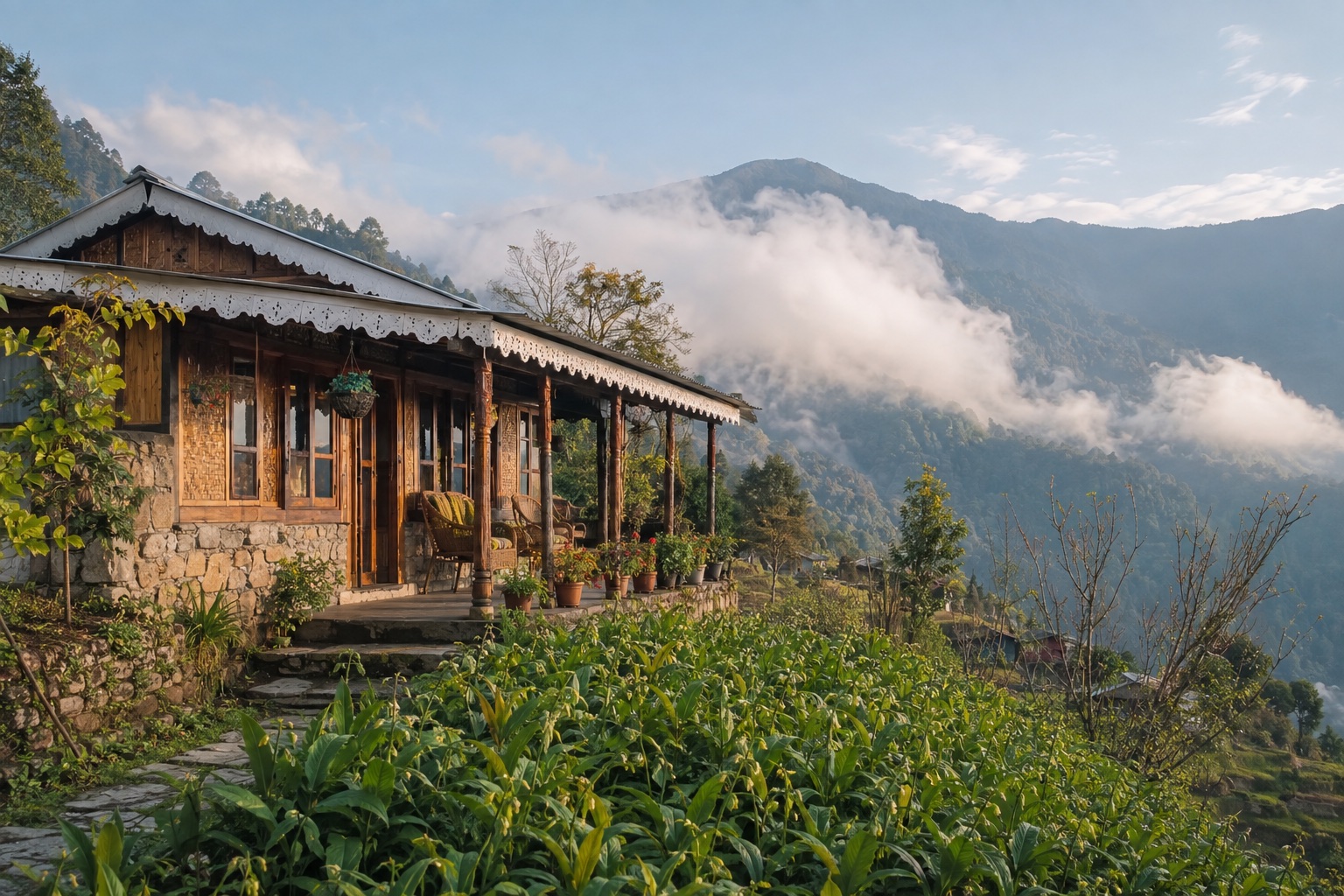
Before you choose the property
Start with the rules that actually shape the project.
A Sikkim homestay under Rule 32 is an owner/family-resident model.
Rented houses are ineligible for the located homestay category.
A homestay may offer 1–5 tourist rooms.
Scope: Source-checked regulatory and business-planning guidance. It does not approve a particular title, building, tax position, food activity or operating structure.
01 / Executive finding
The practical starting point
- The present Sikkim tourism-registration framework is built around the Sikkim Registration of Tourist Trade Act, 2024 (Act 23 of 2024) and the Sikkim Registration of Tourist Trade Rules, 2025. The official 2025 Rules expressly state that they are made under section 29(1) of the 2024 Act and extend throughout Sikkim. The direct official Gazette copy of the 2024 Act itself was Not stated in the current official material reviewed during this review, although the Rules, current fee notification, Atithi system and Government statements all identify that Act as the governing statute. [S1, opening notification; S6, portal]
- The homestay-specific Rules describe a house located “basically in a rural area” and require the applicant to be the house owner/promoter, with the owner and family physically residing in the same homestay unit. [S1, Rules 30 and 32(1)–(2)]
- The live 2026 Tourism Trade Registration Portal conflicts with that rural limitation: it expressly advertises registration for “rural and urban homestay units” in Gold, Silver and Bronze categories. No later Gazette amendment expressly expanding Rule 32 from rural to urban was located. New urban homestay applications therefore require written Tourism Department clarification.
The official sources are not aligned. [S1, Rules 30/32; S2, portal “Homestays”] - A qualifying homestay has a minimum of one and maximum of five rooms exclusively for tourists. The Rules do not state a separate maximum number of guest beds for the Sikkim homestay category. [S1, Rule 32(1), Rule 32(9)]
- The homestay Rules require a double room of at least 150 sq ft, a single room of at least 100 sq ft, and an attached bathroom/toilet of at least 36 sq ft. Minimum bed length is 6.5 ft. [S1, Rules 32(6), 32(9), 35]
- Rented houses are expressly ineligible for the Sikkim homestay category. This makes a long-term lessee materially different from an owner-occupier, even though other tourism categories may have different rules. [S1, Rule 32(9)]
- Form IV is individual-owner oriented: it seeks Sikkim Subject/Certificate of Identification, ownership/Parcha, a minimum Class-X certificate, access plan, photographs, Panchayat/Councillor recommendation and a “GST clearance certificate.” The reviewed homestay provisions do not establish a company, LLP, trust, partnership, professional manager or caretaker as an alternative registration holder. [S1, Form IV; Rule 32(2)]
- Since 1 September 2026, physical submission and physical movement of homestay registration applications have been discontinued. Applications for Homestays, Hotels/Resorts, B&Bs, Service Apartments, Holiday Homes and Restaurants are to be submitted and processed online through Sikkim SSO; the Bank Receipt System was simultaneously discontinued for these online services. [S5, Office Order Ref. 162/T&CAD/2026, 29 August 2026]
- Current homestay registration fees are ₹5,000 Gold / ₹3,000 Silver / ₹2,000 Bronze; annual renewal fees are ₹2,000 / ₹1,500 / ₹1,000 respectively. Payment through the official portal does not guarantee eligibility or approval. [S3, Pricing Policy, Notification Ref. 06/DoT&CAv dated 25 July 2025]
- The initial tourism registration certificate is stated to be valid for one year and is renewed annually. Renewal should be sought at least one month before expiry; the Rules also address late renewal, penalties and cancellation after the permitted late period. [S1, Rules 6, 52 and 55]
- The Rules establish a trade-licence dependency: tourism registration is not the complete authority to commence business. Rule 5 provides for tourism registration for obtaining the concerned trade licence and says the commencement certificate is issued only after submission of that trade licence. [S1, Rule 5]
- Registered accommodation must participate in Sikkim's Tourism Sustainable Development Fund/Atithi GIS framework. The Rules presently prescribe ₹50 per overnight tourist, subject to specified exemptions; the accommodation operator records guests through Atithi and transfers collected amounts on the prescribed cycle. [S1, Rules 70–83; S6, Atithi/GoS clarification]
- Foreign-guest reporting contains a second material conflict. The current central Immigration and Foreigners Rules, 2025, Rule 17, expressly include a “home stay” within accommodation and require electronic Form III reporting within 24 hours of foreigner arrival and departure, with electronic records retained for at least one year. The current Sikkim Police Special Branch page instead instructs homestays/institutions to use Form S.
The official sources are not aligned; the Sikkim FRO should resolve the current operational filing route in writing. [S8, Rule 17, p.28 of Gazette PDF; S9, FRO/IVFRT instructions] - The current Tourism Form IV asks for a “GST clearance certificate”, but that wording does not establish that every small homestay is legally required to obtain GST registration. CBIC material states a ₹20 lakh service-supplier registration threshold for Sikkim, subject to the CGST Act's compulsory-registration provisions and other facts. The exact Tourism Department meaning of “GST clearance certificate” therefore needs clarification. [S1, Form IV; S11, CBIC threshold material]
- Evidence is not sufficient for publication as a settled statewide guide because the rural/urban contradiction, absence of a located current Gold/Silver/Bronze grading checklist, unauthenticated portions of the newly launched SSO workflow, the Form-IV GST-clearance issue and the foreign-guest Form III/Form S conflict remain unresolved.
02 / Document chronology
Use the current rules and implementation
13 June 2008 — Sikkim Registration of Tourist Trade Rules, 2008. These rules were made under the Sikkim Registration of Tourist Trade Act, 1998. Their definition of “hotel” broadly included homestay and several other accommodation/food businesses. They remain downloadable but are historical. [S17] 2013 — Home Stay Establishment Rules/Form era. The Tourism website still hosts an Annexure-I application titled “Application Form under the Registration of Home Stay Establishment Rules, 2013.” It required, among other items, a ₹1,000 B.R. receipt and did not contain the current Class-X or GST-clearance entries. It is not consistent with the 2025 Rules, 2025 fee notification or September 2026 online process and should be treated as legacy material only. [S16] 2024 — Sikkim Registration of Tourist Trade Act, 2024 (23 of 2024). The current 2025 Rules and current registration fee notification both identify this Act as their statutory foundation. The direct Gazette text of the Act was Not stated in the current official material reviewed during this review. [S1; S3] 2025 — Sikkim Registration of Tourist Trade Rules, 2025. These contain the current located homestay-specific Rules 30–36, application Form IV, inspection/registration provisions, renewal and operating provisions, and the TSD framework. Exact Gazette publication number/date are not printed in the official downloadable copy reviewed. [S1] 25 July 2025 — Fee Notification Ref. 06/DoT&CAv. Current Tourism portal uses this notification for Gold/Silver/Bronze homestay registration and renewal fees. [S3] 1 September 2025 — Immigration and Foreigners Rules, 2025. Central rules replaced specified earlier foreigner-registration rules, subject to savings, and now expressly include homestays in Rule 17's accommodation-reporting regime. [S8, Rule 1 and Rule 17] 19 June 2025 / 24 June 2025 — UNNATI Homestay Guidelines. These are a funding programme framework, not a replacement for the Sikkim Tourism Rules. [S14–S15] 26 August 2026 — Tourism online registration system launched. Fresh registration and annual renewal for six establishment categories were moved to the SSO-linked online system. [S4] 29 August 2026 — Office Order Ref. 162/T&CAD/2026. Effective 1 September 2026, physical submission/movement and the Bank Receipt System were discontinued for homestays and the other online categories. [S5]
Chronology conclusion
The later digital office order resolves the practical submission/payment channel against the still-printed B.R. field in Form IV: a current applicant should use SSO and the online gateway, not the historical Bank Receipt mechanism. No located instrument expressly amended the words “basically in a rural area” in Rules 30/32. Consequently the portal's newer statement that both urban and rural homestays are registerable remains an unresolved substantive inconsistency rather than an amendment that can safely be assumed. The exact express repeal/supersession chain from every 2008/2013 instrument to the current Act/Rules is Not stated in the current official material reviewed.
03 / Category definitions
Choose the right accommodation category
| Category | Location | Eligible owner/applicant | Residence requirement | Operator allowed | Capacity | Food position | Source |
|---|---|---|---|---|---|---|---|
| Homestay | Rules: house “basically” in rural area. Portal: rural and urban. The official sources are not aligned | Individual/family house owner/promoter; Form IV requires local identity and ownership evidence | Owner/promoter with family physically resides in same homestay unit | Separate operator replacing owner: Not stated in the current official material reviewed | 1–5 rooms exclusively for tourists; bed ceiling not stated | Local cuisine considered at verification; kitchen hygiene prescribed; FSSAI separately applies if a food business is conducted | [S1, Rules 30–35/Form IV; S2] |
| Bed & Breakfast | Zoning must permit B&B use | Owner-occupied model; if applicant is not owner, reviewed B&B provision states applicant's family should reside and owner NOC is required | Owner/applicant-family residence contemplated | More flexible than homestay, but exact separate professional-operator entitlement Not stated in the material reviewed | “Usually 3 to 6” rooms in reviewed Rules | Food offered/charges displayed; food hygiene applies | [S1, B&B provisions] |
| Service Apartment | Address must otherwise be lawful | Owner must own landed property | Owner-residence requirement Not stated in the material reviewed in reviewed Rule 40 | Rule contemplates an operator who should be qualified and know English/Hindi | 1–6 rooms / maximum 12 beds in reviewed Rule 40 | Equipped kitchen required | [S1, Rule 40] |
| Holiday Home | Address-specific | Reviewed with service-apartment framework | Not stated in the material reviewed | Operator contemplated under reviewed provisions | Up to six rooms/12 beds where Rule 40 applies | Equipped kitchen | [S1, Rule 40] |
| Hotel/Resort | Separate tourism stream | Separate hotel/resort rules and grades | No homestay residence rule should be imported | Separate business operator model | Separate hotel classification | Separate FSSAI/local requirements | [S2; S1] |
| Guest House/Lodge | Portal places these with Hotel/Resort stream | Exact standalone eligibility definition Not stated in the current official material reviewed | Not stated in the material reviewed | Not stated in the material reviewed | Not stated in the material reviewed | Separate food-law analysis where food supplied | [S2, portal category label] |
| Farm stay | Not stated in the current official material reviewed as a separate current Sikkim Tourism category | Not stated in the material reviewed | Not stated in the material reviewed | Not stated in the material reviewed | Not stated in the material reviewed | Not stated in the material reviewed | — |
The fact that another category accommodates a different ownership or operator arrangement does not allow those provisions to be imported into the homestay category.
04 / Eligibility decision tree
Check whether the applicant and property qualify
Start with the exact property address and local-body category.
- Is the address rural/GPU territory?
- Yes → proceed.
- No, it is an urban/municipal/ward address → Rules 30/32 say “basically” rural, while the live portal advertises urban homestays. Confirm this in writing with the authority. [S1, Rules 30/32; S2]
- Protected/forest/high-altitude/heritage-sensitive location → tourism-category fit alone does not determine land/building/environment/foreigner permissions. Confirm this in writing with the authority.
- Who owns the house?
- Applicant owns it and can provide ownership/Parcha → proceed.
- Applicant is only a long-term tenant/lessee → Rule 32 says rented houses are not eligible. does not appear to fit the published homestay definition. [S1, Rule 32(9)]
- Joint/inherited ownership → ownership proof is required, but a current homestay-specific co-owner-consent mechanism was not located. Confirm this in writing with the authority.
- Company/LLP owns property → the specific homestay Rules require an individual/family owner/promoter residing there; corporate registration-holder entitlement is not established. Confirm this in writing with the authority.
- Who is the proposed applicant?
- Individual Sikkim owner holding Sikkim Subject/COI evidence → proceed.
- Non-owner professional operator, company, LLP, management company, trustee or firm → no current homestay-specific route was located. Confirm this in writing with the authority.
- Who will actually live in the property?
- Owner/promoter and family will physically reside in the same unit → proceed.
- Owner lives permanently elsewhere and caretaker alone lives on site → owner-residence requirement is not met on the located text. does not appear to fit the published homestay definition.
- Owner periodically visits but is not physically resident → does not appear to fit the published homestay definition unless Tourism gives a contrary written interpretation. [S1, Rule 32(2)]
- Who will operate it?
- Resident owner/family operates it → proceed.
- a professional company manages reservations/operations while qualifying owner/family remains resident → the permitted boundary of professional management is not defined. Confirm this in writing with the authority.
- Management company replaces resident owner → does not appear to fit the published homestay definition on the present evidence.
- How many guest rooms?
- 1–5 qualifying tourist rooms → proceed.
- More than 5 → Consider another accommodation category.
- Maximum guest-bed capacity proposed but no room problem → statewide homestay bed ceiling is Not stated in the material reviewed. Not established in the published material.
- Do rooms meet current dimensional standards?
- Double ≥150 sq ft; single ≥100 sq ft; attached bath/toilet ≥36 sq ft → proceed.
- Below these → does not appear to fit the published homestay definition/STANDARD. [S1, Rule 32]
- Is the property existing and inspection-ready?
- Existing, completed, owner-occupied and compliant → This appears to fit the published route, subject to the remaining checks, subject to rural/urban status and departmental approval.
- Proposed new construction/land only → the Rules' provisional registration route reviewed is expressly for hotels/resorts, not homestays. Confirm this in writing with the authority before construction is designed around a future homestay approval. [S1, Rule 8]
- Existing running property using an old registration → check current annual validity/renewal and migrate to current digital process. This appears to fit the published route, subject to the remaining checks only if present requirements continue to be met. Use these branches as a starting test and confirm the result for the exact property.
05 / Applicant and operating structures
Set the ownership and operating structure
| Structure | Supported route | Principal obstacle | Source | Clarification required |
|---|---|---|---|---|
| Resident individual owner | Strongest supported model: owner owns house, has required local identity/ownership evidence, lives with family in unit, 1–5 rooms | Rural/urban status and grade must still be resolved | S1 Rules 30–35/Form IV | Exact grade criteria; live portal declarations |
| Joint or inherited ownership | May be possible if applicant is a qualifying owner | Current homestay Form IV does not set out a specific co-owner-consent/partition/affidavit mechanism | S1 Form IV | Whether every co-owner must consent; form/format |
| Owner living elsewhere | No supported homestay route located | Owner and family must physically reside in same unit | S1 Rule 32(2) | Whether any temporary-absence exception exists |
| Owner using caretaker | Caretaker can practically assist only if department permits; cannot be assumed to replace owner residence | No caretaker exception located in Sikkim homestay Rules | S1 Rule 32(2) | Whether caretaker can perform specified duties while owner/family remain resident |
| Long-term lessee | No homestay route located | “Houses which are rented are not eligible” | S1 Rule 32(9) | Whether another accommodation category is appropriate |
| Company/partnership/LLP | General Rules can recognise legal entities for tourism businesses, but homestay-specific provisions are narrower | No express company/LLP homestay registration-holder entitlement; owner/family residence incompatible with ordinary corporate ownership | S1 Rules 6, 32; Form IV | Can a company ever hold the homestay certificate where an individual owner/resident is separately identified? |
| Professional operator/management company | Back-office/management services may be contractually possible but the regulatory boundary is unlocated | No provision proves registration holder and operating entity may differ | S1 Rule 32 | Which functions may be outsourced without changing homestay status? |
| Capital-only participant, no property | Capital participation alone is not a Tourism-registration qualification | Must first identify a qualifying owner/property/applicant structure | S1 Rules 30–32 | Whether investment arrangement affects certificate holder or trade licence |
| Landowner proposing new construction | Property may ultimately qualify after lawful construction, but no homestay-specific provisional-registration route was located | Building use/design/local approvals and eventual owner residence must be solved before capital is committed | S1 Rules 8, 30–35 | Pre-construction Tourism confirmation; urban/rural position; local building permissions |
A private LLP agreement, profit share, management contract, power of attorney or lease cannot by itself override a statutory eligibility condition.
06 / Property and classification standards
Prepare the property for inspection
| Topic | Mandatory / classification / guidance / unclear | Requirement | Applies when | Source | Confidence |
|---|---|---|---|---|---|
| Property location | Mandatory but conflicting | Rules: basically rural; portal: rural and urban | All new homestays | S1 Rules 30/32; S2 | LOW — conflict |
| Ownership | Mandatory | Applicant/owner must own house; rented houses ineligible | All | S1 Rule 32(2),(9) | HIGH |
| Owner residence | Mandatory | Owner/promoter and family physically reside in same unit | All | S1 Rule 32(2) | HIGH |
| Guest rooms | Mandatory | Minimum 1, maximum 5 exclusively for tourists | All | S1 Rule 32(1),(9) | HIGH |
| Total rooms in building | Unclear | Overall building-room ceiling separate from tourist rooms Not stated in the current official material reviewed | Larger houses | S1 | LOW |
| Guest beds/capacity | Unclear | State homestay maximum beds Not stated in the material reviewed | All | S1/Form IV records number of beds | LOW |
| Double-room size | Mandatory | ≥150 sq ft | Double guest room | S1 Rule 32(6) | HIGH |
| Single-room size | Mandatory | ≥100 sq ft | Single guest room | S1 Rule 32(6) | HIGH |
| Bathroom/toilet | Mandatory | Attached; minimum 36 sq ft | Guest rooms | S1 Rule 32(6),(9) | HIGH |
| Bed | Mandatory | Minimum 6.5 ft; mattress, pillows, seasonally appropriate bedding, clean linen/towels | Guest rooms | S1 Rule 35 | HIGH |
| Room condition | Mandatory | Clean, airy, pest-free, damp-proof, ventilated; suitable furniture/storage/sitting/reading/writing facilities | All guest rooms | S1 Rules 34–35 | HIGH |
| Toiletries/towels | Mandatory | Toiletries plus bath and hand towels; sanitary bin | Guest rooms | S1 Rule 34 | HIGH |
| Kitchen | Mandatory operating standard | Well maintained, smoke-free, hygienic, pest-free and ventilated | Where kitchen used | S1 Rule 34 | HIGH |
| Kitchen size | Unclear | Minimum area Not stated in the material reviewed | All | — | LOW |
| Local cuisine | Inspection consideration | Physical verification includes local cuisine | Registration inspection | S1 Rule 30 | HIGH |
| Common areas | Unclear | Minimum lounge/dining/common-area dimensions Not stated in the material reviewed | All | — | LOW |
| Architectural character | Mandatory/preference wording | Traditional/ethnic architecture; Rule uses preference for wood/bamboo/stone | Homestay property | S1 Rule 32(3) | MEDIUM |
| Road access | Mandatory | Easy access from road; footpath in good condition | All | S1 Rule 32(7) | HIGH |
| Adjacent guest unit | Permitted | Separate units adjacent to main block may be within owner's premises | Where layout uses separate unit | S1 Rule 32(8) | HIGH |
| Parking | Unclear | Universal Sikkim homestay parking minimum Not stated in the material reviewed | All | — | LOW |
| Reception | Unclear for Tourism registration | Dedicated reception requirement Not stated in the material reviewed in Sikkim homestay Rules; UNNATI separately requires one for incentive applicants | Funding applicants only under UNNATI | S14 | HIGH within UNNATI; not general law |
| Signage | Unclear for registration | Universal signage specification Not stated in the material reviewed; UNNATI requires directional signage | UNNATI applicants | S14 | MEDIUM |
| Water | Mandatory | 24-hour water availability | All | S1 Rule 34 | HIGH |
| Hot water | Unclear | General Sikkim homestay requirement Not stated in the material reviewed in reviewed Rules | All | — | LOW |
| Electricity | Unclear in Rule 32–35 | Explicit minimum/backup standard Not stated in the material reviewed | All | — | LOW |
| Power backup | Unclear | Not stated in the material reviewed | All | — | LOW |
| Heating/cooling | Unclear | Not stated in the material reviewed | All | — | LOW |
| Internet/Wi-Fi | Unclear | Not stated in the material reviewed | All | — | LOW |
| Waste | Mandatory | Wet/dry waste segregation | All | S1 Rule 34 | HIGH |
| Emergency medical access | Mandatory operating standard | Immediate vehicle arrangement to nearest hospital/doctor for serious illness or on demand | Guest operation | S1 Rule 34 | HIGH |
| Fire equipment/NOC | Address-specific/unclear | Homestay-specific universal Fire NOC or equipment schedule Not stated in the material reviewed in Form IV/Rules 30–35 | Property-specific | Local/fire authority review | LOW |
| Structural certificate | Unclear | Universal structural-stability certificate Not stated in the material reviewed | Property-specific | — | LOW |
| Accessibility | Unclear | Universal accessibility/inclusive-design standard for Sikkim homestays Not stated in the material reviewed | All | — | LOW |
| Language | Mandatory | At least one family member able to communicate in English or Hindi | All | S1 Rule 32(4) | HIGH |
| Local tourism knowledge | Mandatory | Operator should know Sikkim tourism/history | All | S1 Rule 32(5) | HIGH |
| Training | Declaration/operating condition | Applicant undertakes willingness to attend training | Registered applicant | S1 Rule 33/Annexure IX | HIGH |
| Grade | Mandatory application field | Gold/Silver/Bronze selected | Application | S1 Form IV; S3 fee table | HIGH |
| Grade-specific criteria | Unresolved | Current Sikkim Gold/Silver/Bronze grading checklist Not stated in the current official material reviewed | Classification | S1 Rule 17; Form IV | LOW — publication blocker |
| UNNATI classification | Funding only | Gold/Silver under separate Annexure-I; not Bronze | Only UNNATI incentive assessment | S14 | HIGH, scheme-only |
UNNATI's different room sizes, bed numbers and Gold/Silver checklist must not be substituted for the Sikkim Tourism registration standards. They serve a separate incentive programme.
07 / Documents and declarations
Assemble the application file
| Document | Who provides/signs | Format/stamp requirement | Validity period | When required | Source | Unresolved issue |
|---|---|---|---|---|---|---|
| Sikkim Subject / Certificate of Identification | Applicant | Portal upload format unauthenticated | Current/valid evidence | Registration | S1 Form IV | Whether any alternative local-residency certificate is accepted for homestay |
| Ownership proof / Parcha | Applicant/owner | Electronic upload now | Current title record | Registration | S1 Form IV | Joint-title treatment not specified |
| Minimum Class-X passed certificate | Applicant | Electronic upload now | No expiry stated | Registration | S1 Form IV | Whether equivalence certificates accepted |
| Location plan showing access from major road | Applicant | “Need not be to scale” in Form IV | Property-specific | Registration | S1 Form IV | Digital file type/size not public |
| Passport photographs | Applicant | 3 passport-size photographs | No period stated | Registration | S1 Form IV | Current portal may capture/upload differently |
| Homestay photographs | Applicant | 5 photographs, different angles | Current representation desirable | Registration | S1 Form IV | File size/type unauthenticated |
| Panchayat/Councillor recommendation | Panchayat/Councillor | Exact prescribed format Not stated in the material reviewed | Validity not stated | Registration | S1 Form IV | Especially unclear for urban applications |
| Private/Government category | Applicant declaration | Form field | — | Registration | S1 Form IV | Meaning of “Government” category not explained in reviewed homestay provisions |
| GST clearance certificate | Applicant | Exact document/issuing authority Not stated in the material reviewed | Not stated in the material reviewed | Registration | S1 Form IV | Material ambiguity for applicant below GST-registration threshold |
| Number of beds | Applicant | Form field | — | Registration | S1 Form IV | Maximum permitted bed number not stated |
| Gold/Silver/Bronze grade | Applicant | Form selection | — | Registration | S1 Form IV | Current criteria/checklist not located |
| Property/house measurements | Applicant | Form field + inspection | — | Registration/inspection | S1 Form IV/Rule 30 | Portal detail unknown |
| Annexure IX undertaking | Owner | Signed undertaking | — | Rule 33 compliance | S1 Rule 33/Annexure IX | Annexure incorrectly refers to “Sikkim Registration of Tourist Trade Act, 2025”; current framework identifies Act 2024 |
| Bank Receipt | Legacy Form IV text | Form IV still shows “B.R. for Rs.__” | — | No longer current payment channel | S1 Form IV; S5 | Superseded operationally by online gateway from 1 Sep 2026 |
| Online payment record | Applicant/portal | Online gateway | Transaction-specific | Current process | S3/S5 | Exact payment event in authenticated workflow not inspected |
| Trade licence | Concerned local authority | Local-authority format | Authority-specific | Needed before tourism commencement certificate | S1 Rule 5 | Local authority and prerequisites depend on address |
| Character certificate | — | — | — | Not stated in the material reviewed as a Form-IV homestay document | — | Do not import B&B or UNNATI requirements |
| Applicant police antecedent verification | — | — | — | Not stated in the material reviewed as a general Tourism Form-IV requirement | — | UNNATI separately asks for police clearance |
| Staff police verification | Employer/staff | Address-specific police rules may apply | — | Not stated in the material reviewed as a Tourism homestay requirement | S9 | Separate employee/tenant verification law should be checked if relevant |
| Fire NOC | Fire authority | Authority-specific | — | Universal homestay requirement Not stated in the material reviewed | — | Address/building-specific assessment required |
| Structural certificate | Engineer/authority | — | — | Not stated in the material reviewed | — | Address/building-specific |
| Completion/occupancy certificate | Local/building authority | — | — | Tourism Form IV does not establish universal requirement | — | Must be checked for exact building |
| Affidavit/stamp paper | Applicant | — | — | Homestay-specific requirement Not stated in the material reviewed | — | Do not copy Form III/B&B requirements |
| Co-owner NOC | Co-owner | — | — | Not stated in the material reviewed for homestay | — | Written Tourism clarification required |
| Company/LLP authorisation | Entity | — | — | Not stated in the material reviewed because corporate holder itself is unconfirmed | — | Fundamental eligibility issue |
08 / Application and inspection process
Follow the application and inspection process
| Step | Responsible person/authority | Input/document | Resulting record | Stated period | What does not happen automatically |
|---|---|---|---|---|---|
| 1. Address/category check | Owner/applicant | Exact address, rural/urban status, ownership, room plan | Internal eligibility conclusion | None | Portal availability does not prove address eligibility |
| 2. Verify owner/residence conditions | Applicant | Ownership, COI/Sikkim Subject, family-residence plan | Eligibility file | None | Caretaker/company cannot be assumed equivalent to owner |
| 3. Property readiness | Owner | Rooms, baths, access, hygiene, water, waste, safety | Inspection-ready premises | Before filing/inspection | Filing does not waive physical standards |
| 4. Sikkim SSO account | Applicant | SSO credentials/registration | Single sign-on account | Not stated | SSO account is not Tourism approval |
| 5. Online application | Applicant | Electronic form + supporting documents | Portal application/reference | Current mandatory channel from 1 Sep 2026 | No paper-file route for homestays under current order |
| 6. Select grade | Applicant | Gold/Silver/Bronze | Grade claimed | — | Grade criteria are not currently published in reviewed sources |
| 7. Fee | Applicant | Online payment | Transaction acknowledgement | Portal-dependent | Payment does not establish eligibility or acceptance |
| 8. Department scrutiny | Prescribed Authority/officials | Application/documents | Query/inspection/decision workflow | Rules contain 30-day/one-month language | Clock should not be presented as guaranteed approval where submission is incomplete |
| 9. Physical inspection | Enforcement Officer/authorised officer | Ready premises and documents | Inspection findings | Rule 41: evaluation after application | Inspection can be without prior notice; filing does not reserve a convenient date |
| 10. Deficiency correction | Applicant | Corrective work/documents | Compliance response | Stipulated by authority | Failure to cure can produce rejection |
| 11. Registration decision | Prescribed Authority | Complete compliant application + inspection | Registration certificate/decision | Rule 4/41: approximately 30 days/one month in stated circumstances | Approval not automatic |
| 12. Trade licence | Applicant + local authority | Tourism registration plus local prerequisites | Trade licence | Local authority-specific | Tourism registration does not grant local trade permission |
| 13. Commencement certificate | Tourism authority | Trade licence | Tourism commencement certificate | Not stated in the material reviewed | Tourism registration alone does not automatically authorise commencement |
| 14. Certificate download | Applicant | Approval/payment | Electronic certificate | Portal workflow | Exact authenticated sequence not inspected |
| 15. Post-registration onboarding | Registration holder | Atithi/TSD, tariff, registers, food/foreigner requirements | Operating compliance records | Continuous | Certificate does not remove adjacent obligations |
Rules 30–31 say the homestay application is made to the Prescribed Authority in Form IV, acknowledged with prescribed fee/documents, and followed by physical verification. Rule 41 provides on-site evaluation by the Enforcement Officer and says the property should be ready for inspection at any time, without prior notice. The Government's 2026 portal launch says applicants can submit from home/cybercafé, receive SMS notifications and download a certificate after the approval/payment workflow. Named Prescribed Authority: Not stated in the current official material reviewed. Named Appellate Authority: Not stated in the current official material reviewed. The Rules use these statutory titles, but a current appointment notification identifying the officeholder/title was not located.
09 / Fees, timelines, validity and renewal
Confirm fees, timing and certificate validity
| Item | Verified current position | Source/status |
|---|---|---|
| New registration — Gold | ₹5,000 | S3, current fee notification/portal |
| New registration — Silver | ₹3,000 | S3 |
| New registration — Bronze | ₹2,000 | S3 |
| Annual renewal — Gold | ₹2,000 | S3 |
| Annual renewal — Silver | ₹1,500 | S3 |
| Annual renewal — Bronze | ₹1,000 | S3 |
| Separate inspection fee | Not stated in the current official material reviewed | — |
| Separate classification fee | Not stated in the current official material reviewed | — |
| Payment route | Official online application/payment gateway | S3/S5 |
| Old B.R. system | Discontinued for homestays effective 1 Sep 2026 | S5 |
| Refund after successful submission | Generally non-refundable | S3 Refund Policy |
| Wrong category/grade | No refund under current policy | S3 |
| Ineligible after inspection | Application rejected; fee non-refundable under portal policy | S3 |
| Duplicate payment/technical gateway error | Refund may be available after verification | S3 |
| Numerical refund-processing period | Not stated in the material reviewed; portal only refers to departmental/payment-gateway processing | S3 |
| Initial registration validity | 1 year | S1 Rule 6/general registration provision |
| Normal renewal | Annually | S1/S4 |
| Renewal filing window | Apply at least 1 month before expiry | S1 Rule 52 |
| Late renewal | Rules permit late renewal up to 2 months after expiry | S1 Rule 52 |
| Grace/late penalty | Rule 55 provides 30-day grace, then ₹100 per day | S1 Rule 55 |
| Failure beyond permitted late period | Registration stands cancelled after two months under Rule 52 | S1 |
| Registration disposal language | Rules contain 30-day/one-month disposal language for complete/eligible applications | S1 Rules 4/5/41 |
| Appeal filing | 30 days from communication of order; delayed appeal may be entertained for sufficient cause | S1 Rule 19 |
| Appeal proceedings | Stated to be completed within 3 months, extendable with reasons in writing | S1 Rule 19 |
The 30-day/one-month provisions are not a promise that a defective, incomplete, disputed or ineligible application will receive approval by that date.
Legacy certificate warning
The old 2013 form's ₹1,000 B.R. amount is not current. Current fees come from the 25 July 2025 fee notification and current online portal. [S16 versus S3]
10 / Operating duties after registration
Run the registered homestay correctly
Certificate and trade status. Registration must remain valid and renewed annually. Rule 5 separately links commencement to the concerned trade licence. Certificate transfer/subletting/assignment is restricted and requires written permission of the Prescribed Authority; the certificate is described as non-transferable. [S1, Rules 5 and 67] Tariffs/rates. Operators of tourism entities must submit tariffs to the Prescribed Authority at the beginning of the financial year under the Rules; overcharging can lead to financial penalty and repeat enforcement. [S1, Rule 64] Complaint and billing records. Rule 18 requires registered tourism entities to maintain a complaint/suggestion book, guest/tourist visitor register and numbered duplicate bill/receipt books. [S1, Rule 18] Guest identification. Under Rule 18, a guest should not be admitted until the prescribed details and identity information are entered. The rule requires identity-card records to be maintained for at least three months. [S1, Rule 18] Food-rate display. Rule 18 requires the rate list of eatables to be displayed where applicable. [S1, Rule 18] Cancellation/refund to guests. Rule 16 contains a general cancellation schedule in the current Tourism Rules: more than 72 hours before the booking date—50% of advance refundable; more than 48 hours—25%; more than 24 hours—10%; within 24 hours—no refund. Applicability to the particular transaction and any later consumer-law requirements should be checked before publishing a consumer-facing cancellation rule. [S1, Rule 16] Atithi/TSD. Accommodation operators must record tourists in Atithi and administer the TSD Fund. The Rules currently impose ₹50 per overnight tourist, with exemptions including children below five, government officials on duty and qualifying local residents. Collection/deposit/reporting duties include the weekly transfer mechanism prescribed in Rules 75–83 and TSD-information display. [S1, Rules 70–83; S6] Foreign visitors. Separate central reporting applies. MHA Rule 17 requires:
- particulars from each foreigner, including OCI Cardholder;
- arrival/departure record;
- electronic retention for at least one year;
- electronic transmission of Form III within 24 hours after arrival; and
- departure details within 24 hours after departure. “Accommodation” expressly includes a home stay. [S8, Rule 17(1)–(7), Gazette PDF p.28] Sikkim Police's current FRO page nevertheless says Homestays/Institutions use Form S. Until clarified, operators intending to receive foreign guests should obtain written FRO guidance rather than silently choosing either instruction. [S9] Protected-area permits. Foreign guests face Sikkim-specific RAP/PAP restrictions independently of accommodation registration. [S18] Food. A homestay that conducts a food business must assess FSSAI/FoSCoS registration or licence by its actual Kind of Business and turnover/activity. FoSCoS currently shows ₹12 lakh as the petty-food-business registration threshold for relevant categories; restaurant/hotel and other categories have their own licensing criteria. Do not automatically register a five-room Sikkim homestay as an FSSAI “hotel” merely because Tourism calls it accommodation. [S10] Waste and hygiene. Wet/dry segregation, hygienic kitchen, clean rooms/bathrooms and 24-hour water remain ongoing standards, not one-time inspection conditions. [S1, Rule 34] Monthly tourism statistics outside Atithi/TSD:
Not stated in the current official material reviewed. Universal certificate-display requirement specifically for homestays:Not stated in the current official material reviewedin the reviewed homestay chapter. Incident-reporting period specifically for homestays:Not stated in the current official material reviewed. Insurance: no mandatory homestay insurance provision was located. Public liability/property/business interruption insurance should therefore be characterised as a business-risk recommendation, not a located Tourism-registration condition.
11 / Adjacent approvals and dependencies
Close the approvals outside Tourism
| Topic | What tourism registration resolves | What it does not resolve | Likely authority | Official source located | Property-specific question |
|---|---|---|---|---|---|
| Land title | Confirms Tourism expects ownership evidence | Marketable title, inheritance dispute, encumbrance, land-transfer restrictions | Land Revenue/competent title authority | S1 Form IV | Is applicant's title sufficient and undisputed? |
| Lease | Homestay Rule expressly excludes rented houses | Rights under other accommodation categories | Tourism + title/local authority | S1 Rule 32(9) | Is proposed arrangement legally a tenancy/lease? |
| Building use | Nothing conclusive beyond premises inspection | Residential/commercial use permission | Local body/UDD/RDD/GMC as applicable | Rule 5 only establishes trade-licence link | Is guest accommodation lawful at this exact property? |
| Sanctioned plan | Tourism inspection does not legalise construction | Building-plan approval/deviations | Local building authority | Not stated in the material reviewed as universal Form-IV document | Are existing additions sanctioned? |
| Completion/occupancy | Not resolved | Completion/occupancy requirements | Local authority | Not stated in the material reviewed | Does this building require and hold the appropriate certificate? |
| Trade licence | Tourism registration is a precursor under Rule 5 | Actual issuance of trade licence | Concerned local authority | S1 Rule 5 | Which body issues the licence at this address? |
| Fire | Tourism inspects general safety | Fire NOC/equipment under other law | Sikkim Fire & Emergency Services/local authority | Homestay-specific universal NOC Not stated in the material reviewed | Does building size/use trigger fire approval? |
| Food/FSSAI | Tourism checks kitchen/hygiene | FSSAI registration/licensing | FSSAI/state Food Safety authority | S10 | What FoSCoS KOB correctly describes meal operations? |
| Police | Tourism Form IV does not impose a general police-clearance document | Foreign reporting, employee/tenant verification and other police obligations | Sikkim Police/FRO | S9 | Will staff/caretaker/foreign guests trigger separate filings? |
| Foreign guests | Nothing | MHA Rule 17, FRO system and PAP/RAP | MHA/Bureau of Immigration/Sikkim FRO | S8/S9/S18 | Which portal/form does FRO currently require after the 2025 Rules? |
| Environment | Tourism registration does not grant environmental permission | Forest/protected-area/waste/sewage/environmental approvals | Forest & Environment/SPCB/local body | No universal homestay clearance located | Is site within regulated/protected/ecologically sensitive land? |
| Water | Requires 24-hour availability as operating standard | Connection legality, tariff, source permission | PHE/local authority/water authority | S1 Rule 34 | Is commercial/guest use permitted on existing connection? |
| Electricity | Tourism registration alone does not determine connection category | Domestic/commercial tariff and sanctioned load | Power Department/SERC | Universal current homestay concession order Not stated in the material reviewed | Which tariff category applies to the exact connection? |
| Property tax | None | Assessment/category/concession | Local authority | Not stated in the material reviewed | Does use alter tax assessment? |
| GST | Form asks for GST-clearance document | Actual liability/registration/rate/returns | CBIC/Commercial Taxes | S11 | Is applicant liable under ss.22–24 or voluntarily registered? |
| Udyam | None | MSME registration | Ministry of MSME | S12 | Is Udyam useful/required for financing or scheme application? |
| Protected destination | Tourism category does not override PAP/RAP/other access control | Guest permits/location restrictions | Tourism/FRO/MHA | S18 | Can foreign/domestic guests lawfully access the destination? |
| Waste/sewage | Rule 34 requires wet/dry segregation | Local collection/disposal/septic/sewer permissions | Local body/SPCB/PHE | S1 Rule 34 | What disposal system is lawful at site? |
12 / Incentives, subsidy and funding
Evaluate incentives without assuming sanction
A. UNNATI 2024 — current verifiable central programme
The strongest current, homestay-specific incentive source located is the Uttar Poorva Transformative Industrialization Scheme (UNNATI), 2024, administered by DPIIT. DPIIT issued dedicated Homestay Guidelines in June 2025, and Sikkim's Commerce & Industries Department lists those guidelines on its own circular page. [S13–S15]
| Item | Verified position |
|---|---|
| Scheme | UNNATI 2024 |
| Geography | North Eastern states including Sikkim |
| Homestay minimum investment | ₹50 lakh in construction of building and other durable physical assets for the service-sector homestay framework |
| Location condition | Homestay guidelines contemplate location within 10 km of main tourist attractions/events, with NER State Government to notify geographical areas/list of attractions |
| Sikkim-specific qualifying-attraction notification | Not stated in the current official material reviewed |
| State Tourism registration | Required for the incentive framework |
| Minimum operational history before incentive application/claim | Homestay unit holder may apply for incentives only after one year of operation under the homestay guidelines |
| Minimum bookings | 10 bookings annually under scheme conditions |
| Classification | Scheme-specific Gold/Silver classification; not Sikkim Tourism's Gold/Silver/Bronze structure |
| Evaluation | District-level evaluation/DIC process under UNNATI framework |
| Investment transactions | Eligible construction/durable-asset transactions must flow from the unit's current bank account; cash transactions are excluded from eligible value |
| GST invoice timing | Eligible construction/durable-asset GST invoices must be on/after 09 March 2024 |
| Post-operation investment | Investment after actual commercial operation date is excluded from eligible investment calculation under relevant guideline |
| Phased commencement | Maximum three phases; final commencement not later than four years from UNNATI registration |
| Application route | UNNATI online portal/DIC/DPIIT process |
| Current general filing status | FURTHER REGISTRATIONS PRESENTLY STOPPED because applications exceed available state allocations; portal says registration may resume if existing applications are rejected or funds become available |
The current portal warning is especially important: although DPIIT's scheme page shows an amended outer registration date of 30 September 2026, the portal presently says that further applications have been stopped because applications have exceeded available funding allocated to the states. The calendar deadline therefore does not mean a new applicant can currently file. [S13]
B. Capital Investment Incentive
The located scheme material provides differentiated Zone A/Zone B assistance. For a homestay that otherwise qualifies:
- GST-applicable unit: CII described as 30% in Zone A, subject to ₹5 crore cap; 50% in Zone B, subject to ₹7.5 crore cap.
- GST-not-applicable unit: the located scheme table provides 30% in Zone A / 50% in Zone B, with the stated caps reaching ₹10 crore under the relevant table. The exact applicable Zone A/Zone B classification for a Sikkim property must be determined from the official UNNATI zone list; it cannot be assumed from district name alone. [S14, incentive table]
C. Capital Interest Subvention
The scheme provides an interest-subvention component, with the located table showing:
- Zone A: 3% for seven years;
- Zone B: 5% for seven years. This requires eligible financing and scheme sanction; it is not a promise that a bank will lend or that DPIIT will accept the project.
D. Manufacturing & Services Linked Incentive
For new eligible service units, the UNNATI portal describes MSLI upper limits of:
- 75% of eligible investment value in Zone A;
- 100% in Zone B, subject to the scheme's eligible-value calculation, net-GST mechanism, overall caps, registration and claims rules. [S13]
E. Processing/sanction route
The homestay guidelines establish an evaluation mechanism involving district/state industry authorities and require scheme scrutiny, verification and sanction. The general route is: online UNNATI filing → DIC/evaluation scrutiny → state-level processing/recommendation → competent DPIIT approval/claim process. For interest-related assistance, bank/financial-institution appraisal and eligible borrowing are separately material. No assistance should be modelled as cash receivable until the property:
- fits Sikkim Tourism rules;
- fits UNNATI's additional eligibility;
- falls in a notified eligible location;
- meets minimum investment;
- obtains scheme registration;
- makes qualifying expenditure through the permitted route;
- operates for the required period;
- files the claim; and
- receives separate sanction.
F. Critical separation: Tourism standard versus UNNATI standard
UNNATI's Annexure-I uses Gold/Silver, different room/capacity criteria and additional items such as reception, signage, police clearance and other scheme conditions. These are funding eligibility requirements and must not be treated as if they are the Sikkim Tourism Department's general Gold/Silver/Bronze registration criteria. [S14]
G. Other state support
Government material refers to homestay-development/capacity-building programmes in Sikkim, but a current, generally open public application with verified per-property grant amount, eligible applicant, expenditure base, bank route and sanction procedure was Not stated in the current official material reviewed. Accordingly:
- a generic “Sikkim homestay subsidy” percentage should not be published;
- a Mega Homestay initiative should not be presented as an open cash scheme without its current guidelines;
- training under Sikkim tourism/livelihood programmes should not be described as a capital subsidy;
- electricity/property-tax concessions should not be modelled unless the underlying current tariff/order is obtained.
13 / Business implications
Translate the rules into a workable project
Before selecting or acquiring property
the project team should establish, for every candidate property:
- exact address, GPU/ward/municipal body and district;
- rural versus urban status;
- ownership chain and whether the intended applicant personally owns the house;
- whether the property would be rented, leased or management-only;
- identity/residency status of the proposed certificate holder;
- whether that owner and family will physically live in the same unit;
- present total rooms and proposed tourist rooms;
- measured room and bathroom sizes;
- access from the road;
- lawful building use and local trade-licence route;
- foreign-guest/location restrictions; and
- whether the commercial model depends on any unresolved urban-homestay interpretation. An urban property should not be acquired on the assumption that the portal wording is sufficient evidence of eligibility.
Before construction or renovation
For a land-only or major-construction project, obtain:
- local building/planning position;
- Tourism Department written category confirmation where material;
- owner-residence plan;
- room-count/room-size confirmation;
- access feasibility;
- utilities/waste/sewage feasibility;
- fire/building-safety position;
- whether the address is eligible for any planned incentive. The Rules' provisional-registration mechanism located for hotels/resorts should not be represented as a homestay pre-approval.
Registration holder versus operating entity
The current sources do not prove that a homestay certificate may be held by one person while a company/LLP becomes the independent regulated operator. The safer research distinction is:
- property title holder — owns land/building;
- eligible homestay applicant — person satisfying Rule 32/Form IV;
- tourism registration holder — person named on certificate;
- resident host — owner/family physically residing in unit;
- manager/service contractor — potentially performs contracted functions;
- employer — engages staff;
- commercial contracting party/investor — contributes capital or receives contractual economics. Those roles should not be collapsed until the Department confirms which may legally differ.
What an LLP or management agreement cannot solve by itself
An LLP, company or management agreement cannot by contract:
- make a rented house “owned”;
- replace a mandatory resident owner;
- expand five tourist rooms into a larger homestay;
- turn an urban address into a permitted rural one;
- waive local building/trade approvals;
- obtain a Tourism grade;
- guarantee a subsidy; or
- transfer a non-transferable Tourism certificate.
Property-development scope
Architectural work, extension, renovation, utility modification and change of use remain conditional on address-specific approvals. Tourism registration should be one workstream inside property due diligence, not the substitute for it.
Commercial planning file
Before the project team proposes business terms, the property file should answer:
- Who owns the property?
- Who can legally apply?
- Who must reside there?
- Is the property rural or urban?
- Is any lease involved?
- How many rooms will legally be sold?
- Do measured rooms/bathrooms qualify?
- What Tourism grade is intended and on what published criteria?
- Which local authority issues the trade licence?
- Is renovation/construction lawfully sanctioned?
- Will food be sold and under what FSSAI KOB?
- Will foreign guests be hosted?
- Who runs Atithi/TSD and guest registers?
- Who employs/verifies staff?
- Does any subsidy assumption survive current scheme closure/location rules?
- Is the proposed management/company structure accepted in writing by Tourism where it differs from the resident owner? No fixed ownership percentage, capital contribution, revenue share or income commitment can be derived from the tourism rules.
14 / Official-source conflicts
Resolve conflicting official instructions
Conflict 1 — rural versus urban homestay eligibility
Source A: Sikkim Registration of Tourist Trade Rules, 2025, Rules 30 and 32. Proposition: homestay house is located “basically in a rural area.” [S1] Source B: Current Tourism Trade Registration Portal. Proposition: the Department has a registration framework for “rural and urban homestay units” across Gold/Silver/Bronze. [S2] Date/hierarchy: Source B is much newer operational material, but no Gazette amendment overriding the rural wording of Source A was located. Conclusion: The official sources are not aligned. Affected properties: every proposed new homestay inside Gangtok or another municipality/urban ward, and any address whose rural/urban legal status is uncertain. Authority to resolve: Prescribed Authority / Homestay & Hospitality Section, Tourism & Civil Aviation Department, with the relevant DTO copied. A written answer should identify the legal notification/order authorising urban homestay registration.
Conflict 2 — current paper Form IV versus September 2026 online/payment process
Source A: Form IV embedded in the 2025 Rules contains a B.R. receipt field. [S1] Source B: Office Order Ref. 162/T&CAD/2026 states that physical submission/movement and the Bank Receipt System are discontinued for homestays effective 1 September 2026 and all applications are processed through SSO/online payment. [S5] Hierarchy/date: The newer implementation order expressly changes the administrative submission/payment method. Conclusion: practical channel resolved in favour of online SSO/payment, but the statutory Form IV has not been textually harmonised. Affected properties: every current applicant. Public-guide treatment: show the Form-IV document requirements but instruct users that the live process is online; do not tell applicants to procure a legacy B.R.
Conflict 3 — foreign guest Form III versus Sikkim Police Form S
Source A: Ministry of Home Affairs, Immigration and Foreigners Rules, 2025, Rule 17. It expressly includes “home stay” in accommodation and requires electronic Form III transmission within 24 hours. [S8] Source B: current Sikkim Police Special Branch page states:
- hotels → Form C;
- homestays/institutions → Form S. [S9] Date/hierarchy: The central Rules were notified on 1 September 2025 and supersede specified older foreigner-registration rules. The state webpage appears operational but does not identify a later legal instrument displacing Rule 17. Conclusion:
The official sources are not aligned. Affected properties: every homestay accepting foreigners or OCI Cardholders. Authority to resolve: Foreigners Registration Office, Special Branch, Sikkim Police —fro_siest@nic.in— should confirm the current electronic form and portal following the 2025 central Rules.
Conflict/ambiguity 4 — “GST clearance certificate”
Source A: Form IV requires “GST clearance certificate.” [S1] Source B: central GST law does not make GST registration universally compulsory for every very small service supplier merely because it operates a homestay; current CBIC explanatory material gives a ₹20 lakh service threshold for Sikkim, subject to compulsory-registration provisions and other facts. [S11] These propositions are not necessarily legally contradictory because a “GST clearance certificate” might mean a no-liability/clearance document rather than GSTIN. However, its meaning and issuing authority are not given in Form IV. Conclusion: APPLICATION REQUIREMENT AMBIGUOUS. Affected properties: new or small owner-operated homestays below the normal GST registration threshold. Authority to resolve: Tourism Department with the Sikkim Commercial Taxes/GST authority.
Conflict 5 — Act-year error in Annexure IX
Annexure IX refers to a “Sikkim Registration of Tourist Trade Act, 2025”, while the Rules, fee portal and current Government systems identify the governing Act as the Sikkim Registration of Tourist Trade Act, 2024. [S1/S3] This appears to be a drafting inconsistency rather than evidence of a separate 2025 Act. Conclusion: retain the discrepancy in internal compliance notes; applicants should use the Department's current generated undertaking rather than correcting official wording themselves.
Apparent classification conflict that is not a legal conflict
Sikkim Tourism uses Gold/Silver/Bronze; UNNATI Homestay Guidelines use Gold/Silver and their own checklist. [S1/S3/S14] This should not be reconciled into one grading table because they serve different legal purposes:
- Sikkim Tourism grade → tourism registration/classification;
- UNNATI grade → additional scheme/incentive assessment. The problem is instead that the current Sikkim Tourism Gold/Silver/Bronze criteria themselves were not located.
16 / Source register
Official source register
| ID | Issuing body | Document or portal | Document/order number | Published | Effective | Language | Status/currentness | Official URL | Pages/sections reviewed | Notes |
|---|---|---|---|---|---|---|---|---|---|---|
| S1 | Tourism & Civil Aviation Department, Government of Sikkim | [PRIMARY/FORM] The Sikkim Registration of Tourist Trade Rules, 2025; official filename DM25A008_manual.pdf | The downloadable official copy leaves notification No./date blank; exact notification number/date Not stated in the current official material reviewed | Exact Gazette publication date Not stated in the material reviewed | Rules state “come into force at once” | English | Current substantive Tourism Rules identified by Department | Official Rules PDF | Rules 3–6, 16–21, 30–41, 52, 55–57, 64–83; Form III, Form IV; Annexure IX | Made under Act 23 of 2024. |
| S2 | Tourism & Civil Aviation Department / Government of Sikkim | [PORTAL] Tourism Trade Registration & Renewal Portal | — | Live 2026 portal | Current | English | Current public registration gateway | Tourism Registration Portal | Public landing page, categories, SSO instructions, contact | Says rural and urban homestays; conflicts with S1 rural wording. |
| S3 | Tourism & Civil Aviation Department | [PORTAL/IMPLEMENTATION] Pricing, Refund & Cancellation, Privacy policies | Fee Notification Ref. 06/DoT&CAv dated 25/07/2025 | 25 Jul 2025 for fee notification; portal policies live 2026 | Current | English | Current fee/payment implementation | Pricing Policy ; Refund Policy ; Privacy Policy | Entire public pages | Current Gold/Silver/Bronze fees; online-payment and refund rules. |
| S4 | Government of Sikkim / IPR | [IMPLEMENTATION] Tourism Department Launches Online Registration and Renewal System | — | 26 Aug 2026 | 26 Aug 2026 rollout announcement | English | Current implementation statement | Government announcement | Announcement dated 26 Aug 2026 | Six accommodation/food categories brought online. |
| S5 | Additional Director, Homestay & Hospitality Section, Tourism & Civil Aviation Department | [IMPLEMENTATION] Office Order | 162/T&CAD/2026 | 29 Aug 2026 | 1 Sep 2026 | English | Current implementation order | Official Order PDF | 1 page, complete | Physical submissions and BRS discontinued for homestays and other online categories. Filename as shown in URL. |
| S6 | Tourism & Civil Aviation Department, Government of Sikkim | [PORTAL/IMPLEMENTATION] Atithi GIS / TSD Fund public material | Gazette Notification No.37 referenced by portal | Current portal; GoS clarification 10 Jan 2026 | Current | English | Current guest/TSD implementation | Atithi GIS ; Government TSD clarification | Portal instructions; Rules 70–83 cross-checked | ₹50 TSD currently corroborated. |
| S7 | Tourism & Civil Aviation Department | [CONTACT] TIC/DTO contact page | — | Current site | Current | English | Current contact route | Tourism TIC/DTO contacts | Department and district offices | Used for district escalation. |
| S8 | Ministry of Home Affairs, Government of India | [CENTRAL] Immigration and Foreigners Rules, 2025 | G.S.R. 596(E); Gazette No.552; CG-DL-E-01092025-265858 | 1 Sep 2025 | 1 Sep 2025 | Hindi/English | Current central foreigner rules | MHA official Gazette PDF | Rules 1, 10–17; PDF pp.1, 27–28, Form III p.33 | Supersedes specified earlier foreigner-registration rules subject to savings. Exact filename Immigration_and_Foreigners_Rules_2025_16092025.pdf; |
| S9 | Sikkim Police, Special Branch/FRO | [CONTACT/IMPLEMENTATION] Special Branch / IVFRT instructions | — | Current police page | Current as displayed | English | Current state operational instruction | Sikkim Police Special Branch | FRO section; IVFRT links; contact | Says homestays/institutions use Form S; conflicts with later central Rule 17 Form III. |
| S10 | Food Safety and Standards Authority of India | [CENTRAL] FoSCoS eligibility / FSSAI registration | Food Safety and Standards Act framework | Current FoSCoS | Current | English | Current central food-business portal | FoSCoS eligibility portal | Petty FBO, Hotel, Restaurant and related KOB criteria | Tourism registration does not substitute for food-business registration/licensing. |
| S11 | CBIC, Government of India | [CENTRAL] GST registration/threshold material | CGST Act 2017, ss.22–24 and CBIC updates | Current statutory framework | Current | English | Central tax dependency | CBIC CGST Act portal | ss.22–24; threshold updates | Current CBIC explanatory material identifies ₹20 lakh service threshold for Sikkim, subject to statutory exceptions. |
| S12 | Ministry of MSME, Government of India | [CENTRAL] Udyam Registration portal | — | Current | Current | English/Hindi | Current MSME portal | Official Udyam portal | Registration and MSME classification information | Not located as a Sikkim Tourism registration prerequisite. |
| S13 | DPIIT, Ministry of Commerce & Industry | [CENTRAL/FUNDING] UNNATI 2024 scheme and portal | F.No. P-44015/1/2023-DBA-II; 2026 amendment | Scheme effective 9 Mar 2024; amendment published Apr 2026 | Registration outer date amended to 30 Sep 2026 | English | Current scheme, but new registrations presently stopped | DPIIT UNNATI scheme page ; UNNATI portal | Scheme summary; current portal notice; amendments | Portal says further applications stopped because state allocations are exceeded. |
| S14 | DPIIT | [CENTRAL/FUNDING] Homestay Guidelines under UNNATI, 2024 | OM F.No. P-44015/1/2023-DBA-II dated 19 Jun 2025 | 19 Jun 2025; Sikkim Industries posted 24 Jun 2025 | Scheme-specific | English | Current funding/classification guideline, not Sikkim Tourism registration law | Official DPIIT Homestay Guidelines PDF | 27 pp.; eligibility, facilities, processing, classification, claims, Annexure-I | Filename 75401748a766b9e3a8e35e28a99939e5.pdf; |
| S15 | Commerce & Industries Department, Government of Sikkim | [IMPLEMENTATION/FUNDING] Circular index — Guidelines for Homestay under UNNATI | — | 24 Jun 2025 | Scheme-specific | English | Confirms state publication of S14 | Sikkim Industries circular page | Entry dated 24 Jun 2025 | Funding only. |
| S16 | Tourism Department, Government of Sikkim | [Background source only/LEGACY] Application under Home Stay Establishment Rules, 2013 | Annexure I | 2013-era | Legacy | English | Still downloadable but inconsistent with current system | Legacy Homestay Form PDF | Complete form | Old ₹1,000 B.R. and older document list; do not use for current applications. Filename New Homestay Form.pdf; |
| S17 | Department of Tourism, Government of Sikkim | [Background source only/LEGACY] Sikkim Registration of Tourist Trade Rules, 2008 | Notification No.12/TD/08-09 dated 06.06.2008; Gazette No.218 dated 13.06.2008 | 13 Jun 2008 | Legacy | English | Historical; not current homestay basis | 2008 Rules PDF | Historical rules | Governed earlier 1998 Act. Exact express repeal provision connecting all historical instruments to 2024/2025 framework was not located. |
| S18 | Tourism & Civil Aviation Department | [CENTRAL/LOCATION DEPENDENCY] Restricted Area Permit information | — | Current site | Current | English | Relevant to foreign guests/locations, not homestay registration itself | Sikkim RAP information | RAP/PAP locations, application, foreigner conditions | Does not substitute for FRO accommodation reporting. |
Review and corrections
Keep the guide current.
Sources were checked on . Recheck the live application route before filing because portals and implementation instructions can change.
Send a correction with the relevant official source. Browse all states and Union territories.