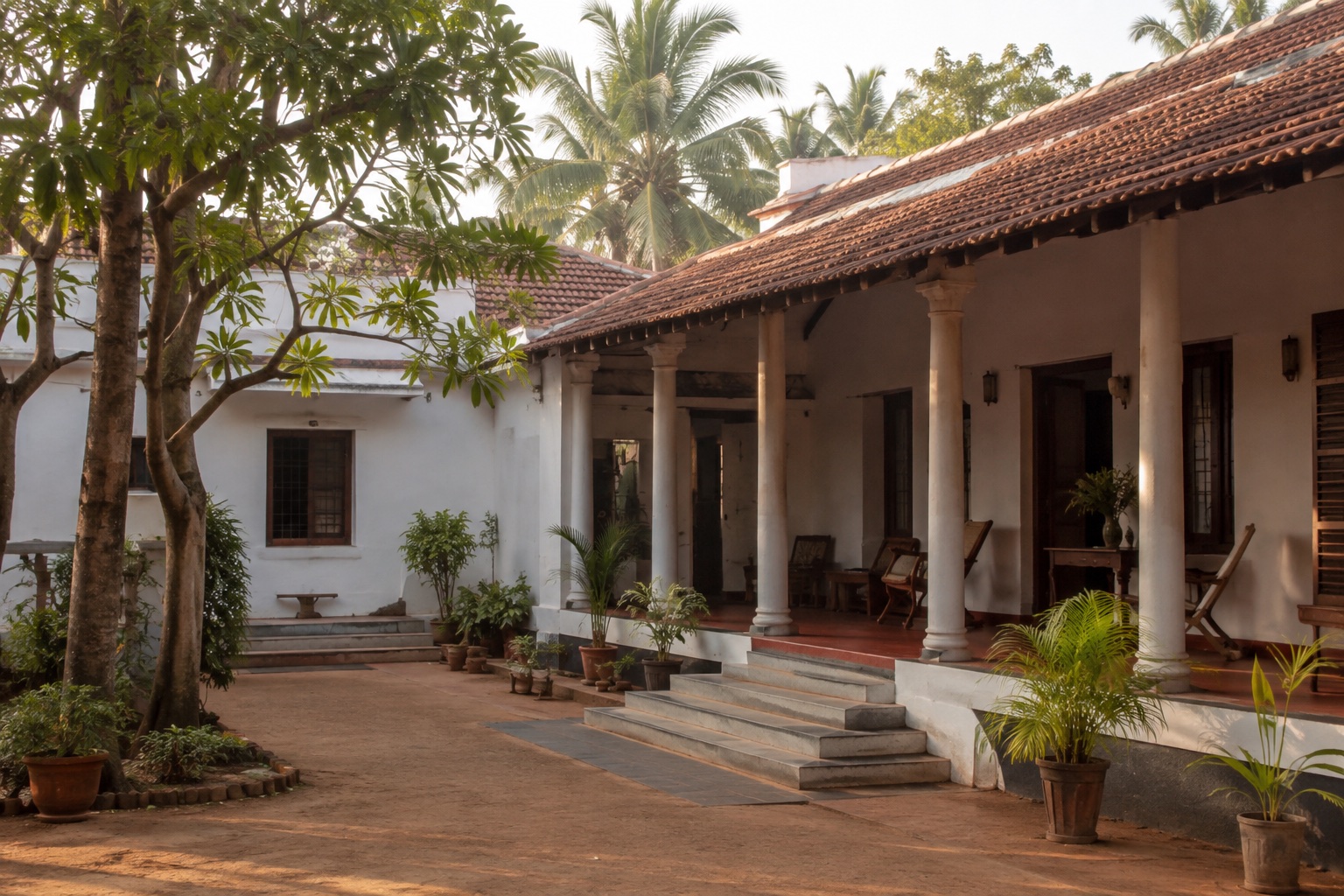
Before you choose the property
Start with the rules that actually shape the project.
Registration under the located Guidelines is compulsory statewide for the Homestay/B&B categories.
Current Homestay definition requires resident owner/promoter and permits 1–6 rooms/12 beds.
Current B&B definition uses a resident designated agent/operator where the owner/promoter does not reside and permits 1–8 rooms/16 beds.
Scope: Source-checked regulatory and business-planning guidance. It does not approve a particular title, building, tax position, food activity or operating structure.
01 / Executive finding
The practical starting point
- Tamil Nadu’s current homestay framework is G.O.(Ms) No.105 dated 27 April 2022 and its annexed Guidelines, effective 1 June 2022, as materially amended by G.O.(Ms) No.242 dated 7 July 2026. The live Tourism Operator Registration System currently links the 2026 “B&B, Home Stay Amendment”. [S1, pp.1–2; S2, pp.2–20; S3, pp.1–4; S4, G.O. Guidelines]
- Registration is compulsory for a Bed & Breakfast or Homestay establishment under the Guidelines, which expressly extend to the whole State of Tamil Nadu. Tourism registration is expressly defined as registration/classification, not as a substitute for other licensing. [S2, pp.2–3, clauses 1–2]
- Under the July 2026 definition, a Homestay requires the owner/promoter to physically reside in the same premises and permits 1–6 lettable rooms, maximum 12 beds. [S3, p.2, amendment 1(d)]
- A Bed & Breakfast is now the category in which the owner/promoter does not reside but a designated agent/operator resides at the establishment; it permits 1–8 lettable rooms, maximum 16 beds. [S3, pp.1–2, amendment 1(c)]
- No permanent-domicile, Tamil Nadu domicile or prescribed number of years of local residence was located. The rule located is physical residence at the establishment, not domicile. [S3, pp.1–2]
- The premises are required by the base Guidelines to be a purely residential unit. Approved building plan “as applicable” and a Chartered Engineer’s stability certificate form part of the published registration file. Tourism registration itself therefore does not establish lawful land use, sanctioned construction, occupancy status or local-body compliance. [S2, pp.5, 14]
- Classification remains Silver or Gold. The published Form B contains grade-specific standards including room areas of 100 sq ft for Silver and 120 sq ft for Gold, bathroom areas of 24 sq ft and 40 sq ft respectively, and numerous mandatory/desirable facilities. [S2, pp.15–18, Form B]
- Current registration fees introduced in July 2026 are: Silver ₹8,000 for 5 years or ₹15,000 for 7 years; Gold ₹13,500 for 5 years or ₹18,500 for 7 years. Renewal is ₹10,000 Silver / ₹15,000 Gold. Inspection/reinspection charges exist but the current amount was Not stated in the current official material reviewed. [S3, p.2; S2, p.5]
- The 2026 amendment substitutes the inspection machinery: an inspection committee constituted by the Commissioner/Director of Tourism prepares the report, the District Tourism Development Committee (DTDC) examines and recommends, and the Commissioner/Director passes the final order. It says the process shall be completed within 60 days of application if all required documents are submitted; this is not an approval guarantee. [S3, p.3, substituted clause 5]
- Renewal is to be done online at least three months before expiry. A maximum two-month post-expiry delay is permitted with ₹5,000 for each month of delay; beyond two months, the amended clause says registration will be cancelled and the facility shut down. [S3, p.3, substituted clause 8]
- A major publication problem remains: the still-published Form B contains the superseded room limits of 3 rooms/6 beds for Homestay and 6 rooms/12 beds for B&B, notwithstanding the 2026 G.O.’s express increase to 6/12 and 8/16. For inspection-document purposes, the official materials are therefore not fully aligned. [S2, p.15, Form B; S3, p.2]
- Another material implementation conflict remains because surviving 2022 processing provisions and Form B continue referring to an external “Inspection Agency”, whereas G.O.(Ms) No.242 substitutes a Commissioner/Director-constituted Committee and DTDC process. [S2, pp.6–8, clauses 5–7/Form B; S3, p.3]
- The 2023 Tourism Policy says rural homestays, termed “Countryside Stays,” shall receive special incentives under the Homestay Scheme; however, ordinary Homestay is not listed among the Chapter 15 eligible tourism-project categories reviewed, and a current financial “Homestay Scheme” instrument specifying amount, eligibility, ceilings and sanction procedure was Not stated in the current official material reviewed. [S7, pp.29, 79–81]
- Foreign-guest reporting is now governed by the Immigration and Foreigners Rules, 2025: Rule 17 expressly includes “home stay”, covers foreigners including OCI cardholders, requires electronic arrival and departure reporting within 24 hours, and at least one year’s electronic retention. The older Tamil Nadu Guidelines still use the legacy “Form-C” wording. [S15, Rule 17, p.27; S2, pp.9,18]
- There is enough official evidence to describe the core category, residence condition, room cap, fees, classification and principal process, but not enough alignment to publish an unqualified operating guide without written Tourism Department clarification on the post-July-2026 inspection checklist/process, non-individual/operator structures, GST-upload treatment and incentive scheme.
02 / Document chronology
Use the current rules and implementation
2019 — Tamil Nadu Combined Development and Building Rules. G.O.(Ms) No.18 established the statewide combined planning/building framework for Corporations, Municipalities, Town Panchayats and Village Panchayats. Later amendments exist, meaning the 2019 PDF cannot alone establish the current development-control position of a specific property. [S12] 27 April 2022 — G.O.(Ms) No.105. Government approved the annexed B&B/Homestay Guidelines and prescribed commencement on 1 June 2022. [S1, paras 4–6] 1 June 2022 — Guidelines take effect. They introduced compulsory statewide registration, Homestay/B&B definitions, Silver/Gold classification, forms, documents, inspection and operating duties. [S2] 2023 — Tamil Nadu Tourism Policy. It introduces “Countryside Stays” as rural homestays and states that special incentives would be available under a “Homestay Scheme”. It separately creates an eligible-project category for Plantation/Farm Tourism Projects. [S7, p.29; pp.79–81] 1 September 2025 — Immigration and Foreigners Rules, 2025. These superseded specified earlier foreigner-registration rules and established current accommodation reporting through Rule 17. “Home stay” is expressly included. [S15, Rule 17] 13 March / 1 April 2026 — FSSAI reforms. FSSAI revised turnover thresholds with effect from 1 April 2026: registration up to ₹1.5 crore, State licence above ₹1.5 crore up to ₹50 crore, Central licence above ₹50 crore, subject to the applicable food-business categorisation. [S14, paras 3–5] 7 July 2026 — G.O.(Ms) No.242. This is the latest located Tamil Nadu homestay amendment. It expressly substitutes the B&B and Homestay definitions/capacity, fee table, clause 5 inspection machinery and clause 8 renewal rule; it also omits the old initial-validity item and inserts online self-renewal. [S3, pp.1–3] Unresolved chronology issue: S3 did not publish a fully consolidated replacement of S2. Consequently, S2’s Form B and parts of clause 6 still contain the superseded capacity and “Inspection Agency” terminology. The later G.O. controls where it expressly substitutes text, but the procedural form itself remains stale online.
03 / Category definitions
Choose the right accommodation category
| Category | Location | Eligible owner/applicant | Residence requirement | Operator allowed | Capacity | Food position | Source |
|---|---|---|---|---|---|---|---|
| Homestay Establishment | Whole Tamil Nadu; residential premises | Applicant definition includes owner/promoter or agent/operator, but current Homestay definition centres on resident owner/promoter | Owner/promoter physically resides in same premises | Management role appears in Forms/Guidelines, but an operator cannot replace the resident-owner element of the current Homestay definition without written clarification | 1–6 lettable rooms; max 12 beds | Form B: FSSAI permit “where applicable” | [S2, cls.1–4/Form B; S3, p.2] |
| Bed & Breakfast Establishment | Whole Tamil Nadu; includes buildings in plantations | Owner/promoter, agent/operator route published | Owner/promoter does not reside; designated agent/operator resides | Yes, expressly contemplated | 1–8 lettable rooms; max 16 beds | FSSAI where applicable | [S3, pp.1–2; S2, Form B] |
| Countryside Stay | Rural areas | Homeowner/family concept in Tourism Policy | Policy describes tourists staying with homeowner/families | Separate operator rule Not stated in the material reviewed | Not stated in the material reviewed as a separate category | Not stated in the material reviewed | [S7, p.29] |
| Plantation/Farm Tourism Project | Anywhere in State under Tourism Policy | Eligible project/enterprise under incentive framework | No residence requirement stated in the project eligibility table | Enterprise/project model contemplated | Minimum 5 guest rooms; not stated as a maximum | Café may be one of service options; food-licensing remains separate | [S7, p.81] |
| Guest House / Service Apartment / Lodging House | Depends on local body | Local licensing/use rules, not the homestay Guidelines | Not stated in the material reviewed in homestay framework | Not stated in the material reviewed | Not stated in the material reviewed | Separate local/food rules may apply | [S11, Schedule III] |
| Hotel / Resort | Project/category dependent | Separate tourism/building regimes | No homestay residence rule | Separate regime | Not stated in the material reviewed in current homestay sources | Separate | [S7; S2] |
| Farm stay as a standalone TORS registration category | — | Not stated in the current official material reviewed | Not stated in the material reviewed | Not stated in the material reviewed | Not stated in the material reviewed | Not stated in the material reviewed | S7 instead identifies “Plantation/Farm Tourism Project” for policy incentives |
“Countryside Stay” should not be presented as a demonstrated third TORS registration category: the policy text describes rural homestays, while the operative registration Guidelines locate Homestay/B&B as the registered categories.
04 / Eligibility decision tree
Check whether the applicant and property qualify
Start with the exact property address and local-body category. Identify Corporation/Municipality/Town Panchayat/Village Panchayat, planning authority, whether the site is coastal, forest-adjacent, heritage-controlled or otherwise specially regulated, and the sanctioned/current use of the building. 1. Is there already a specific residential property?
- No — only capital is available. No property-specific TORS application can yet be completed because Form A requires the establishment address, ownership details, road/access, areas, rooms, plans, photographs and map coordinates. Not established in the published material
- Land exists but there is no lawful residential building yet. Secure planning/building feasibility first; tourism registration does not confer development permission. Confirm this in writing with the authority
- Yes. Continue. 2. What is the ownership/lease position?
- Owner applying directly with published ownership proof → continue.
- Agent/operator acting for owner with the published duly registered special power of authorisation → continue, subject to category/residence.
- Lessee relying only on a lease without the published owner authorisation → Confirm this in writing with the authority
- Joint/inherited property where not every co-owner has consented and authority mechanics are unclear → Confirm this in writing with the authority 3. Who will physically live in the premises?
- Owner/promoter physically lives there → test Homestay.
- Owner/promoter lives elsewhere but a designated agent/operator resides → test B&B.
- Neither owner/promoter nor designated resident operator lives there → does not appear to fit the published homestay definition
- “Caretaker” lives there but is not demonstrably the designated agent/operator contemplated by the Guidelines → Confirm this in writing with the authority 4. Applicant identity and residency
- Individual resident owner/promoter → continue.
- Company, LLP, partnership, trust or society proposed as the residence-bearing Homestay applicant → current forms/rules do not clearly explain how an artificial legal person satisfies physical residence → Confirm this in writing with the authority
- No Tamil Nadu domicile but physically resident at the property → no domicile restriction was located → continue on other criteria. 5. Room/bed plan
- Homestay: 1–6 lettable rooms and no more than 12 beds → continue.
- B&B: 1–8 lettable rooms and no more than 16 beds → continue.
- Above those current limits → Consider another accommodation category
- Homestay uses rooms 4–6 or B&B rooms 7–8 → legally within G.O.242’s current limits, but stale Form B remains online → Confirm this in writing with the authority 6. Is the building purely residential and capable of meeting the required documents/standards?
- Yes, with appropriate plan, stability certificate, access, safety, rooms and facilities → continue.
- Mixed/uncertain use, unapproved additions, unresolved conversion or absence of required building documentation → Confirm this in writing with the authority 7. Existing, proposed or already running?
- Existing lawful residence, not yet operating, meeting Homestay residence/capacity standards → This appears to fit the published route, subject to the remaining checks
- Running but unregistered → registration is compulsory; the historical 2022 three-month transition is long expired → Confirm this in writing with the authority
- Proposed building/renovation not yet lawfully approved → Not established in the published material Use these branches as a starting test and confirm the result for the exact property.
05 / Applicant and operating structures
Set the ownership and operating structure
| Structure | Supported route | Main obstacle | Source | Question requiring clarification |
|---|---|---|---|---|
| Resident individual owner | Strongest published Homestay route if owner/promoter lives in same premises and standards/cap are met | Property/local approvals still separate | [S2–S3] | None on basic category; address-specific approvals remain |
| Joint/inherited ownership | Ownership proof can potentially be produced | Co-owner consent/signature rule Not stated in the material reviewed | [S2, p.4] | Must every co-owner consent/execute authority? |
| Owner living elsewhere | Current definition points away from Homestay | Must use B&B structure with resident designated agent/operator if otherwise eligible | [S3, pp.1–2] | Confirm category treatment where owner only visits periodically |
| Owner using caretaker | “Caretaker” is not a defined status | Resident agent/operator is defined; caretaker alone is not | [S2, definitions; S3] | Can caretaker become designated operator after registered authorisation? |
| Long-term lessee | Lease alone is not stated as sufficient in registration document list | Published operator route requires owner’s registered special authorisation | [S2, pp.4,20] | Can a lessee be registration holder, or only authorised operator? |
| Company / partnership / LLP | Not stated in the material reviewed as an expressly supported Homestay registration-holder route | Physical-residence requirement and natural-person Form A fields create uncertainty | [S2 Form A; S3] | Can an entity own/hold registration while a named resident promoter/host satisfies residence? |
| Professional operator / management company | Guidelines define operator and contemplate authorised management | Corporate operator and its residence status are not clearly addressed; management agreement is not the same instrument as registered special authority | [S2, pp.3–4,20] | Can a company be “operator”, and what individual must reside? |
| Capital-only participant | No application route until property/applicant/host/operator structure exists | Form A is property-specific | [S2, Forms] | Decide property first |
| Landowner proposing new construction | Can develop only after independent planning/building path | TORS is not building permission | [S2; S12] | Confirm allowable use/design with planning/local authority before construction |
The broad definition of “Owner” in S2 includes persons receiving or entitled to receive property tariff/profits in capacities such as agent, trustee, guardian, manager or receiver. That wording does not by itself settle corporate/LLP eligibility or remove the current Homestay physical-residence requirement. [S2, p.3]
06 / Property and classification standards
Prepare the property for inspection
| Topic | Mandatory / classification / guidance / unclear | Requirement | Applies when | Source | Confidence |
|---|---|---|---|---|---|
| Residential character | Mandatory | Premises to be purely residential units | Both categories | [S2, p.5] | HIGH |
| Host residence | Mandatory/category definition | Homestay: owner/promoter resides; B&B: designated agent/operator resides where owner does not | Category selection | [S3, pp.1–2] | HIGH |
| Homestay rooms/beds | Mandatory | 1–6 lettable rooms; max 12 beds | Homestay | [S3, p.2] | HIGH; stale Form B conflict |
| B&B rooms/beds | Mandatory | 1–8 lettable rooms; max 16 beds | B&B | [S3, pp.1–2] | HIGH; stale Form B conflict |
| Total non-guest rooms | Unclear | No separate cap on owner/family rooms located; Form A asks rooms offered under Guidelines | Both | [S2, Form A p.12] | MEDIUM |
| Guestroom area | Classification | Silver 100 sq ft; Gold 120 sq ft | Classification | [S2, Form B p.15] | HIGH |
| Room condition | Classification | Clean, airy, pest-free, without dampness, outside window/ventilation | Both grades | [S2, Form B p.15] | HIGH |
| Attached bathroom | General condition + classification inconsistency | General clause requires attached bathrooms; Form B calls attached private bathroom Desirable Silver / Mandatory Gold | Both | [S2, p.6/Form B p.16] | LOW — official text not aligned |
| Bathroom area | Classification | Silver 24 sq ft; Gold 40 sq ft | Classification | [S2, Form B p.16] | HIGH |
| Hot/cold water | Classification | 24-hour hot/cold water with proper sewerage: Desirable Silver / Mandatory Gold | Classification | [S2, Form B p.16] | HIGH |
| Water/power | Mandatory general condition | Adequate water, power, ventilation and lighting | Both | [S2, p.6] | HIGH |
| Backup power | Unclear | Not stated in the current official material reviewed as universal homestay requirement | — | — | LOW |
| Kitchen | Classification | Clean, hygienic, smoke-free, pest-free kitchen mandatory for Silver and Gold in Form B | Classification | [S2, Form B p.16] | HIGH |
| Dining area | Classification | Desirable Silver; Mandatory Gold | Classification | [S2, Form B p.16] | HIGH |
| Cutlery/crockery | Classification | Mandatory both | Classification | [S2, Form B p.16] | HIGH |
| Heating/cooling | Classification | According to climate; Desirable Silver / Mandatory Gold | Classification | [S2, Form B p.16] | HIGH |
| Internet/Wi-Fi | Classification | Desirable Silver / Mandatory Gold | Classification | [S2, Form B p.16] | HIGH |
| Earthed socket | Classification | 15A earthed guestroom socket mandatory both | Classification | [S2, Form B p.16] | HIGH |
| Parking | Mandatory + conflicting classification | General clause: minimum one car parking and at least one parking place per two rooms, premises/vicinity; Form B says “sufficient parking” Desirable Silver/Mandatory Gold | Both | [S2, p.6/Form B p.15] | LOW — conflict |
| Road access | Mandatory general | Easily accessible by motorable road | Both | [S2, p.6] | HIGH |
| Surveillance | Classification | Mandatory Silver and Gold | Both | [S2, Form B p.15] | HIGH |
| Fire safety | Mandatory general/classification | Hygiene/safety including fire safety; fire extinguisher mandatory in Form B | Both | [S2, pp.6,18] | HIGH for tourism standard; external fire NOC issue separate |
| Waste | Classification/local dependency | Garbage disposal as per municipal laws mandatory both | Both | [S2, Form B p.17] | HIGH |
| First aid | Application/facility disclosure | Included in facility list/photos | Both | [S2, pp.5,14] | HIGH |
| Lounge/public area | Classification | Desirable Silver / Mandatory Gold | Classification | [S2, Form B p.17] | HIGH |
| Reception restriction | Unclear | Not stated in the current official material reviewed | — | — | LOW |
| Signage | Unclear | Homestay-specific signage mandate/restriction Not stated in the material reviewed | — | — | LOW |
| Accessibility | Unclear | Homestay-specific inclusive-design/accessibility schedule Not stated in the material reviewed | Address/building classification may create other obligations | [S12] | LOW |
| Approved building plan | Application requirement | Copy required “as applicable” | Registration | [S2, p.5/p.14] | HIGH |
| Structural stability | Application requirement | Chartered Engineer stability certificate | Registration | [S2, p.5/p.14] | HIGH |
07 / Documents and declarations
Assemble the application file
| Document | Who provides/signs | Format/stamp requirement | Validity period | When required | Source | Unresolved issue |
|---|---|---|---|---|---|---|
| Form A | Applicant | Published application form; online submission | Not stated | Initial application | [S2, pp.11–13] | Authenticated current web form not inspected |
| Form C undertaking | Owner/promoter/agent/operator | Signed prescribed undertaking | Not stated | Registration/renewal file | [S2, p.19] | Portal e-sign/upload mechanism not public |
| Ownership proof | Owner | Title deed or property-tax receipt or electricity-bill receipt stated | Not stated | Owner applicant | [S2, p.4] | Co-owner/inherited-property consent rule not located |
| Special power of authorisation | Owner → promoter/agent/operator | Published specimen says ₹50 non-judicial stamp “as applicable value in force”, registered by Sub-Registrar | Minimum 4 years from application in specimen | Where authorised person applies/manages | [S2, p.20] | Does 4-year minimum suffice for 5/7-year registration? |
| Location plan — major roads | Applicant | Upload | Not stated | Application | [S2, pp.4,14] | File format/size not public |
| Access plan — bus/rail/airport | Applicant | Upload, distances required | Not stated | Application | [S2, pp.4,14] | — |
| Building/facade/street/interior photographs | Applicant | Soft/scanned copies | Not stated | Application | [S2, pp.4,14] | Pixel/file rules not located |
| Facility photographs | Applicant | Includes parking, Wi-Fi, cooking, laundry, phone, first aid etc. | Not stated | Application | [S2, p.14] | Checklist contains some merely desirable facilities |
| Approved building plan | Applicant/property owner | Copy | Not stated | “As applicable” | [S2, p.5] | What substitutes for lawful older buildings is not stated |
| Stability certificate | Chartered Engineer | Certificate | Validity not stated | Application | [S2, p.5] | Current acceptable age not stated |
| Latitude/longitude and map | Applicant | Online map/location | Not stated | Application | [S2, p.5] | File format not public |
| GST registration | Applicant/operator | Copy/details | Not stated | Published checklist/Form A | [S2, pp.5,12,14] | Whether portal permits “not applicable” where GST registration is not legally required is unknown |
| PAN | Operator/applicant | Copy/details | Not stated | Application | [S2, pp.5,12,14] | Entity vs individual PAN implementation unclear |
| Form B checklist | Applicant + inspector observations | Published checklist | At application/renewal | Registration/renewal | [S2, pp.15–18] | Stale capacity and inspector nomenclature |
| Character certificate | — | — | — | — | — | Not stated in the current official material reviewed |
| Police verification of owner/operator/staff | — | — | — | — | — | Not stated in the current official material reviewed as a TORS application document |
| General local-body NOC | — | — | — | — | — | Not stated in the material reviewed as a universal tourism-registration document |
| Fire NOC | — | — | — | — | — | Fire-safety standard is located; universal separate Fire NOC for every homestay is Not stated in the material reviewed |
| FSSAI registration/licence | Relevant FBO | FoSCoS/FSSAI route | Current FSSAI regime | “Where applicable” | [S2 Form B; S14] | Exact food-business category must be determined from actual activity |
Form C states that information/documents must be correct/authentic and material facts must not be concealed; false information or concealment can expose the applicant to legal action and summary cancellation. [S2, p.19]
Download the Tamil Nadu property and application checklist ↓
08 / Application and inspection process
Follow the application and inspection process
| Step | Responsible person/authority | Input/document | Resulting record | Stated period | What does not happen automatically |
|---|---|---|---|---|---|
| 1. Property/category assessment | Applicant | Address, ownership, host/operator, rooms/beds, residential/building status | Decision to pursue Homestay/B&B/other category | None | No approval merely from meeting definition |
| 2. Choose Silver/Gold | Applicant | Form B facility standards | Classification sought | Before operation | Applying Gold does not guarantee Gold |
| 3. TORS signup | Applicant | Name, mobile, email, OTP, CAPTCHA | User account route | Public page gives no service period | Signup is not an application or registration [S5] |
| 4. Online application | Applicant | Form A and attachments | Application record | Before commencement | Submission does not permit operation [S2, p.4] |
| 5. Payment | Applicant | Registration fee + applicable inspection charge | Payment record | At application | Payment is non-refundable and not approval [S2, p.5; S3, p.2] |
| 6. Document scrutiny | Current post-2026 committee/process; surviving S2 still describes “Inspection Agency” | Application documents | Scrutiny/query/inspection readiness | Overall S3 condition: 60 days if all documents | Current authenticated query UI not inspected |
| 7. Physical inspection | Committee constituted by Commissioner/Director under S3 | Property + applicable checklist | Detailed inspection report | Included in conditional 60-day process | Inspector may recommend lower category, not higher [S3, p.3] |
| 8. Rectification if required | Applicant | Assessment deficiencies | Online compliance report | Surviving S2 says within 30 days | Failure leads to rejection/fresh application under S2; post-S3 implementation terminology needs clarification [S2, p.7] |
| 9. Reinspection if required | Current authority unclear because S2 says Inspection Agency + Tourism representative | Compliance report + reinspection fee | Reinspection report | Not stated | Reinspection is not automatic approval |
| 10. DTDC examination | District Tourism Development Committee | Detailed inspection report | DTDC recommendation | Included in S3 conditional 60 days | DTDC recommendation is not final registration |
| 11. Final order | Commissioner/Director of Tourism | DTDC recommendation | Approval/refusal/order | S3: process within 60 days if all docs | No guarantee of approval [S3, p.3] |
| 12. Certificate | Department/TORS | Approved application | Registration & Classification Certificate downloadable online | No separate period | Certificate does not replace other licences [S2, p.8] |
| 13. Appeal if rejected/cancelled | Owner → Secretary to Government, Tourism Department | Appeal against order | Final Secretary decision under located clause | Within 30 days of communication | Appeal does not suspend other legal obligations [S2, p.9] |
The 2022 text says an applicant selects a physical-inspection time slot and describes an external inspection agency. Since the 2026 G.O. substitutes clause 5 but not every sentence in clause 6/Form B, the exact current online scheduling and reinspection architecture requires written confirmation. [S2, pp.6–7; S3, p.3]
09 / Fees, timelines, validity and renewal
Confirm fees, timing and certificate validity
| Item | Current verified position | Nature | Source/status |
|---|---|---|---|
| Silver initial registration — 5 years | ₹8,000 | Current amended fee option | [S3, p.2] |
| Silver initial registration — 7 years | ₹15,000 | Current amended fee option | [S3, p.2] |
| Gold initial registration — 5 years | ₹13,500 | Current amended fee option | [S3, p.2] |
| Gold initial registration — 7 years | ₹18,500 | Current amended fee option | [S3, p.2] |
| Silver renewal | ₹10,000 | Current amended fee | [S3, p.2] |
| Gold renewal | ₹15,000 | Current amended fee | [S3, p.2] |
| Late renewal | ₹5,000 for each month of delay, max 2 months post-expiry | Current rule | [S3, p.3] |
| Renewal filing | At least 3 months before expiry | Current amended rule | [S3, p.3] |
| Maximum late period | 2 months after expiry | Current amended rule | [S3, p.3] |
| Failure beyond late period | Registration cancelled; facility shut down | Current amended rule | [S3, p.3] |
| Renewal duration | Further period not exceeding 3 years at a time | Surviving clause after S3 renumbering | [S2, p.6; S3, p.2] |
| Inspection charge | Department fixes from time to time | Amount Not stated in the material reviewed publicly | [S2, p.5] |
| Reinspection charge | Department fixes from time to time | Amount Not stated in the material reviewed | [S2, pp.5,7] |
| Payment route | Online/payment gateway | Published process | [S2, p.5] |
| Refund | Fee once paid not refunded/adjusted | Mandatory rule | [S2, p.10; S3 lower-grade rule] |
| Overall process | Within 60 days of application if all required documents submitted | Conditional administrative rule; not approval guarantee | [S3, p.3] |
| After rectification compliance | S2 says registration finalised within 30 days after receipt of compliant rectification report | Surviving/overlapping text | [S2, p.9] |
Validity caution: G.O.242 expressly omitted the former clause that made initial registration valid to the end of the second succeeding financial year. Its new fee table instead prices 5-year and 7-year registration options. The safest public wording is therefore “the amended fee table provides 5-year and 7-year initial registration options,” rather than relying on the superseded 2022 validity formula. [S3, p.2]
10 / Operating duties after registration
Run the registered homestay correctly
- Maintain category conditions and standards. Periodic inspection is permitted. Major deficiencies can lead to suspension for up to 60 days while rectification occurs; guests must not be accommodated during suspension. Failure to rectify may lead to cancellation. [S2, pp.8–9]
- Display room information/rates. The Guidelines require room photographs on boarding sites and the maximum room tariff at the premises and online booking sites. [S2, p.9, clause 12(a)]
- Notify facility changes. Changes in facilities are to be informed online to the Department within one week. [S2, p.9, clause 12(b)]
- Guest records. Form B makes a guest check-in/check-out register mandatory for both grades and specifically mentions passport details for foreign tourists. A separate minimum retention period for ordinary domestic guest records was Not stated in the material reviewed in the tourism Guidelines. [S2, Form B p.18]
- Domestic ID requirements. A precise tourism-rule list of Aadhaar/passport/driving licence/etc. for domestic guests was Not stated in the current official material reviewed.
- Foreign guests. Rule 17 of the Immigration and Foreigners Rules, 2025 requires the accommodation keeper to collect required particulars from every foreigner including an OCI cardholder, maintain the electronic record at least one year, transmit Form III within 24 hours after arrival and transmit departure details within 24 hours after departure. “Home stay” is expressly included. [S15, Rule 17]
- Foreign-reporting portal. The current Bureau of Immigration portal identifies the online process as Form III while retaining legacy Form C labels in places. [S16]
- Tourism statistics. The authenticated TORS navigation contains a “Tourist Statistics” module, but the filing frequency, fields and applicability to Homestay were not publicly inspectable without authentication. [S4–S5]
- Food. Form B requires FSSAI permission “where applicable.” Whether the host is an FBO and which Kind of Business/licence class applies depends on the actual food service. [S2, Form B; S14]
- Tax. The Guidelines require compliance with applicable Income Tax, GST and other laws; they do not themselves determine the tax result. [S2, p.9]
- Waste. Garbage disposal according to municipal law is mandatory in Form B. [S2, p.17]
- Safety. General maintenance, hygiene, cleanliness and fire safety remain required; Form B specifically requires a fire extinguisher. [S2, pp.6,18]
- Staff/caretaker police verification: Not stated in the current official material reviewed as a universal tourism duty.
- Mandatory local employment/training quota: Not stated in the current official material reviewed for ordinary Homestays.
- Guest invoice/billing format: Not stated in the material reviewed as a separate tourism-registration prescription; tax invoicing must be considered under applicable tax law.
- Incident reporting: a distinct universal homestay incident-reporting procedure was Not stated in the material reviewed.
- Insurance: a compulsory Homestay insurance policy was Not stated in the material reviewed. As a commercial risk-management recommendation, the property/operator should independently assess property, public-liability, employer and other relevant covers; this is not a published TORS condition.
11 / Adjacent approvals and dependencies
Close the approvals outside Tourism
| Topic | What tourism registration resolves | What it does not resolve | Likely authority | Official source located | Property-specific question |
|---|---|---|---|---|---|
| Land/building use | Registers/classifies Homestay/B&B | Lawful land use, zoning, planning permission, unauthorised additions, change of use | CMDA/DTCP/local planning/local body as applicable | S12 | Is the exact accommodation use lawful at this survey/address? |
| Sanctioned plan | Requires copy “as applicable” | Does not regularise deviations | Planning/local body | S2/S12 | Does present building match approved plan? |
| Completion/occupancy | Tourism Guidelines do not decide it | Completion/occupancy requirement for exact building | Local/planning authority | Address-specific | Which certificate is legally required for this building? |
| Older construction | No special relaxation located | Historic/legacy building legality | Local/planning authority | Not stated in the material reviewed as homestay exception | What documentary substitute is accepted? |
| Fire | Sets tourism fire-safety standard | Separate Fire & Rescue NOC applicability | TN Fire & Rescue/local/building authority | Homestay-wide NOC rule Not stated in the material reviewed | Does size/use trigger additional fire approval? |
| Food | Form B says FSSAI where applicable | FBO status and licence/registration class | FSSAI/FoSCoS; State Food Safety | S14 | What food is prepared/sold and by whom? |
| Police | Foreign reporting cross-reference | Domestic police NOC/staff verification | District police/FRRO as applicable | No universal TORS police NOC located | Is any local order applicable? |
| Foreign guests | Tourism registration recognises duty | Does not perform Form III reporting | Bureau of Immigration/FRRO/FRO | S15–S16 | Has accommodation keeper completed portal registration? |
| Local-body trade/public-building licence | Nothing definitive | Whether exact use falls within local licence schedule | Corporation/Municipality/Town Panchayat/Panchayat | S11 | What local use classification applies? |
| CRZ | Nothing | Prior CRZ clearance where development falls within CRZ | TNSCZMA/DCZMA/MoEFCC/SEIAA/planning authority | S13 | Is site within mapped CRZ and what works are proposed? |
| Forest/protected area | Nothing | Forest/wildlife/ecosensitive restrictions | Forest/Wildlife/competent authority | Property-specific source not selected without location | Is site inside/near protected or notified area? |
| Heritage | Nothing | Archaeology/heritage/local restrictions | ASI/State Archaeology/local planning as applicable | Property-specific | Is building/site protected or within regulated area? |
| GST | Checklist requests GST details/copy | Does not itself determine statutory GST liability | CBIC/GST authorities | S18 | Is applicant/operator legally required to register, and whose GSTIN belongs on TORS? |
| Udyam | Nothing | MSME registration/status | Ministry of MSME | S17 | Is Udyam commercially/incentive-relevant? |
| Water | Requires adequate supply | Source permission, borewell/local connection/sewerage legality | Local body/water authority/TWAD etc. | Property-specific | Source, capacity and disposal route? |
| Electricity | Requires adequate power | Tariff category/load/service conversion | TANGEDCO/TNPDCL as applicable | S2 only says applicable rate applies | What tariff/service category applies to actual use? |
| Property tax | Nothing | Assessment/use classification | Local body | S2 says applicable rate applies | Does operating use alter assessment? |
| Waste/sewerage | Requires municipal-law compliance | Collection contract, septic/STP/local rules | Local body/TNPCB where applicable | S2/S11 | How will waste and sewage actually be handled? |
| Pollution | Nothing | Consent/authorisation where activity triggers it | TNPCB | Property-specific | Does any ancillary activity trigger consent? |
The Town Panchayat Schedule III reviewed names eating houses/restaurants and certain lodging uses including Guest House and Service Apartment but does not expressly name Homestay. It should therefore not be converted into a blanket claim that every Tamil Nadu Homestay owes the same Town Panchayat trade licence/fee. [S11, Schedule III] For coastal sites, TNSCZMA states that development activities within CRZ require prior CRZ clearance from the competent authority after the prescribed coastal-zone process. Tourism registration does not displace this. [S13]
12 / Incentives, subsidy and funding
Evaluate incentives without assuming sanction
A. Ordinary Homestay / “Countryside Stay”
Official scheme statement located: Tamil Nadu Tourism Policy 2023, p.29 states that rural homestays, called “Countryside Stays”, are to be promoted and that such projects “shall be given special incentives under the Homestay Scheme”. [S7, p.29] Current operative Homestay Scheme containing financial quantum, ceiling, beneficiary, eligible expenditure, bank route and sanction process: Not stated in the current official material reviewed. Current applications confirmed open: Not stated in the current official material reviewed. Publication consequence: no percentage, rupee amount, loan promise or subsidy entitlement should presently be published for an ordinary Tamil Nadu TORS Homestay.
B. Separately qualifying Plantation/Farm Tourism Project
This is a distinct Tourism Policy eligible project and should not be treated as interchangeable with Homestay. Verified eligibility under the Policy includes:
- minimum plantation land: 5 acres;
- minimum built-up area: 5,000 sq ft;
- minimum guest rooms: 5;
- at least three specified services among café, interpretation centre, souvenir store and produce-conversion centre; and
- botanically rich plantation/herbs/fruits/tea/spices accessible to tourists;
- permitted anywhere in the State. [S7, p.81] If a project independently qualifies under that eligible-project category, Tourism Policy incentive machinery may become relevant.
Category A incentive framework
For eligible Category A tourism projects, the Policy identifies capital subsidy, additional capital subsidy, interest subvention, payroll incentive and quality-certification incentive. The ordinary Homestay registration category is not itself shown in the reviewed Chapter 15 eligible-project table, so these figures must not be advertised as Homestay benefits merely because a property has TORS registration. [S7, pp.79–84]
| Assistance | Verified Policy formula/condition | Sanction route | Automatic? |
|---|---|---|---|
| Capital subsidy — Category A eligible project | 25% of ECA; ceiling stated as ₹25 lakh for Micro and ₹1.5 crore for Small/Medium in Policy | Tourism → MSME Department | No; subject to eligibility, sanction and MSME rules [S7, p.82] |
| Additional capital subsidy | Certain eligible founder/co-founder categories: 5% ECA, max ₹5 lakh, with ≥26% equity; scaling existing MSE: 5% ECA max ₹25 lakh; additional Micro benefit 10% ECA max ₹5 lakh | Only projects approved for capital subsidy; MSME route | No [S7, p.83] |
| Interest subvention | Up to 5% on specified eligible loans; Policy ceilings include ₹25 lakh / ₹20 lakh depending route; maximum six years | MSME-policy route | No; timely payment condition applies [S7, p.83] |
| Payroll | Policy incentive subject to employment conditions | MSME route | No |
| Quality certification | Reimbursement framework subject to recognised certification and proof | Administering department | No |
Current MSME classification caution: the Tourism Policy PDF reproduces older MSME thresholds, but the official Udyam portal now states, from 1 April 2025, Micro ≤ ₹2.5 crore investment and ₹10 crore turnover; Small ≤ ₹25 crore and ₹100 crore; Medium ≤ ₹125 crore and ₹500 crore. The administering Tourism/MSME Departments should confirm which current classification governs incentive processing rather than a public guide reproducing stale 2023 footnote thresholds. [S17]
Eligible Capital Assets
For the Tourism Policy incentive system, ECA includes specified site infrastructure, structures/buildings, plant/machinery, MEP installations, fixtures/furniture and utilities. Buildings may be leased only under the Policy’s specified lease condition of at least 10 years. ECA expressly excludes land, working capital, capitalised interest, pre-construction/consultant expense and intangibles. [S7, p.88] This incentive-specific acceptance of leased assets does not establish that a lessee is a lawful Homestay registration holder under the separate 2022/2026 TORS Guidelines.
Application and sanction
The Tourism Policy says incentive applications go first to the Department of Tourism. For Category A, its Policy Cell checks eligibility/completeness, after which eligible applications go to the MSME Department for sanction/disbursement. B/C projects go through the corresponding Industries route. Supporting documents are subject to Operational Guidelines. [S7, pp.92–94] Current portal acceptance/open window for an ordinary Homestay subsidy: Not stated in the current official material reviewed.
13 / Business implications
Translate the rules into a workable project
Before selecting or acquiring property
the project team should establish, before commercial commitment:
- exact address, survey/property identifiers and local body;
- title/ownership/co-owner position;
- lawful residential status;
- sanctioned-plan and existing-building status;
- whether owner/promoter will actually reside;
- whether the intended operating structure is Homestay or B&B;
- proposed guest rooms/beds;
- access and parking feasibility;
- planning/local-body/CRZ/forest/heritage constraints;
- whether food will be served;
- who will hold TORS registration, contract with guests, employ staff and receive revenues. A capital-only participant therefore needs property and legal-structure screening before a TORS strategy exists.
Before construction or renovation
Do not design a building around TORS room limits first and attempt to legalise it later. Planning/building classification, sanctioned use, structural feasibility, access, parking, coastal/protected constraints and infrastructure should be tested before capital expenditure. TORS registration is not development permission. [S2; S12–S13]
Registration holder versus operating entity
The Guidelines contemplate owners, promoters, agents and operators and can issue certificates to an owner/promoter/operator/agent “as the case may be”. They also require a registered special power where a promoter/agent/operator acts for the owner. [S2, pp.4,8,20] However, the current Homestay definition specifically requires owner/promoter physical residence. No current source located proves that an LLP/company management entity may itself satisfy that residence condition or become the sole Homestay registration holder while the owner lives elsewhere. Accordingly, registration holder, property owner, resident host, operator, management company, employer and investor should not be collapsed into one concept.
What an LLP or management agreement cannot solve by itself
An LLP/company or contractual management agreement does not, without official confirmation:
- convert a non-resident owner’s property into a Homestay;
- replace the published registered special power of authorisation;
- establish that a corporate operator satisfies a residence requirement;
- legalise the building or land use;
- remove food/GST/foreign-reporting obligations; or
- guarantee transferability of registration.
Property-development assessment should include
A project property file should separately record:
- title/encumbrance/co-owner position;
- development-control and sanctioned-building position;
- intended TORS category;
- resident person and legal relationship to owner;
- registration holder;
- operator/manager;
- rooms/beds offered;
- Form B Silver/Gold gaps;
- building/access/parking/fire/waste/utilities;
- food and foreign-guest systems;
- GST/business-entity analysis;
- site-specific environment/protected-area issues;
- incentive eligibility, if independently qualifying;
- unresolved authority questions. Commercial terms should be proposed only after those facts are known. No fixed ownership percentage, capital contribution, return, room rate, occupancy or income commitment follows from the regulatory sources.
14 / Official-source conflicts
Resolve conflicting official instructions
Conflict 1 — current room caps versus Form B
Source A: G.O.(Ms) No.242/2026, p.2. Homestay: 1–6 rooms/12 beds; B&B: 1–8 rooms/16 beds. [S3] Source B: still-published Form B, p.15. Homestay: 1–3 rooms/6 beds; B&B: 1–6 rooms/12 beds. [S2] Hierarchy/date: S3 is later and expressly substitutes the definitions and clause 4(f)(ii), so the substantive legal cap is resolved in favour of S3. Implementation status: The official sources are not aligned because the inspection checklist itself has not been updated. Affected properties: Homestays proposing rooms 4–6 and B&Bs proposing rooms 7–8. Written answer should come from: Commissioner/Director of Tourism/TORS, copied to relevant District Tourism Officer, asking whether inspectors have an updated internal checklist reflecting G.O.242.
Conflict 2 — inspection authority/process
Source A: S3 replaces clause 5 with Commissioner/Director-constituted Committee → DTDC → Commissioner/Director final order, conditional 60-day process. Source B: surviving S2 clause 6/Form B still uses “Inspection Agency”, applicant-selected slots, inspection-agency observations and reinspection by agency plus Department representative. Hierarchy: S3 expressly replaces clause 5 but does not rewrite all related clause 6/Form B references. Status: The official sources are not aligned. Affected: every new application, rectification/reinspection and potentially renewal. Resolve with: Commissioner/Director of Tourism/TORS.
Conflict 3 — parking
Source A: S2 general registration condition requires minimum one car parking and at least one parking space per two rooms, on premises or vicinity. [S2, p.6] Source B: Form B describes “sufficient parking with adequate road width” as Desirable for Silver and Mandatory for Gold. [S2, p.15] Hierarchy: same instrument; no amendment found resolving the internal difference. Status: The official sources are not aligned. Affected: especially Silver applicants with constrained parking. Resolve with: Tourism inspection authority in writing before committing to a constrained site.
Conflict 4 — attached bathroom
Source A: general clause 4(f) says bedrooms should have attached bathrooms. [S2, p.6] Source B: Form B marks attached private bathrooms Desirable for Silver and Mandatory for Gold. [S2, p.16] Status: The official sources are not aligned. A prudent Silver project should not rely on the “Desirable” box to omit an attached bathroom when the general condition appears to require it.
Conflict 5 — initial validity versus amended fee options / authorisation term
Source A: S3 expressly omits the old second-succeeding-financial-year initial-validity clause and prices 5-year/7-year initial registrations. [S3, p.2] Source B: S2 special-power specimen requires authorisation for a minimum of four years from application. [S2, p.20] This is not a direct logical contradiction, but the current documents do not explain how an authorised operator’s minimum four-year instrument aligns with a 5- or 7-year registration. Status: The official sources are not aligned / WRITTEN CLARIFICATION REQUIRED.
Conflict 6 — processing timelines
Source A: S3: process within 60 days of application if all required documents are submitted. [S3, p.3] Source B: S2: registration “finalised within 30 days” of receipt of compliance report after rectifications. [S2, p.9] The 30-day period may describe a later remedial stage rather than displace the overall 60-day rule, but this is not expressly reconciled. Status: The official sources are not aligned / OVERLAPPING STAGES. Neither should be presented as a guaranteed approval time.
Conflict 7 — foreign-guest form terminology
Source A: Tamil Nadu S2 refers to Bureau of Immigration Form-C. [S2, pp.9,18] Source B: later central Immigration and Foreigners Rules, 2025 use Form III and expressly include Homestay, foreigners including OCI, arrival/departure within 24 hours and electronic retention. [S15, Rule17] Hierarchy: later central statutory rules govern current national reporting. Status: substantively resolved by S15, but Tamil Nadu material is stale in terminology.
Conflict 8 — Homestay incentive
Source A: Tourism Policy p.29 promises special incentives to rural Countryside Stays under a Homestay Scheme. [S7] Source B: Chapter 15’s reviewed eligible-tourism-project table does not list ordinary Homestay, while it separately lists Plantation/Farm Tourism Projects. [S7, pp.79–81] No current separate Homestay Scheme instrument defining the promised financial benefit was located. Status: The official sources are not aligned — IMPLEMENTATION INSTRUMENT Not stated in the material reviewed. Affected: rural property owners expecting subsidy. Resolve with: Department of Tourism Policy Cell/Commissioner of Tourism in writing.
Conflict 9 — GST upload versus separate GST liability
Source A: TORS Guidelines/Form A/checklist request GST registration details/copy without stating “where applicable”. [S2, pp.5,12,14] Source B: GST registration liability arises under GST legislation according to statutory conditions; TORS registration is not itself identified as the legal trigger. [S18, s.22] The hidden authenticated TORS form could have an N/A mechanism, but it was not inspected. Status: OFFICIAL APPLICATION IMPLEMENTATION NOT ALIGNED / WRITTEN CLARIFICATION REQUIRED. Tax liability itself should be determined separately by a tax professional.
16 / Source register
Official source register
| ID | Issuing body | Document or portal | Document/order number | Published | Effective | Language | Status/currentness | Official URL | Pages/sections reviewed | Notes |
|---|---|---|---|---|---|---|---|---|---|---|
| S1 | Government of Tamil Nadu, Tourism, Culture and Religious Endowments (T3-1) Dept. | G.O. approving B&B/Homestay Guidelines; filename GO_BedandBreakfastHomestayEstablishments.pdf | G.O.(Ms) No.105 | 27 Apr 2022 | 01 Jun 2022 | English | PRIMARY; remains foundation, subject to S3 amendments | Official G.O.105 PDF | pp.1–2/order | |
| S2 | Department of Tourism, Government of Tamil Nadu | Guidelines + Forms A/B/C + Special Power; filename Guidelines_BedandBreakfastHomestayEstablishments.pdf | Annexed Guidelines under G.O.105 | 2022 | 01 Jun 2022 | English | PRIMARY / FORM; current only as amended; several stale clauses/forms remain online | Official 2022 Guidelines and forms | pp.2–20 | |
| S3 | Government of Tamil Nadu, Tourism, Culture and Special Initiatives (T3-1) Dept. | Amendment to B&B/Homestay Guidelines; filename displayed/redirected as B&B, Home Stay.pdf | G.O.(Ms) No.242 | 07 Jul 2026 | No deferred date located | English | PRIMARY; latest homestay amendment located and linked by live TORS | Official G.O.242/2026 amendment | pp.1–4 | |
| S4 | Department of Tourism, Government of Tamil Nadu | Tourism Operator Registration System | — | Live | Live | English | PORTAL; current | TORS official portal | public homepage/G.O. list/login | Links S3 as current B&B/Home Stay amendment. |
| S5 | Department of Tourism, Government of Tamil Nadu | TORS New User Signup | — | Live | Live | English | PORTAL | TORS signup page | signup fields | No signup submitted. |
| S6 | Department of Tourism, Government of Tamil Nadu | TORS Contact page | — | Live | Live | English | CONTACT | TORS contact page | contact details | Wallajah Road, Chennai; TORS phone/email. |
| S7 | Government of Tamil Nadu, Department of Tourism | Tamil Nadu Tourism Policy 2023; filename Tamil Nadu Tourism Policy 2023.pdf | Policy notification number/date Not stated in the material reviewed in PDF reviewed | 2023-branded | Five years from notification or until new policy | English | IMPLEMENTATION / POLICY; no replacement located; not the B&B/Homestay registration rule | Tamil Nadu Tourism Policy 2023 | pp.19,29,79–94 | |
| S8 | Department of Tourism, Government of Tamil Nadu | State tourism contact page | — | Live | Live | English | CONTACT | Department of Tourism contact page | contact footer | Government email tourism@tn.gov.in. |
| S9 | Dindigul District Administration | Contact Directory | — | Last updated 03 Sep 2026 | Current page | English | CONTACT | Dindigul district contact directory | Tourism Officer entries | District Tourism Officer, Kodaikanal and Assistant Tourism Officer listed. |
| S10 | Chengalpattu District Administration | Tourist Information | — | Last updated 25 Aug 2026 | Current page | English | CONTACT | Chengalpattu tourism contact page | lines 95–121 | District Tourism Development Officer contact. |
| S11 | Directorate of Town Panchayats, Tamil Nadu | FAQ / local trade-licence schedules | Underlying local-body rules; page does not state single G.O. number | Live | Current page | English | IMPLEMENTATION | Town Panchayat FAQ and schedules | Schedule III and procedure | Does not name “homestay” in Schedule III; should not be treated as universal homestay licence rule. |
| S12 | Government of Tamil Nadu / MAWS | Tamil Nadu Combined Development and Building Rules 2019; filename Tamil-Nadu-Combined-Development-and-Building-Rules-2019_Gazette_43_Ex_III_1a_04.02.2019.pdf | G.O.(Ms) No.18; SRO-A-2(c)/2019 | 04 Feb 2019 | 2019 | English | PRIMARY — ADJACENT; later amendments exist; site-specific consolidated position not reviewed | Official TNCDBR 2019 Gazette PDF | enabling notification/framework | |
| S13 | Tamil Nadu State Coastal Zone Management Authority | Procedure for CRZ Application | CRZ Notifications 2011/2019; MoEFCC OM 26 Apr 2022 cited | Live | Current | English | IMPLEMENTATION — ADJACENT | TNSCZMA CRZ procedure | procedure paras | Applies only where the property/development falls in CRZ. |
| S14 | Food Safety and Standards Authority of India | Revised turnover-threshold order; filename served as 69b4054bb6cd6Order dated 13thMarch2026_Revised Turnover threshold.pdf | F.No. RCD-01002/1/2021-Regulatory-FSSAI-Part(1) | 13 Mar 2026 | 01 Apr 2026 | English/Hindi | CENTRAL | FSSAI revised thresholds order | pp.1–4 | |
| S15 | Ministry of Home Affairs, Government of India | Immigration and Foreigners Rules, 2025; filename Immigration_and_Foreigners_Rules_2025_16092025.pdf | G.S.R.596(E) | 01 Sep 2025 | Gazette publication | English/Hindi Gazette | CENTRAL / PRIMARY | Immigration and Foreigners Rules 2025 | Rule 17; Form III | |
| S16 | Bureau of Immigration / NIC | Form III accommodation reporting portal | — | Live | Live | English | CENTRAL / PORTAL | Official Form III/Form C portal | login/public notice | Portal still retains some “Form C” legacy naming. |
| S17 | Ministry of MSME, Government of India | Udyam Registration Portal | — | Live | Current MSME thresholds from 01 Apr 2025 | English | CENTRAL / PORTAL | Official Udyam portal | classification and registration statements | Not located as a universal TORS prerequisite. |
| S18 | Central Board of Indirect Taxes and Customs | CGST Act online text | Central Goods and Services Tax Act, 2017 | Current official page | As amended from time to time | English | CENTRAL / PRIMARY | CBIC CGST Act page | Chapter VI, s.22 | Used only to show GST registration is governed separately; not a tax opinion. |
Review and corrections
Keep the guide current.
Sources were checked on . Recheck the live application route before filing because portals and implementation instructions can change.
Send a correction with the relevant official source. Browse all states and Union territories.