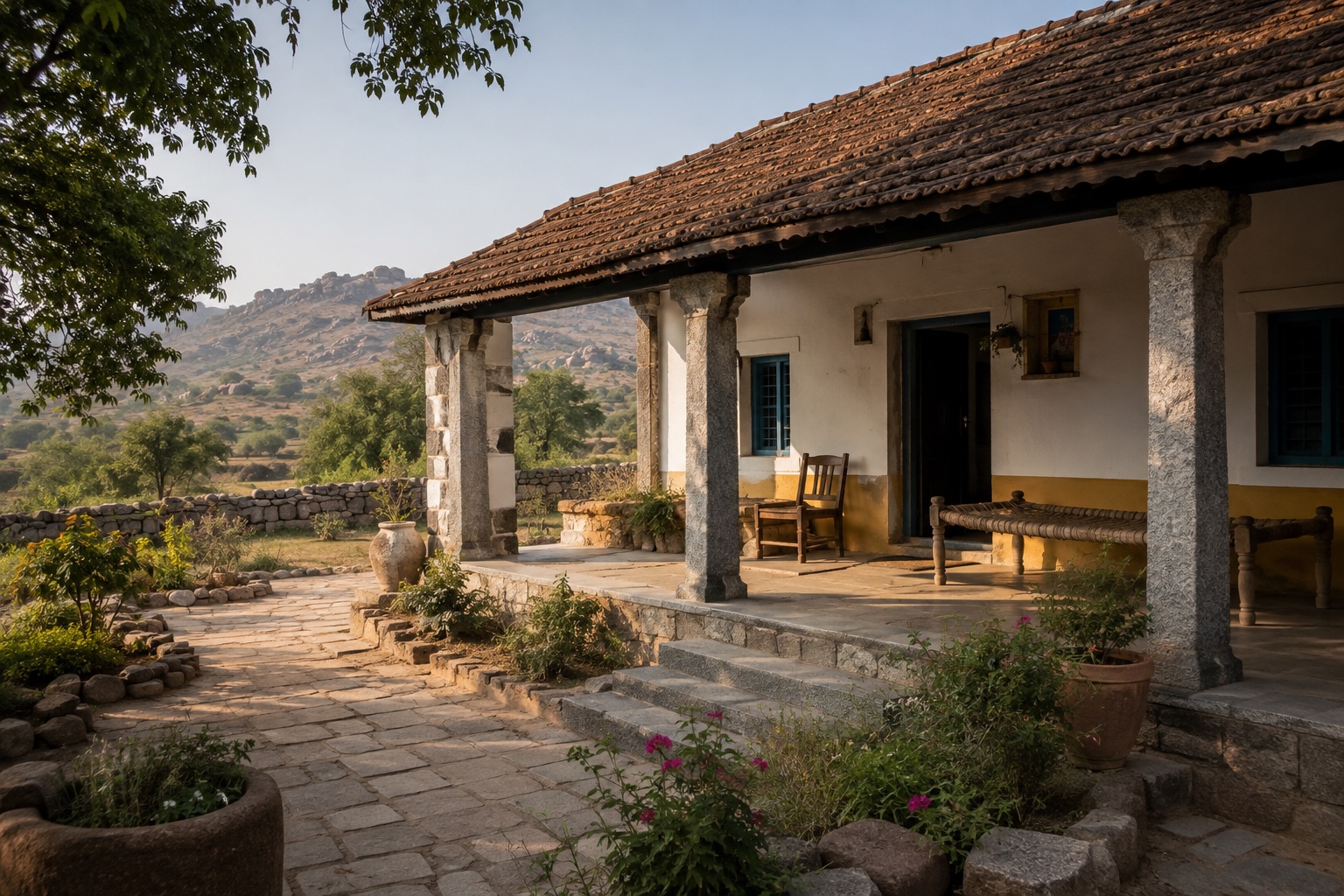
Before you choose the property
Start with the rules that actually shape the project.
Telangana Tourism operates a Silver/Gold homestay classification scheme.
The current-linked guideline requires residential premises and states 1–8 letting rooms.
Silver/Gold classification/reclassification fees are stated as ₹2,000/₹4,000 by demand draft.
Scope: Source-checked regulatory and business-planning guidance. It does not approve a particular title, building, tax position, food activity or operating structure.
01 / Executive finding
The practical starting point
- Telangana has an official Department of Tourism homestay classification/registration framework under Notice No. 1781/Homestay/C1/2016 dated 26 July 2016. The Tourism Department’s current website links its “Home Stays” menu to a file named `HOMESTAY GUDELINES New.pdf`, making that document the strongest current implementation source located. However, the PDF does not state when its substantive revisions were made or identify an amending government order. [S1, pp. 1–2; S3, Home Stays menu]
- The current-linked guideline describes the classified product as fully operational rooms in a homestay facility classified as a “Telangana Tourism Home Stay Establishment” and says the scheme is intended for accommodation in district headquarters, rural areas and tourist destinations. [S1, p. 3, Introduction and Concept]
- The current-linked guideline says classification is available only to residential premises, with a minimum of 1 guest room and maximum of 8 guest rooms. [S1, p. 5, cl. 2]
- A second official PDF remains publicly accessible under the older filename `HOMESTAY GUDELINES.pdf`. It carries the same Notice No. and date but says the owner and family must physically reside in the establishment and caps letting at 5 rooms/10 beds. No official rescission or amending instrument expressly resolving this difference was located. This is a material The official sources are not aligned finding. [S2, p. 5, cl. 2; S1, p. 5, cl. 2]
- The same conflict affects non-resident owners. The legacy PDF expressly excludes accommodation where the owner/promoter and family do not reside there; the current-linked “New” PDF removes that wording from cl. 20. Yet its application form still asks for particulars of family or an authorised person residing in the establishment. A non-resident-owner/caretaker model therefore requires written Tourism Department clarification before it is represented as eligible. [S2, p. 7, cl. 20; S1, p. 7, cl. 20; S1, p. 12, Annexure I]
- No Telangana domicile or permanent-resident qualification was located. The dispute in the official sources concerns physical residence in the establishment, not Telangana domicile. [S1/S2 comparison]
- The application form permits the property to be described as owned or leased and requires a sale deed or lease deed, but the undertaking, police verification and signature blocks are framed around the “owner.” This supports use of leased premises as a property fact; it does not conclusively establish that a lessee, company, LLP or management company may be the tourism-registration holder. [S1, pp. 10–13, Annexure I; pp. 16–17, Annexures III–IV]
- Classification is in two grades, Silver and Gold. The stated classification/reclassification fees are ₹2,000 for Silver and ₹4,000 for Gold, payable by demand draft to the Commissioner/Director of Tourism. [S1, pp. 5–6, cls. 1, 7]
- Classification is stated to remain valid for 2 years, and renewal should be sought 3 months before expiry. A separate verified renewal fee or online renewal workflow was not located. [S1, p. 5, cl. 5]
- The inspection/classification committee includes Tourism, India Tourism-Hyderabad, IHM Hyderabad, the concerned police station, IATO and TAAI representatives; its recommendation is approved by the Commissioner/Director of Tourism. [S1, p. 6, cls. 8–10]
- The guideline says classification cases will be finalised within 30 days of a complete application. This is a published departmental process statement, not a guarantee that a compliant application will be approved within 30 days. [S1, p. 7, cl. 22]
- The most consequential property-readiness requirements include an approved local-authority building plan, police clearance, attached bathrooms for every guest room, minimum room/bathroom areas by grade, 24-hour hot/cold water with sewage connection, a compliant kitchen and breakfast dining area, internet, and municipal-law-compliant garbage disposal. [S1, pp. 10–15, Annexures I–II]
- Tourism registration does not replace planning/land-use/building permission, fire, food-safety, local-body, GST, foreign-guest reporting or protected-location approvals. TG-bPASS independently processes building, occupancy, land-use and land-conversion matters; current central rules separately govern FSSAI and foreigner reporting. [S6; S7; S9–S13]
- Telangana Tourism Policy 2025–2030 establishes an incentive framework for new tourism units, including specified rural/STA incentives. Homestay-specific eligibility under those incentives was Not stated in the material reviewed IN CURRENT OFFICIAL IMPLEMENTATION MATERIAL; the policy must not be represented as an automatic homestay subsidy. [S5, §§5, 6.4, 7]
- Because the two official homestay PDFs are not aligned on owner residence and the maximum room/bed scale, and because the live applicant dashboard could not be inspected without authentication, the evidence is presently insufficient for a public guide that states those points as settled law or policy.
02 / Document chronology
Use the current rules and implementation
26 July 2016 — original homestay notice/guideline
The legacy official PDF, S2, carries Notice No. 1781/Homestay/C1/2016 dated 26-07-2016. Its key eligibility proposition is that the premises must be residential, the owner and family must physically reside in the same establishment, and only 1–5 rooms/10 beds may be let. Its cl. 20 also excludes owner-non-resident accommodation.
Undated later revision — current-linked “New” guideline
S1 carries exactly the same notice number and date but materially rewrites cl. 2 to permit 1–8 rooms and removes the explicit owner/family physical-residence wording. Its cl. 20 likewise removes the non-resident-owner exclusion. No amending order, corrigendum, revised issue date, effective date or supersession statement was located in S1. The present Tourism website links “Home Stays” to S1, which is strong evidence that the Department intends S1 to be used operationally. It is not, however, enough to fabricate a formal supersession that the Department has not published in the sources inspected.
2025–2030 — state tourism policy
Telangana Tourism Policy 2025–2030 is the State’s first dedicated tourism policy and applies to new tourism units for its stated policy period. It establishes project/location categories, an incentive framework and institutional machinery. It does not by itself resolve S1/S2 homestay eligibility conflicts.
2026 — adjacent central changes
From 1 April 2026, FSSAI implemented revised food-business turnover thresholds, and the 2026 licensing amendments introduced perpetual validity for food registrations/licences subject to compliance. These changes matter independently where the homestay provides food.
Chronology conclusion
No official amendment/rescission expressly superseding S2 with S1 was located. The online-currentness signal favours S1 operationally, but the hierarchy/provenance defect is material enough that the residence and capacity questions should remain public conflicts until the Department gives a written answer.
03 / Category definitions
Choose the right accommodation category
| Category | Location | Eligible owner/applicant | Residence requirement | Operator allowed | Capacity | Food position | Source |
|---|---|---|---|---|---|---|---|
| Telangana Tourism Home Stay Establishment — current-linked text | Residential premises; scheme discussion includes district HQs, rural areas and tourist destinations | Applications invited from interested individuals/private investors; form uses promoter/owner terminology | No explicit owner/family physical-residence sentence in current-linked cl.2; Annexure still seeks resident-family/authorised-person details | Not stated in the material reviewed for independent professional operator | 1–8 letting rooms; no current explicit bed ceiling located | Breakfast must be specified; classification checklist requires compliant kitchen and breakfast dining | [S1, pp.3,5,10–15] |
| Telangana Tourism Home Stay Establishment — legacy text | Residential premises | Owner/promoter | Owner and family must physically reside | Independent operator route Not stated in the material reviewed | 1–5 rooms, maximum 10 beds | Same general homestay model | [S2, p.5 cl.2; p.7 cl.20] |
| Hostel | Not defined in homestay guideline | Not stated in the material reviewed | Not relevant to homestay eligibility | Not stated in the material reviewed | Not stated in the material reviewed | Not stated in the material reviewed | Explicitly ineligible under homestay scheme: [S1, p.7 cl.20] |
| Guest house | Not defined in homestay guideline | Not stated in the material reviewed | Not defined | Not stated in the material reviewed | Not stated in the material reviewed | Not stated in the material reviewed | Explicitly excluded from homestay scheme; Tourism site separately exposes hotel registration EoDB service. [S1; S3] |
| Club house | Not defined | Not stated in the material reviewed | Not stated in the material reviewed | Not stated in the material reviewed | Not stated in the material reviewed | Not stated in the material reviewed | Explicitly ineligible under homestay scheme. [S1, p.7 cl.20] |
| Paying Guest accommodation | Not defined | Not stated in the material reviewed | Not stated in the material reviewed | Not stated in the material reviewed | Not stated in the material reviewed | Not stated in the material reviewed | Explicitly ineligible under homestay scheme. [S1, p.7 cl.20] |
| Hotel | Separate Tourism EoDB registration route exists | Governed separately; exact current eligibility not analysed here | Not a homestay residence rule | Separate regime | Not stated in the material reviewed in homestay source | Separate food obligations | [S3, EoDB menu] |
| B&B | Not stated in the current official material reviewed | Not stated in the material reviewed | Not stated in the material reviewed | Not stated in the material reviewed | Not stated in the material reviewed | Not stated in the material reviewed | — |
| Farm stay | Policy mentions Homestay/Farm Stay owners in skill-development context, but no classification definition was located | Not stated in the material reviewed | Not stated in the material reviewed | Not stated in the material reviewed | Not stated in the material reviewed | Not stated in the material reviewed | [S5, §6.7] |
| Resort | Not defined in S1/S2 | Separate tourism-unit treatment may apply | Not stated in the material reviewed | Not stated in the material reviewed | Not stated in the material reviewed | Not stated in the material reviewed | [S5 for policy only] |
| Serviced accommodation | Not stated in the material reviewed | Not stated in the material reviewed | Not stated in the material reviewed | Not stated in the material reviewed | Not stated in the material reviewed | Not stated in the material reviewed | — |
04 / Eligibility decision tree
Check whether the applicant and property qualify
- Fix the exact property address and local-body category.
- Determine whether it is in GHMC, another municipality, Nagar Panchayat or rural/panchayat jurisdiction.
- Determine whether the site is affected by a notified heritage structure, protected monument, forest/ecotourism area or other special planning restriction.
- If address/local jurisdiction is not fixed: Not established in the published material for property-specific approvals.
- Establish title or lease status.
- Owner with clear sale/title documentation: proceed.
- Long-term lease: S1 allows an application to state that premises are “owned or leased” and asks for the lease deed, but registration-holder eligibility remains unclear: Confirm this in writing with the authority.
- Co-owned/inherited property without a sole applicant or documented authority: co-owner-consent rule Not stated in the material reviewed: Confirm this in writing with the authority.
- Identify the proposed applicant.
- Individual resident owner: strongest factual fit with S1 and S2, subject to property compliance: This appears to fit the published route, subject to the remaining checks.
- Individual non-resident owner: S1/S2 conflict: Confirm this in writing with the authority.
- Company, LLP, partnership, trust or society: no explicit registration-holder rule located: Not established in the published material.
- Capital-only participant without any property right: cannot complete the property-specific application: This does not appear to fit the published route.
- Identify who will live in the property.
- Owner + family: compatible with the strict legacy definition.
- Authorised resident/caretaker but owner elsewhere: Annexure I mentions an authorised person residing, while legacy cl.2/cl.20 requires owner-family residence: Confirm this in writing with the authority.
- No owner/family/authorised resident: Consider another accommodation category until Tourism confirms otherwise.
- Identify the operator.
- Owner operates: explicitly contemplated.
- Professional manager assists owner while registration remains with owner: operational contracting is possible as a commercial concept, but tourism-law allocation of responsibilities is Not stated in the material reviewed.
- Management company intended to hold registration or replace resident host: Confirm this in writing with the authority.
- Check the room and bed plan.
- 1–5 guest rooms and ≤10 beds: fits both located capacity formulations, subject to all other conditions.
- 6–8 guest rooms: fits S1 but conflicts with S2: Confirm this in writing with the authority.
- More than 8 guest rooms: This does not appear to fit the published route.
- More than 10 beds but no more than 8 rooms: S1 has no located bed cap, S2 has a 10-bed cap: Confirm this in writing with the authority.
- Determine development stage.
- Fully operational residential premises ready for inspection: potentially eligible.
- Existing building requiring renovation: planning/building approval must be checked first; classification should follow readiness.
- Proposed/new construction: Tourism documentation mentions applicants capable of building additional rooms, but classification covers fully operational rooms and requires an approved building plan: This may fit after the stated conditions are completed.
- Running guest house/PG/hostel: This does not appear to fit the published route under S1 cl.20. Use these branches as a starting test and confirm the result for the exact property.
05 / Applicant and operating structures
Set the ownership and operating structure
| Structure | Supported route | Principal obstacle | Source | Clarification needed |
|---|---|---|---|---|
| Resident individual owner | Strongest route: owner applies, signs undertaking, obtains police clearance and operates residential premises | Must satisfy room/property/classification standards | S1 pp.5–17; S2 legacy definition | Confirm whether S1 formally supersedes S2 |
| Joint or inherited ownership | Title can be evidenced, but application signature is framed in singular “owner” terms | Co-owner NOC/authority rule not stated | S1 Annexure I | Whether all co-owners must consent or one authorised co-owner may apply |
| Owner living elsewhere | S1 no longer expressly requires owner residence | S2 expressly prohibits; S1 Annexure wording remains residency-oriented | S1/S2 | Required in writing |
| Owner using caretaker | “Person authorized residing” appears in Annexure I | No rule says caretaker substitutes for owner/family residence | S1 p.12; S2 p.5/p.7 | Whether caretaker satisfies host/residence requirement |
| Long-term lessee | Application expressly asks “owned or leased” and requests lease deed | Undertaking/police/signature wording remains owner-centric | S1 pp.10–17 | Whether lessee may be applicant/registration holder; whether owner NOC required |
| Company | Notice references “private investors”, but application does not expressly recognise corporate applicant | No entity-holder provision | S1 p.1, Annexures | Whether company can be registration holder and who signs/passes police verification |
| Partnership firm | No explicit prohibition located | No explicit eligibility located | S1 | Entity-holder eligibility |
| LLP | No explicit route | Udyam or corporate existence does not establish tourism eligibility | S1; S15 | Whether LLP can hold registration or only contract with eligible owner |
| Professional management company | No provision located separating registration holder from operator | Registration duties repeatedly imposed on “owner” | S1 cls.14–21, Annexures | Whether management company may run guest operations and under what delegation |
| Capital-only participant | Can fund/search commercially, but cannot complete property-specific tourism application without premises/applicant rights | No property/title/applicant yet | S1 Annexure I | Structure must be fixed before application |
| Landowner proposing new construction | May develop premises subject to planning approvals; classification is for operational rooms | Tourism classification is not pre-construction permission | S1 p.4; S6–S7 | Land use, building use, sanctioned plan, occupancy, final applicant and residence model |
Udyam specifically recognises enterprise forms for MSME purposes, but that cannot be imported into the Telangana Tourism definition of an eligible homestay registration holder.
06 / Property and classification standards
Prepare the property for inspection
| Topic | Mandatory / classification / guidance / unclear | Requirement | Applies when | Source | Confidence |
|---|---|---|---|---|---|
| Residential character | Mandatory | Homestay classification only for residential premises | All | S1 p.5 cl.2 | HIGH |
| Guest rooms | Mandatory but conflict | S1: 1–8; S2: 1–5 | All | S1 p.5; S2 p.5 | LOW — conflict |
| Beds | Conflict | S2: maximum 10 beds; S1 does not state current bed ceiling | All | S2 p.5 | LOW |
| Room condition | Classification mandatory | Clean, airy, pest-free, no dampness, outside window/ventilation | Both grades | S1 p.14 item 3 | HIGH |
| Minimum room area | Classification mandatory | Silver 120 sq ft; Gold 200 sq ft | Offered guest room | S1 p.14 item 4 | HIGH |
| Private bathroom | Classification mandatory | Attached private bathroom with every room and toiletries | Both grades | S1 p.14 item 6 | HIGH |
| Minimum bathroom area | Classification mandatory | Silver 30 sq ft; Gold 40 sq ft | Each guest bathroom | S1 p.14 item 7 | HIGH |
| WC | Classification mandatory | Seat/lid and toilet paper | Both | S1 p.14 item 8 | HIGH |
| Hot/cold water | Classification mandatory | 24-hour running hot/cold water with proper sewage connections | Both | S1 p.14 item 9 | HIGH |
| Water-saving fittings | Grade-specific | Desirable Silver; mandatory Gold | Bathrooms | S1 p.14 item 10 | HIGH |
| Kitchen | Classification mandatory | Smoke-free, clean, hygienic, odour-free and pest-free | Both | S1 p.14 item 11 | HIGH |
| Dining/breakfast | Classification mandatory | Dining area serving fresh continental and/or traditional Indian breakfast | Both | S1 p.14 item 12 | HIGH |
| Cutlery/crockery | Classification mandatory | Good quality | Both | S1 p.14 item 13 | HIGH |
| Cooling/heating | Classification mandatory | According to climate; guest-room temperature 20–25°C | Both | S1 p.14 item 14 | HIGH |
| Internet | Classification mandatory | Internet connection | Both | S1 pp.14–15 item 16 | HIGH |
| 15A earthed socket | Grade-specific | Desirable Silver; mandatory Gold | Guest room | S1 p.15 item 17 | HIGH |
| Telephone extension | Grade-specific | Desirable Silver; mandatory Gold | Guest room | S1 p.15 item 18 | HIGH |
| Wardrobe/hangers | Mandatory | Wardrobe with at least four clothes hangers | Both | S1 p.15 item 19 | HIGH |
| Furniture/work table | Mandatory | Chairs, working table and necessary furniture | Both | S1 p.15 item 22 | HIGH |
| Laundry | Grade-specific | Desirable Silver; mandatory Gold | Establishment | S1 p.15 item 23 | HIGH |
| Refrigerator | Grade-specific | Desirable Silver; mandatory Gold | Room | S1 p.15 item 24 | HIGH |
| Lobby/lounge | Grade-specific | Desirable Silver; mandatory Gold | Common area | S1 p.15 item 25 | HIGH |
| Public-area heating/cooling | Grade-specific | Desirable Silver; mandatory Gold | Enclosed public rooms | S1 p.15 item 26 | HIGH |
| Parking/road width | Grade-specific | Sufficient parking/adequate road width: desirable Silver, mandatory Gold | Site | S1 p.14 item 2 | HIGH |
| Reception | Unclear | No separate reception-desk requirement located | — | Not stated in the material reviewed | — |
| Signage | Unclear/restriction | No general signage standard located; Telangana Tourism logo/name must not be used in publicity/receipts/letterhead/stamps | Registered units | S1 p.7 cl.18 | HIGH |
| Electricity backup | Unclear | No generator/UPS requirement located | — | Not stated in the material reviewed | — |
| Garbage | Classification + local-law dependency | Disposal facilities as per municipal laws | Both | S1 p.15 item 27 | HIGH |
| Fire equipment | Application disclosure | Application asks details of fire-fighting equipment/hydrants “if any” | Application | S1 p.12 | HIGH |
| Smoke/heat detectors | Classification desirable | Desirable in both Silver and Gold | Classification | S1 p.15 item 34 | HIGH |
| Security guard | Grade-specific | Desirable Silver; mandatory Gold | Classification | S1 p.15 item 35 | HIGH |
| Doctor contact | Mandatory | Name/address/telephone of doctors | Both | S1 p.15 item 30 | HIGH |
| Safekeeping | Grade-specific | Desirable Silver; mandatory Gold | Guest room | S1 p.15 item 33 | HIGH |
| Accessibility | Application guidance only | Facilities for differently abled listed as additional “not mandatory” facility | Tourism form only | S1 p.11 | HIGH for tourism form; separate law not assessed |
| Structural safety certificate | Homestay-specific requirement | Not stated in the material reviewed | — | — | — |
| Building plan | Application mandatory | Approved local-authority building plan copy requested | Application | S1 pp.10–11 | HIGH |
| Completion/occupancy certificate | Homestay-specific rule | Not stated in the material reviewed in S1; may arise under building law | Property-specific | S6 | MEDIUM |
| Older-construction exemption | Homestay-specific | Not stated in the material reviewed | — | — | — |
The classification checklist itself contains an internal drafting anomaly: item 36 marks the guest check-in/check-out register “N” for Silver and “M” for Gold, although the legend defines only M and D. Independently, cl.15 requires a visitor’s book and the guideline provides a prescribed register form, so guest records should not be treated as optional merely because “N” is undefined. [S1, p.15 item 36; p.7 cl.15; p.18 register]
07 / Documents and declarations
Assemble the application file
| Document | Who provides/signs | Format/stamp requirement | Validity period | When required | Source | Unresolved issue |
|---|---|---|---|---|---|---|
| Application form, Annexure I | Applicant/promoter; final signature phrased as owner | Prescribed form | Not stated | Initial application | S1 pp.10–13 | Corporate/lessee signature not explained |
| Background note on promoter | Promoter | No format specified | Not stated | Enclosure | S1 p.12 | Scope/detail not stated |
| Sale deed or lease deed | Owner/lessee | Copy | Not stated | Application | S1 pp.10–11 | Owner NOC for leased property not specified |
| Approved building plan | Applicant/local authority | Copy of local-authority approval | Not stated | Application | S1 p.11 | Occupancy/completion evidence not stated |
| Police clearance regarding owner antecedents/proposed activity | Concerned police station | Copy; Annexure IV model | Not stated | Application | S1 p.11, p.17 | Treatment of directors/partners/lessee/caretaker not stated |
| Family/authorised-person particulars | Promoter/owner | Ages, professions and relationships | Not stated | Enclosure | S1 p.12 | Creates residence ambiguity |
| Signed classification checklist | Applicant | Signed on all pages/certification | Current at inspection | Application | S1 p.6, pp.14–15 | Portal implementation not inspected |
| Undertaking, Annexure III | Owner | Prescribed undertaking | Not stated | Application | S1 p.16 | No stamp-paper requirement stated |
| Owner casualty/liability affidavit | Home Stay owner | Affidavit; stamp value/notarisation not stated | Not stated | Registration | S1 p.7 cl.16 | Exact format Not stated in the material reviewed |
| Police Verification, Annexure IV | SHO/police station | Prescribed format with stamp | Not stated | Application/registration | S1 p.17 | Whether separate local police NOC is required in addition not clarified |
| Demand draft | Applicant | DD payable Commissioner/Director Tourism | Application-time | Classification/reclassification | S1 p.6 cl.7 | Whether portal now accepts digital payment Not stated in the material reviewed |
| Exterior/interior photographs | Applicant | Building, bathroom, living room, bedroom, parking etc. | Current | Application | S1 p.12 | File type, dimensions, size Not stated in the material reviewed |
| Room/property dimensional data | Applicant | Entered in form | Current | Application | S1 pp.10–12 | Architect certification not expressly required |
| Road width and parking information | Applicant | Form field | Current | Application | S1 p.11 | Formal traffic/parking NOC not stated |
| Food type | Applicant | Form field | Current | Application | S1 p.12 | FSSAI number not requested in located form |
| Tariff | Applicant | Single/double room tariff fields | Current | Application | S1 p.12 | GST-inclusive/exclusive format not stated |
| Fire-fighting/hydrant details | Applicant | Form field “if any” | Current | Application | S1 p.12 | Does not substitute Fire NOC |
| Character certificate | — | — | — | — | Not stated in the material reviewed | Police verification is located; separate “character certificate” is not |
| Co-owner consent/NOC | — | — | — | — | Not stated in the material reviewed | Must be clarified for jointly held property |
| Company board resolution | — | — | — | — | Not stated in the material reviewed | Entity-holder route itself unclear |
| Architect drawing/site map | — | — | — | — | Not stated in the material reviewed beyond approved building plan | Portal may request more post-login |
| Aadhaar/PAN | — | — | — | — | Not stated in the material reviewed in S1 | Portal-only requirements could differ |
| Portal file-format limits | — | — | — | — | NOT INSPECTABLE WITHOUT LIVE FORM | Authentication barrier |
No rule located requires a particular stamp-paper denomination for the undertaking or casualty affidavit.
08 / Application and inspection process
Follow the application and inspection process
| Step | Responsible person/authority | Input/document | Resulting record | Stated period | What does not happen automatically |
|---|---|---|---|---|---|
| 1. Property eligibility check | Owner/promoter + local authority | Address, residential use, title/lease, room plan | Internal go/no-go | None | Tourism does not cure defective title/use |
| 2. Building/local approvals | Owner/developer + relevant local authority | Sanction plan; land/building application as applicable | Building/land-use approvals | TG-bPASS service-specific | Does not create homestay registration |
| 3. Property preparation | Owner | Rooms, bathrooms, kitchen, utilities, safety, furniture | Inspection-ready premises | None | Classification is not available merely from plans |
| 4. Police verification | Applicant + concerned police station | Annexure IV / antecedent and activity clearance | Police verification | Not stated | Approval by police does not equal tourism approval |
| 5. Application preparation | Owner/promoter | Annexure I, checklist, undertaking, title/lease, plan, police verification, photographs, background, resident-family/person details | Complete application file | None | Completion is applicant responsibility |
| 6. Fee | Applicant | DD ₹2,000 Silver / ₹4,000 Gold | Payment instrument | At application | Payment is non-dispositive |
| 7. Submission | Applicant | Complete file + fee | Application received by Commissioner/Director, Tourism | None expressly stated | No approval merely on filing |
| 8. Inspection | Classification Committee | Application + physical premises | Committee observations/recommendation | Applicant must remain inspection-ready | No right to defer inspection stated |
| 9. Rectification | Applicant | Correct identified deficiencies | Compliance reconsideration | Period allotted during inspection; no fixed number | Failure may result in rejection |
| 10. Classification recommendation | Committee | Facilities + service quality | Recommended Silver/Gold/lower category/rejection | Guideline says cases finalised within 30 days of complete application | Recommendation is not final approval |
| 11. Approval | Commissioner/Director Tourism | Committee recommendation | Classification/registration order/certificate | Within overall stated 30-day framework | Approval is discretionary subject to guidelines |
| 12. Appeal | Establishment | Review/reconsideration request | Appeal/review decision | Within 30 days of receiving classification/reclassification communication | Late requests not entertained under guideline |
| 13. Post-approval operation | Registration holder/owner | Guest records, tariffs, service maintenance | Ongoing compliance | Continuous/monthly duties | Registration does not replace adjacent licences |
| 14. Renewal | Home Stay Unit | Renewal application | Renewal/reclassification | Apply 3 months before expiry | Renewal is not automatic |
The classification committee may recommend a lower category than that applied for; where that happens, the guideline says the excess classification fee is not refunded. Deficiencies must be corrected within the time stipulated during inspection. [S1, pp.6–7, cls.11–12] The Tourism Department may conduct surprise inspection without notice. [S1, p.7, cl.13] The live Tourism site has a Homestay Login, but the current post-login certificate-download or online-query workflow was not inspectable.
09 / Fees, timelines, validity and renewal
Confirm fees, timing and certificate validity
| Item | Verified amount/period | Nature | Source | Qualification |
|---|---|---|---|---|
| Silver classification/reclassification fee | ₹2,000 | Departmental fee | S1 p.6 cl.7 | DD route stated |
| Gold classification/reclassification fee | ₹4,000 | Departmental fee | S1 p.6 cl.7 | DD route stated |
| Separate inspection fee | Not stated in the material reviewed | — | — | Do not infer zero permanently |
| Portal/service charge | Not stated in the material reviewed | — | — | Authenticated portal not inspected |
| Renewal fee | Not stated in the material reviewed | — | — | Do not assume classification fee automatically equals renewal fee |
| General refund | Not stated in the material reviewed | — | — | Only lower-grade overpayment rule located |
| Lower classification refund | No refund of excess classification fee | Explicit condition | S1 cl.12 | Applies where committee recommends lower category |
| Classification validity | 2 years from issue of orders | Guideline validity | S1 p.5 cl.5 | Not a perpetual registration |
| Renewal filing window | 3 months before expiry | Guideline requirement | S1 p.5 cl.5 | Full renewal workflow not located |
| Classification finalisation | 30 days from application being made “in all respect” | Departmental guideline statement | S1 p.7 cl.22 | Not an approval guarantee |
| Change notification | Within 30 days | Operating duty | S1 p.7 cl.14 | Applies to changes in facilities |
| Appeal | Within 30 days of communication | Review period | S1 pp.7–8 cl.23 | No late request |
| Show-cause response in sample removal notice | Within a fortnight of receipt | Procedural notice form | S1 p.18 | Relevant where notice is issued |
| FSSAI food registration/licence validity | Perpetual under 2026 reforms unless suspended/cancelled/surrendered | Separate central regime | S9/S10 | Not a tourism-registration rule |
10 / Operating duties after registration
Run the registered homestay correctly
Tariffs and guest communication
The homestay must specify the breakfast offered, display charges and inform visitors in advance. Tariff changes must be conveyed to Telangana Tourism, as must discontinuation of the activity or inclusion of a new tourism activity. [S1, p.5 cl.3; p.7 cl.19] A prescribed guest invoice format, GST wording or record-retention period for invoices is Not stated in the material reviewed.
Certificate/branding
The guidelines prohibit the use of Telangana Tourism’s logo or name in printed publicity material, receipts, letterheads or rubber stamps. Violation is stated to attract cancellation. [S1, p.7 cl.18] A separate requirement to display the classification certificate prominently was Not stated in the material reviewed in the reviewed text.
Visitor book and tourism reporting
A visitor’s book is mandatory; guest remarks are to be obtained and forwarded monthly to the Tourism Department. [S1, p.7 cl.15] No separate monthly occupancy/statistical return form was located beyond that requirement.
Guest identity and register
The prescribed register includes:
- guest name;
- age;
- permanent address;
- phone number;
- nationality;
- passport number;
- photocopy of passport and ID proof;
- check-in/check-out dates and times;
- point of arrival;
- purpose of visit; and
- guest signature. [S1, p.18] A retention period for this register or copies of IDs is Not stated in the material reviewed in S1.
Foreign guests
Separately, the national Bureau of Immigration/FRRO portal states that accommodators are legally required to make the prescribed Form II/Form III reporting for foreigners, now including OCI cardholders under the Immigration and Foreigners Act, 2025. The registration interface expressly accommodates “Hotel / Guest House / Dharamshala / Institute / Individual House etc.” [S11/S12] The current exact deadline for submission of an individual Form III was Not stated in the material reviewed IN THE INSPECTED OFFICIAL TEXT, so no deadline is invented here.
Safety
The owner is made responsible under the Tourism guideline for guest safety/security and casualties and must provide immediate medical and transportation assistance. The guideline additionally requires an owner affidavit concerning casualty liability. [S1, p.7 cls.16, 21] Insurance is not expressly required in the located homestay guideline. Given the owner-liability language, public liability/property/guest-risk insurance is a practical risk-management recommendation, not a located registration condition.
Staff/caretakers
A police verification form exists for the applicant/owner and family. A general rule requiring police verification of every employee, caretaker or contractor was Not stated in the material reviewed. [S1, p.17 Annexure IV]
Food
The classification design assumes food service: kitchen hygiene and a breakfast dining area are mandatory. Food-business compliance must therefore be assessed independently under FSSAI/FoSCoS. Current 2026 FSSAI turnover categorisation is registration up to ₹1.5 crore, State Licence above ₹1.5 crore up to ₹50 crore and Central Licence above ₹50 crore, subject to the applicable kind-of-business criteria. [S9/S10]
Waste and maintenance
Garbage disposal must comply with municipal laws. Classification facilities must continue to be maintained; material facility changes must be reported within 30 days. [S1, p.15 item 27; p.7 cl.14]
11 / Adjacent approvals and dependencies
Close the approvals outside Tourism
| Topic | What tourism registration resolves | What it does not resolve | Likely authority | Official source located | Property-specific question |
|---|---|---|---|---|---|
| Land title | Accepts evidence of ownership/lease in application | Title validity, encumbrance, succession, co-owner authority | Revenue/Registration/civil title authorities | S1 only for application evidence | Who legally controls the exact site? |
| Land/building use | Confirms Tourism sees premises as residential homestay | Lawful development/use and conversion | Local body / MA&UD / TG-bPASS | S6 | Is paid tourist lodging permissible under sanctioned use? |
| Building plan | Requires local approved plan copy | Sanction itself, deviations, regularisation | TG-bPASS/local authority | S1 + S6 | Does existing construction match sanction? |
| Occupancy/completion | Nothing explicit | Whether OC/completion is legally required | Local authority/TG-bPASS | S6 | What OC/completion status is required for this building class? |
| Fire | Tourism form records equipment; checklist treats smoke detectors as desirable | Fire NOC where legally triggered | Fire Services / BuildNow | S7 | Height, use and plot area trigger? |
| Food | Classification requires kitchen/breakfast | FSSAI registration/licence | FSSAI/FoSCoS | S9/S10 | What KoB applies to this operation? |
| Police | Requires antecedent/activity clearance | Other local policing duties and staff checks | Concerned police station | S1 | Who exactly must be verified under proposed ownership/operation model? |
| Foreign guests | Tourism register records passport information | Statutory Form III reporting | Bureau of Immigration/FRRO/FRO | S11/S12 | Which FRRO/FRO controls the address and current reporting procedure? |
| GST | Tourism registration does nothing | GST registration, invoicing, rate/place of supply | CBIC/GST authorities | S13/S14 | Who is supplier and what is aggregate turnover? |
| Udyam | Nothing | MSME registration | Ministry of MSME | S15 | Does proposed business wish/need to register as MSME? |
| Local trade licence | Nothing | Local listed-trade licence | GHMC/other relevant ULB | S8 for GHMC | Is the exact activity a licensed trade in this local body? |
| Property tax | Says pay rates prescribed by appropriate authority | Classification/rate determination | Local body | S1 p.8 cl.24 | Does use change assessment category? |
| Water | Says applicable authority’s rates apply | Connection category, commercial use, capacity | Water/local authority | S1 p.8; local utility | Does guest use alter tariff/category? |
| Electricity | Same | Connection category/load/backup | DISCOM | S1 p.8 | Is existing sanctioned load/use sufficient? |
| Waste | Requires compliance with municipal laws | Collection contract, segregation or special local duties | Local body | S1 p.15 | What local waste rules apply? |
| Heritage | Nothing | Protected-monument/heritage clearance | NMA/Heritage Conservation Committee/local authority | S7 | Is site in regulated/prohibited/vicinity zone? |
| Forest/ecotourism | Nothing | Forest/wildlife/ecotourism permission | Forest Department/TGFDC/CWLW as applicable | S5 policy framework | Is the site in/adjacent to forest/protected area? |
| Environment/pollution | Nothing | Consent/EC applicability if triggered by project scale/activity | TGPCB/MoEFCC/local authority | Homestay-specific trigger Not stated in the material reviewed | Does exact development trigger environmental consent/clearance? |
| Accessibility | Tourism form treats it as non-mandatory additional feature | Building/accessibility obligations under other law | Planning/building authority | S1 + building law to be checked | What accessibility standards attach to proposed building/use? |
For qualifying construction, BuildNow separately identifies fire referrals, heritage clearance and monument-distance restrictions. Those requirements must be tested against the actual site rather than imported indiscriminately into every homestay. GHMC’s portal defines its trade licence as a local-authority licence for a listed business and asks for Aadhaar or PAN/incorporation evidence plus lease deed/legal occupancy. That establishes a local licensing mechanism, not universal homestay applicability.
12 / Incentives, subsidy and funding
Evaluate incentives without assuming sanction
Telangana Tourism Policy 2025–2030
Scheme/policy: Telangana Tourism Policy 2025–2030. Applicability: Policy §5 states that the policy applies to new tourism units and categorises projects by both investment and location. The investment classes range from micro/small projects up to ₹10 crore through medium, large, mega and iconic categories. Location categories include the Hyderabad core within ORR, the region between ORR and RRR, rural Telangana outside RRR, and notified Special Tourism Areas. [S5, §5]
Capital Investment Subsidy
Policy §6.4 provides a CIS of 25% of Eligible Project Cost, excluding land cost, capped at ₹25 lakh, for projects falling under Category C rural Telangana and Category D Special Tourism Areas. It also lists particular tourism-project classes such as adventure projects, caravan parks, caravans, houseboats and wayside amenities with their own minimum investments/caps. [S5, §6.4(i)] Homestay-specific conclusion: Not stated in the current official material reviewed. The policy language on “new tourism units” is not enough to state that every Tourism Department-classified homestay automatically constitutes an eligible project for CIS or that expenditure on a private dwelling will be sanctioned.
SGST reimbursement
Policy §6.4(ii) proposes 50% reimbursement of Net State GST for five years for investors, with stated category limitations including non-eligibility of Hotels & Resorts in Category A and case-by-case treatment for Iconic Projects. [S5, §6.4(ii)] Again, whether a Telangana Tourism Home Stay Establishment qualifies as the relevant “tourism unit/project” for this benefit, which expenditure/commencement date is recognised, how claims are filed and what documentary sanction is required were Not stated in the material reviewed in a homestay-specific implementation order.
Special Tourism Areas/Iconic projects
Special incentives can be offered on a case-by-case basis and may include measures such as lower lease rent, longer SGST reimbursement or viability-gap support. [S5, §6.4(iii)] These are discretionary/case-specific and must not be budgeted as automatic benefits.
Skill-development support
The policy refers to training workshops for Homestay/Farm Stay owners and local communities under its skill-development strategy. This establishes policy recognition of that audience but does not establish a cash subsidy. [S5, §6.7]
Sanction route
Policy §7 identifies:
- State Tourism Promotion Board approval for Iconic and Mega projects;
- an Empowered Committee for assigned large, medium and small/micro projects; and
- Destination Management Organisations in Special Tourism Areas. [S5, §7] However, a current homestay-specific claim form, bank tie-up, eligible-cost certificate, application opening notice, budget allocation or sanction workflow for CIS/SGST reimbursement was Not stated in the material reviewed.
Credit/interest subsidy/loan programmes
A homestay-specific Tourism Department interest subsidy or dedicated loan programme that could be confirmed current and open on 05 September 2026 was Not stated in the current official material reviewed.
Funding conclusion
No capital subsidy, SGST reimbursement, concession or loan should be entered into a project’s committed financing plan until:
- the exact project is accepted as an eligible tourism unit;
- location category is verified;
- eligible project cost is approved;
- application timing is satisfied;
- sanction authority issues a written approval; and
- current budget/application availability is confirmed.
13 / Business implications
Translate the rules into a workable project
Before selecting or acquiring property
the project team should establish, at minimum:
- exact parcel/address and local body;
- title/leaseability and co-owner position;
- sanctioned use and development potential;
- whether the proposed host/applicant will reside at the property;
- whether the intended guest-room plan remains within both the conservative legacy limit and the current-linked limit;
- whether road access/parking can meet the intended grade;
- whether room/bathroom dimensions can meet Silver or Gold;
- fire/heritage/forest/location constraints;
- utility, sewerage and waste feasibility;
- whether the owner is willing and eligible to remain the registration-facing person if an external manager is used. A capital-only participant should therefore treat property selection and applicant structure as pre-registration work, not assume that capital itself creates homestay eligibility.
Before construction or renovation
The design brief should be checked against both tourism classification and local building law. The application itself expects an approved building plan; TG-bPASS independently processes building, occupancy, land-use and conversion matters. Tourism classification should not be used as a substitute for development permission.
Registration holder versus operating entity
The located sources do not establish a general right to have one legal person hold the Tourism registration while a separate LLP/company is the legally recognised operator. Repeated duties are imposed on the “owner”; the application uses owner/promoter terminology; a leased property may be disclosed; and an “authorised person residing” may be listed. None of those propositions independently establishes an operator-separation doctrine. Accordingly, Any project management agreement should be drafted only after obtaining written confirmation where the commercial structure depends on:
- a non-resident owner;
- a corporate registration holder;
- a lessee applicant;
- caretaker residence instead of owner residence; or
- a separate professional operating entity.
What an LLP or management agreement cannot solve by itself
An LLP or management contract cannot independently:
- change residential land/building use;
- increase the regulatory room limit;
- cure the owner-residence conflict;
- substitute for an eligible tourism applicant;
- cure defective title;
- obtain fire/FSSAI/GST/foreigner permissions;
- guarantee Tourism classification; or
- create subsidy eligibility.
Property-development scope
Any renovation, extension, additional rooms, change in building use, structural work or protected-location intervention remains subject to property-specific approval. Once classified, changes in facilities must also be reported to Tourism within 30 days. [S1, p.7 cl.14]
Property-assessment and commercial-planning file
Each project file should distinguish:
- property owner;
- tourism applicant;
- registration holder;
- resident host;
- legal operator;
- staff employer;
- FSSAI food-business operator;
- GST supplier;
- OTA contracting party;
- investor/capital contributor;
- insurance policyholder; and
- party responsible for guest claims. These roles should not be collapsed merely because one commercial agreement allocates economics between participants.
Questions that must be answered before commercial terms
Before the project team proposes revenue share, lease, management fee, capex contribution or investment structure, the project should answer:
- Which S1/S2 residence interpretation will Tourism apply?
- Is the planned room/bed count accepted in writing?
- Who is permitted to hold the certificate?
- Can the owner live elsewhere?
- Can a lessee apply?
- Can a professional manager operate under the owner’s registration?
- Are local building/use approvals already valid?
- Are FSSAI and foreigner-reporting responsibilities allocated?
- Is any proposed subsidy actually sanctioned rather than merely policy-eligible? No fixed ownership percentage, investment contribution or income commitment is recommended by this guide.
14 / Official-source conflicts
Resolve conflicting official instructions
Conflict 1 — maximum rooms and beds
Source A: S2, official legacy guideline, p.5 cl.2. Proposition: Maximum 5 rooms/10 beds. Source B: S1, current-linked “New” guideline, p.5 cl.2 and p.14 checklist. Proposition: Maximum 8 rooms; no equivalent 10-bed ceiling appears in the reviewed current-linked text. Dates/hierarchy: Both documents carry Notice No. 1781/Homestay/C1/2016 dated 26 July 2016. S1 is linked from the present Tourism website, but no dated amendment/supersession clause has been located. Status: The official sources are not aligned. Affected properties: Any proposal with 6–8 letting rooms or more than 10 guest beds. Authority for written resolution: Commissioner/Director, Department of Tourism, Government of Telangana, Kala Bhavan, Ravindra Bharathi, Saifabad, Hyderabad 500004. The current management page identifies Sri L. Ranjeet Nayak, IFS as Director Tourism.
Conflict 2 — owner/family residence
Source A: S2, p.5 cl.2 and p.7 cl.20. Proposition: Owner and family must physically reside in the establishment; accommodation where they do not reside is excluded. Source B: S1, p.5 cl.2 and p.7 cl.20. Proposition: The explicit physical-residence language is absent. Cl.20 excludes accommodation types but no longer expressly excludes non-resident owners. Further inconsistency within S1: Annexure I still asks for particulars of the promoter’s family or “person authorized residing” in the establishment, while undertaking/signature and responsibility provisions repeatedly refer to the owner. Status: The official sources are not aligned. Affected structures: Owner living elsewhere; caretaker-hosted homes; lessee-hosted properties; professionally managed units; companies/LLPs whose directors do not reside at the property.
Conflict 3 — guest register checklist notation
Source A: S1 p.7 cl.15 and p.18 prescribed register require guest recordkeeping/visitor book. Source B: S1 p.15 checklist item 36 marks Silver “N” and Gold “M,” but “N” is not defined in the legend. Status: INTERNAL OFFICIAL DRAFTING INCONSISTENCY. Practical effect: Public guidance should require guest recordkeeping because the substantive clause and prescribed form do so; it should not try to define what the unexplained “N” means.
Conflict 4 — cancellation wording versus notice form
Cl.17 says the Commissioner/Director may cancel registration if a complaint “of any nature” is received, while the prescribed removal notice on p.18 provides a fortnight to show cause before directory removal/revocation. This can be read as a power plus procedural notice rather than necessarily contradictory provisions, but You should not state that registration is cancelled automatically upon any complaint.
16 / Source register
Official source register
| ID | Issuing body | Document or portal | Document/order number | Published | Effective | Language | Status/currentness | Official URL | Pages/sections reviewed | Notes |
|---|---|---|---|---|---|---|---|---|---|---|
| S1 | Department of Tourism, Government of Telangana | `HOMESTAY GUDELINES New.pdf` — Guidelines to Setup & Operate Home Stays in Telangana | Notice No. 1781/Homestay/C1/2016 | PDF states 26-07-2016; date of later revision NOT STATED | Revision effective date Not stated in the material reviewed | English | PRIMARY / current-linked implementation file, but revision provenance unclear | Official “New” Homestay Guidelines PDF | All 20 pages; especially pp.1–8 and Annexures I–IV pp.10–18 | Current website links this file. |
| S2 | Department of Tourism, Government of Telangana | `HOMESTAY GUDELINES.pdf` | Notice No. 1781/Homestay/C1/2016 | 26-07-2016 | 26-07-2016 on face of notice; later status unclear | English | PRIMARY / legacy-conflicting; still officially downloadable | Official legacy Homestay Guidelines PDF | Full 19-page document; particularly p.5 cl.2 and p.7 cl.20 | Conflicts materially with S1. |
| S3 | Telangana Tourism | Current tourism website — Home Stays, EoDB Services, Homestay Login | None stated | Live 2026 | Current | English | PORTAL | Telangana Tourism official site | Public menu, Home Stays and Homestay Login routes | Authenticated dashboard not inspected. |
| S4 | Telangana Tourism | Management Team | None | Live 2026 | Current | English | CONTACT | Management Team | Current leadership listing | Director Tourism shown as Sri L. Ranjeet Nayak, IFS. |
| S5 | Government of Telangana, Tourism | `Telangana_Tourism_Policy_2025-2030.pdf` | Official policy PDF; order/notification number not independently located in accessible official metadata | 2025 | Policy says five years from Government notification | English | PRIMARY POLICY | Telangana Tourism Policy 2025–2030 | §§2–3, §5, §6.4, §§6.7–6.9, §7; indexed contents | Full PDF open failed because of source-size limit; official indexed text used. ([Invalid URL]()) |
| S6 | MA&UD Department, Government of Telangana | TG-bPASS | Telangana Municipalities Act 2019 framework referenced on portal | Live | Current | English | IMPLEMENTATION / BUILDING | TG-bPASS | Salient features, permissions, occupancy, land-use/conversion | Separate from tourism registration. |
| S7 | Government of Telangana | BuildNow — Departments | Building-rule referral framework | Live | Current | English | IMPLEMENTATION / BUILDING / FIRE / HERITAGE | BuildNow Departments | Monument, heritage, Fire NOC, tree-felling sections | Applicability is building/location specific. |
| S8 | Greater Hyderabad Municipal Corporation | Trade Licence | Portal cites G.O.Rt.No.459 dated 29-07-2017 and related instruments | Live | Current within GHMC | English | LOCAL | GHMC Trade Licence | Definition, procedure and documents | Not evidence that every homestay requires a GHMC licence; exact trade/address must be checked. |
| S9 | Food Safety and Standards Authority of India | Order implementing revised turnover thresholds | F. No. RCD-01002/1/2021-Regulatory-FSSAI-Part(1), dated 13-03-2026 | 13-03-2026 | 01-04-2026 | English | CENTRAL / CURRENT | FSSAI revised-threshold order | Paras 2–5 | Registration ≤₹1.5 crore; State Licence >₹1.5–50 crore; Central Licence >₹50 crore, subject to applicable activity criteria. |
| S10 | FSSAI | FoSCoS portal and 2026 licensing FAQ | 2026 amendment framework | Live | Current | English | CENTRAL / PORTAL | FoSCoS | Current announcements/eligibility; 2026 FAQ | 2026 changes include perpetual validity subject to suspension/cancellation/surrender and risk-based compliance. |
| S11 | Bureau of Immigration / Ministry of Home Affairs, Government of India | Form III / former Form C portal | Immigration and Foreigners Act, 2025; Rules 2025 | 2025–26 | Current | English | CENTRAL | Official Form III/Form C portal | Notice and accommodator-registration fields | Covers accommodators and foreigners including OCI cardholders. |
| S12 | Ministry of Home Affairs | Immigration and Foreigners Rules, 2025 | Rules 2025 | 2025 | Current | English/Hindi Gazette | CENTRAL | Immigration and Foreigners Rules 2025 | Form III and relevant rules referenced by form | Current exact filing deadline was not established from inspected text. |
| S13 | CBIC, Government of India | CGST Act | Central Goods and Services Tax Act, 2017, §22 | Current consolidated portal | Current | English | CENTRAL / TAX | CGST Act — CBIC | §22 | General registration threshold provision; exceptions require separate review. |
| S14 | CBIC, Government of India | IGST Act | Integrated GST Act, 2017 | Current consolidated portal | Current | English | CENTRAL / TAX | IGST Act — CBIC | Place-of-supply provision for lodging | Expressly includes “home stay” among lodging accommodation. |
| S15 | Ministry of MSME, Government of India | Udyam Registration portal | MSME notification framework | Live | Current | English | CENTRAL / BUSINESS | Official Udyam portal | Registration conditions | Free, paperless, self-declaration; no renewal. Does not determine Telangana homestay eligibility. |
| S16 | Rangareddy District Administration | District directory | None | Updated 2026 | Current directory | English | CONTACT | Rangareddy directory | District Tourism Officer entry | Sri S. Prabhakar, 9440815446. |
| S17 | Medchal-Malkajgiri District Administration | District officers | None | Updated 2026 | Current directory | English | CONTACT | Medchal-Malkajgiri district officers | Tourism entry | Y. Damodhar Reddy, DTO (I/C), 9959057923. |
| S18 | Peddapalli District Administration | District officers | None | Updated 03-09-2026 | Current directory | English | CONTACT | Peddapalli district officers | Tourism entry | A. Suresh, 9440167222; IDOC, first floor, room 232. |
| S19 | Mulugu District Administration | District officers | None | Updated 2026 | Current directory | English | CONTACT | Mulugu district officers | Tourism entry | Sri Shivaji, 9440816076. |
| S20 | Khammam District Administration | Tourism Department / district officers | None | Updated Aug 2026 | Current directory | English | CONTACT | Khammam Tourism Department | DTO listing | B. Suman Chakravarthy, 9440816081. |
| S21 | Warangal District Administration | District Officers | None | Updated 02-09-2026 | Current directory | English | CONTACT | Warangal district officers | DTO listing | Sri Anil Kumar (I/C), 9290010949. |
Review and corrections
Keep the guide current.
Sources were checked on . Recheck the live application route before filing because portals and implementation instructions can change.
Send a correction with the relevant official source. Browse all states and Union territories.