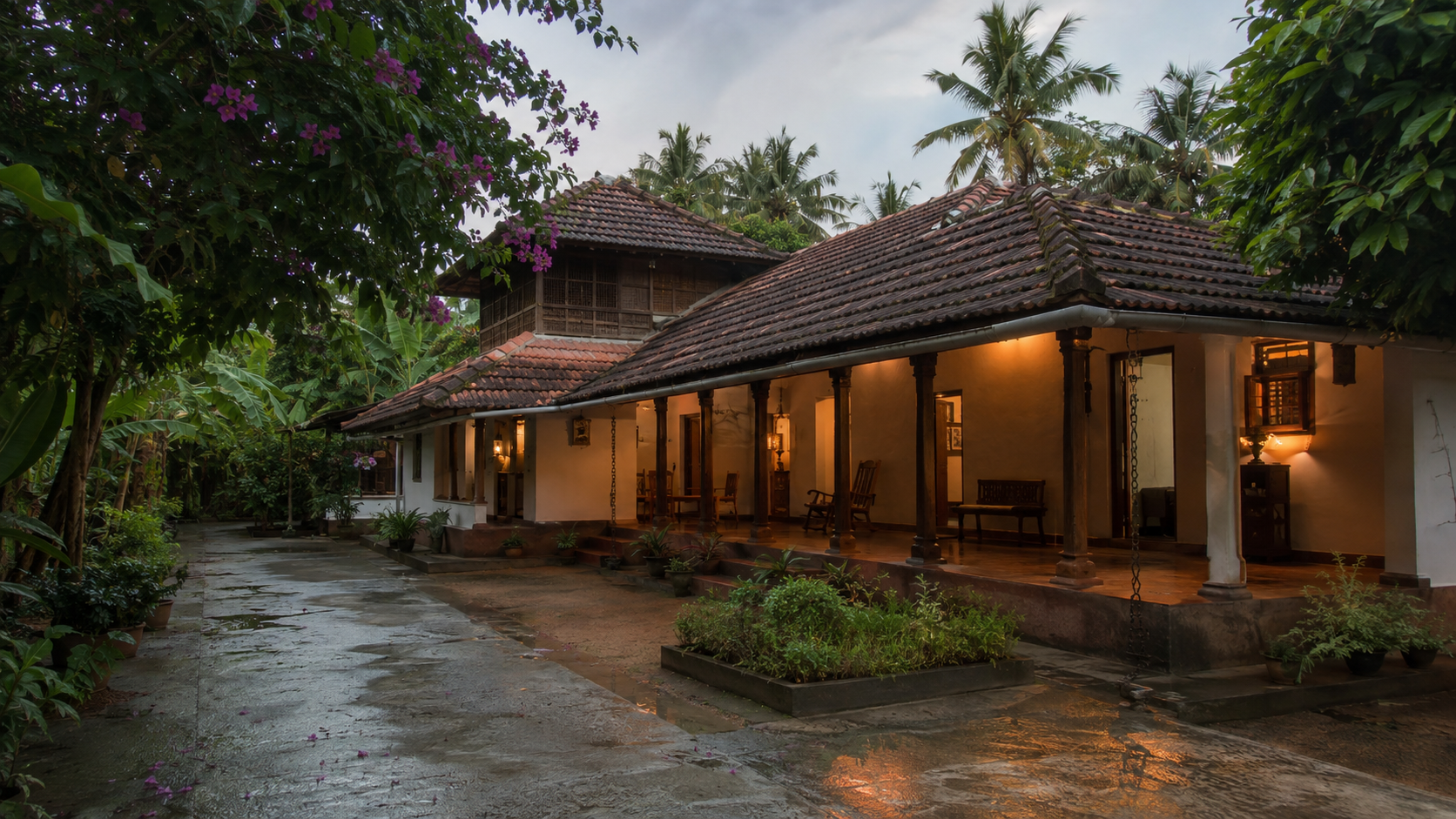
The short answer
Start with the applicant, property and operating model.
Kerala’s published Homestay Classification Scheme is built around a Kerala resident staying in their own house with family. Classification is issued in the house owner’s name, leased or rented houses are excluded, and only operational accommodation units are classified.
The unit may provide one to six guest rooms and two to twelve beds. Properties that depend on a lease or a non-resident operator should be assessed against Kerala’s separate Serviced Villa or another appropriate route.
Scope: Source-checked public guidance, not legal, tax, architectural or property approval. It does not determine eligibility for an address or submit an application.
01 / Current rules
Read the 2020 scheme with the current pages and 2026 amendment.
G.O.(Ms) No.03/2020/TSM provides the current scheme backbone. Current Kerala Tourism pages publish the live eligibility, procedure, documents and classification checklist.
A January 2026 order added a narrow route for the spouse of an absent registered property owner to apply using a valid Power of Attorney. It should not be expanded into a general caretaker or company route.
Kerala Tourism · Homestay classification guidelines Kerala Tourism · G.O.(Ms) No.03/2020/TSM Kerala Tourism · G.O.(Ms) No.1/2026/TSM
| Applicant | Kerala resident in their own house; classification ordinarily in the owner’s name |
|---|---|
| Residence | Owner and family physically reside in the unit |
| Capacity | 1–6 rooms, 2–12 beds |
| Categories | Silver, Gold and Diamond |
| Validity | Three years |
02 / Eligibility
Test the actual arrangement before spending.
- Confirm ownership. The ordinary homestay route does not accept a leased or rented house. Resolve co-ownership or inherited-title questions before applying.
- Confirm residence. The owner and family must physically reside in the unit. A caretaker or external company is not a published substitute.
- Complete the property. Tourism classifies operational units, not proposed or under-construction accommodation.
- Check the guest plan. Provide between one and six rooms and between two and twelve beds while retaining the resident-family arrangement.
03 / Category
Use the category that matches the facts.
Kerala’s Homestay and Serviced Villa routes can share the same six-room and twelve-bed ceiling, but differ materially in ownership, residence and lease structure.
| Category | Starting position |
|---|---|
| Homestay | Resident owner and family in the owner’s operational house; leased or rented houses excluded. |
| Serviced Villa | Independent furnished home under a separate scheme that expressly contemplates the person or company running the establishment and published lease documentation. |
| Hotel or resort | Separate classification and business framework; do not import homestay residence or capacity rules. |
04 / Property standards
Design for the rule and the inspection.
- Every item marked Necessary in the current checklist must be met for the requested grade.
- Bedroom minimum is 120 sq ft excluding the bathroom, reduced to 100 sq ft for traditional or heritage houses; bathroom minimum is 20 sq ft.
- Provide a toilet for every lettable room and twenty-four-hour hot and cold running water.
- Power backup and internet are Necessary for Gold and Diamond; air-conditioning is Necessary for Diamond; several other facilities change by grade.
- Waste segregation, sewage arrangements, kitchen standards, living and dining facilities and room equipment form part of inspection readiness.
05 / Documents
Prepare one consistent property file.
- Acceptance of Regulatory Conditions on ₹200 stamp paper in the published pro forma.
- Residence Certificate and Building Ownership Certificate.
- Up-to-date land-tax receipt and applicant police-clearance certificate from the local Station House Officer.
- The correct current FSSAI registration or licence for the actual food activity.
- Existing plan and elevation, plus two exterior and two interior photographs.
- A local-body NOC is no longer required for Tourism classification, but other local licences and building duties may still apply.
06 / Application
Keep the submission and inspection trail.
- 01. Confirm owner, Kerala residence, family residence, operational status and guest-room plan.
- 02. Complete every Necessary item for the intended Silver, Gold or Diamond grade.
- 03. Create the official classification account and select the Homestay service.
- 04. Upload the current document bundle and pay the amount required by the live system.
- 05. Prepare the whole operational property for the district committee’s physical inspection.
- 06. Display the issued certificate and diarise the reclassification window immediately.
A Rudraleela enquiry starts a property or business conversation. It does not create a government account, make a statutory declaration or pay a registration fee.
07 / Fees and validity
Use the current official amount and printed dates.
| Item | Current position |
|---|---|
| Currently published online application fee | ₹3,750 |
| Amount in G.O.(Ms) No.03/2020/TSM | ₹3,000 |
| Classification validity | Three years |
| Reclassification filing | Three months before expiry |
| Late reclassification | Treated as a fresh application |
Kerala Tourism currently publishes ₹3,750, while the 2020 Government Order states ₹3,000. Follow the amount required by the official filing system and retain the receipt, but describe ₹3,750 as the currently published online fee rather than an amount traced to a located amending order.
08 / After registration
The certificate begins the operating work.
- Display the classification certificate and maintain every Necessary standard continuously.
- Maintain the bill book, occupancy register, feedback register and complaint-and-action register.
- Report a change in facility or service to the concerned District Deputy Director within thirty days.
- Prepare and provide food to guests on demand while maintaining the correct food-safety approval.
- Use Form III under the current Central rules for foreign guests rather than relying on the Kerala page’s legacy C Form wording.
- Apply for reclassification three months before expiry; otherwise the application is treated as fresh.
For central compliance, start with the official FSSAI information and Bureau of Immigration accommodation-reporting portal.
09 / Business planning
Make the commercial structure fit the registration.
A property that depends on a lease, absentee owner or resident caretaker is not a reliable Kerala Homestay candidate merely because its rooms meet the checklist. Examine Serviced Villa or another route before committing money.
An owner may contract for selected management services, but the published scheme does not establish that a company or unrelated operator can replace the resident owner and family. Obtain written clarification where operational control is material.
Tourism classification is only one layer. Building use, completion or occupancy, fire, coastal regulation, food, tax and local-body services remain property-specific checks.
- How to start a homestay in Kochi ↗ — Fort Kochi, Mattancherry, mainland access and coastal-house checks
- How to start a homestay in Munnar ↗ — Resident home, tea-hill location, wet-weather access and land rights
10 / Common questions
Before you proceed.
Can I use a leased house?
Not for the published Homestay route. Kerala expressly excludes leased or rented houses; assess Serviced Villa separately.
Does the owner have to live there?
Yes, under the ordinary Homestay route the owner and family physically reside in the unit.
Can the spouse apply while the owner is away?
The 2026 amendment allows a spouse to apply using a valid Power of Attorney in the stated situation. Confirm how the continuing residence condition applies to the facts.
How much is the fee?
The current website says ₹3,750; the located 2020 Government Order says ₹3,000. Pay only through the official route and retain the payment record.
11 / Sources and review
Use the official document behind the answer.
Checked . The current guidelines, procedure, checklist, documents page, 2020 Government Order and 2026 spouse amendment were compared. No authenticated application was submitted and no company or management-operator permission is inferred.
- Kerala Tourism · Homestay classification guidelines
Current owner, residence, lease, room, online application, fee, validity, change-reporting and reclassification guidance.
- Kerala Tourism · Homestay classification checklist
Current Necessary and Desirable standards for Silver, Gold and Diamond properties.
- Kerala Tourism · Documents to upload
Current public document list. Hidden authenticated fields and file constraints were not inspected.
- Kerala Tourism · Procedure of approval
Current online application, fee and inspection sequence.
- Kerala Tourism · G.O.(Ms) No.03/2020/TSM
Identified Government Order forming the current scheme backbone and stating the older ₹3,000 fee.
- Kerala Tourism · G.O.(Ms) No.1/2026/TSM
January 2026 amendment allowing the spouse of an absent registered property owner to apply with a valid Power of Attorney.
- Kerala Tourism · Serviced Villa scheme
Separate route to assess where the ownership, residence or lease model does not fit Homestay.
- Ministry of Home Affairs · Immigration and Foreigners Rules, 2025
Rule 17 governs electronic accommodation records and arrival and departure reporting for foreign guests, including at homestays.
- FSSAI · Revised turnover-threshold order, 13 March 2026
Current national turnover thresholds from 1 April 2026. The correct registration or licence still depends on the food activity and applicable Kind of Business criteria.
Corrections and updates
Send a correction with the relevant official source. Browse all states and Union territories for other published guides.