The short answer
Do not buy a 'tea-estate homestay' story before checking the land.
Kerala classifies an operational owner-resident home, not a leased holiday cottage. Around Munnar, verify the exact village, ownership and land rights, slope and rain access, and whether the advertised tea view or walking route exists from the guest room. A town house and a road-based hill retreat make different promises.
Scope: This guide turns official destination and registration material into property questions. It does not establish title, permitted building use, an approval, occupancy, a subsidy or room revenue for an individual address.
01 / Owner and house
The family must live in the home it asks Tourism to classify.
Kerala Tourism's ordinary homestay route requires a Kerala-resident owner and family physically living in their own operational house. Leased and rented houses are excluded. A caretaker in a tea-country villa is not a substitute, even if the building has guest-worthy rooms and a dramatic view.
Identify the recorded owner, co-owners, resident family, right to use the land and whether the house is already legally complete. If the business depends on a lease or entirely separate operator, examine the distinct Serviced Villa category before funding renovation.
Official references: Kerala Tourism · Homestay guidelines ↗ · Kerala Tourism · Serviced Villa scheme ↗
A plantation setting does not change the owner-residence requirement or prove title to the approach road, tea land or water source.
02 / The actual Munnar
Town convenience and a remote tea-hill stay have different costs.
Kerala Tourism describes Munnar town, the Tea Museum, Eravikulam National Park and the Mattupetty–Kundala road as different visitor movements. Mattupetty is reached by a winding road from town, not by a casual walk from every 'Munnar' listing. State the actual settlement and the drive to the places guests came to see.
A home close to town may offer supplies and easier arrivals; a peripheral home may offer quiet and landscape. Neither is automatically better. The most important comparison is how a guest reaches the door from a long road journey and whether the same route works in heavy rain or after dusk.
Official references: Kerala Tourism · Munnar ↗ · Kerala Tourism · Mattupetty ↗ · Kerala Tourism · Reaching Munnar ↗
| Possible base | Guest promise | Verify before advertising |
|---|---|---|
| Munnar-town or nearby residential home | A practical base for supplies and separate day trips. | Street access, noise, parking, room privacy and truthful walking claims. |
| Mattupetty-side road base | A road itinerary toward reservoir and tea-country visits. | Actual drive, slope, return after dark and access during rain. |
| Outer tea-hill or plantation-edge house | Quiet scenery when the legal house and host exist. | Title, access easements, water, land classification and whether any view/right belongs to the owner. |
03 / Monsoon access
Design the arrival for rain, fog and drainage—not only a clear morning.
Kerala Tourism places Munnar well away from the airport and railheads; guests ordinarily complete a substantial road leg. Test the final turn, gradient, legal vehicle stop, path lighting and luggage movement. Keep an alternate arrival plan for poor visibility or an interrupted route and avoid promising an exact journey time for every season.
Inspect the roof, retaining walls, surface drainage, damp patches, hot-water capacity, sewage, waste storage and reliable communications. Obtain technical assessment of slope or structural work rather than assuming a pretty existing cottage can safely carry a guest extension.
Official references: Kerala Tourism · Reaching Munnar ↗ · Kerala LSGD · Building permits ↗
- Walk the final approach with a suitcase and identify the night-time drop point.
- Trace where storm water goes above and below the house.
- Confirm safe bathroom hot water, drinking water and a backup contact for weather disruption.
04 / Land and permissions
A tea backdrop is not permission to build on tea, forest or restricted land.
Ask the local body and revenue/planning authorities for the property's land classification, sanctioned plan, completion/use position and permissions needed for any alteration. Kerala LSGD says land development and construction require a permit under the building rules. Protected-area and environmentally sensitive restrictions can be separate; do not extrapolate from another property's approval.
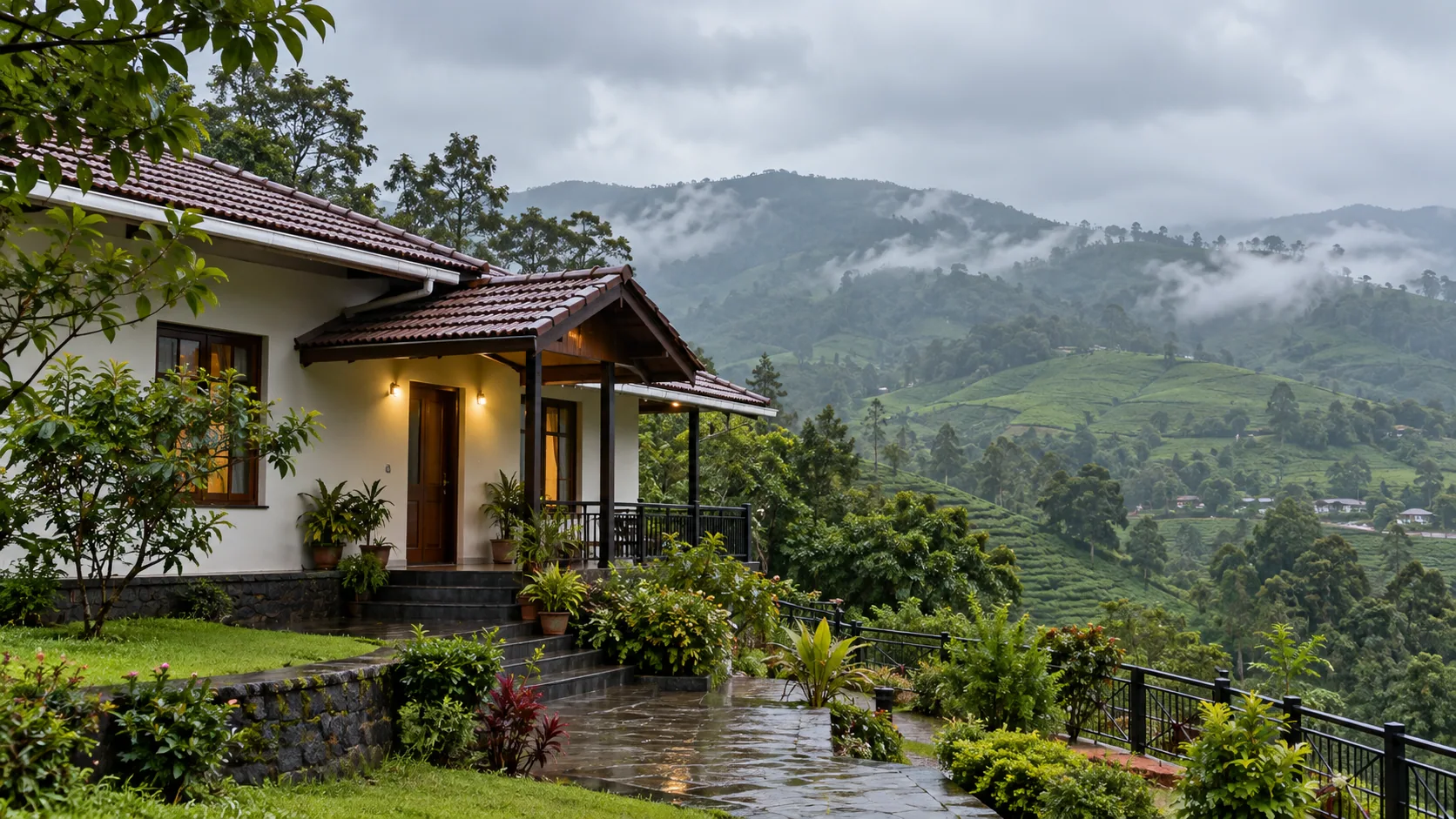
Do not imply a host owns an estate, a view corridor or a private route merely because a photograph includes tea fields. Where the house is near a protected landscape or disputed slope, request an address-specific written determination before making a guest-facing claim or commercial commitment.
Official references: Kerala LSGD · Building permits ↗ · Kerala Tourism · Munnar ↗
05 / Kerala classification
Finish the resident home and every Necessary standard before applying.
The Kerala homestay framework permits one to six guest rooms and two to twelve beds in an operational owner-resident home. Classification is Silver, Gold or Diamond, with minimum bedroom and bathroom areas, toilet and hot/cold-water requirements, and grade-dependent facilities. A scenic location cannot compensate for a failed Necessary item.
Prepare the owner and residence certificates, title/building material, police clearance, plan/elevation, photographs and current food-safety document as set out in the Kerala state guide. The official web fee and 2020 Government Order are not aligned; follow the live filing system and keep the receipt. Tourism classification does not grant the underlying land or building rights.
Official references: Kerala Tourism · Homestay guidelines ↗ · Kerala Tourism · Homestay checklist ↗
06 / Year-round budget
Use ordinary monsoon and off-peak weeks in the first model.
Test bookable nights at a net rate for homes with comparable access, room condition and real views. Deduct resident-host time, housekeeping, heating or hot water, dampness repairs, drinking water, commissions, road-assistance costs and a reserve for weather-related downtime.
A landscape image can create interest, but it cannot fund a weak access road or a legal problem. If the model only works by assuming every room has a plantation view or every day trip is effortless, correct the listing and the forecast before investing.
07 / Next step
Review the address, not just the destination.
Share the title or lease position, exact address, existing building plan, room and bathroom measurements, photographs of the entry and likely guest journey. Rudraleela can help assess category fit, preparation work and operating responsibilities before a commercial proposal is made.
An enquiry is not an application to the Tourism Department and does not guarantee registration or earnings.
Sources and review
Check the local facts again before committing.
Sources checked . No title, plantation-rights or access-easement review, local-body ruling, protected-area overlay, winter/monsoon site inspection, portal submission or occupancy study was completed.
- Kerala Tourism · Homestay guidelines ↗
Owner-resident, non-lease, operational unit, application and reclassification framework.
- Kerala Tourism · Serviced Villa scheme ↗
Separate route with published lease documentation, not automatic suitability for a proposed site.
- Kerala Tourism · Munnar ↗
Official town, tea-history and visitor-attraction context; no implication of private estate rights.
- Kerala Tourism · Mattupetty ↗
Road-based excursion context distinct from Munnar town.
- Kerala Tourism · Reaching Munnar ↗
Official airport, rail and road context; individual transfer times must be verified.
- Kerala LSGD · Building permits ↗
Separate land-development and building-permit route; local and environmental restrictions remain site-specific.
- Kerala Tourism · Homestay checklist ↗
Operational property and grade-specific Necessary items.
Send a correction with an official source. See the Kerala guide for the state route and the India starting guide for the wider planning order.